Lands End Enters the College Football Marketing Arena with a Tailgate Strategy and a Pivot Toward Experiential Retail

The American collegiate sports landscape has long served as a high-stakes arena for corporate sponsorship, typically dominated by beverage giants, automotive conglomerates, and financial institutions vying for the attention of passionate alumni and student consumers. However, the autumn of this year has welcomed a more unexpected contender to the gridiron marketing blitz: Lands End, the classic catalog-turned-ecommerce retailer historically associated with reliable outerwear, predictable swimwear, and traditional canvas accessories.
Over the weekend, Midwest-based parenting creator Lindsey Bosway, who commands an Instagram audience of 120,000 followers, published a sponsored post documenting her return to her alma mater for a weekend football game. Rather than showcasing the ubiquitous branding of energy drinks or major athletic conglomerates, Bosway’s post highlighted a collaboration with Lands End. This digital placement is part of a broader, concerted seasonal campaign designed to reintroduce the 63-year-old brand to a contemporary demographic of consumers who may view the heritage label strictly through the lens of its archival mail-order catalogs or its legendary canvas totes.
The strategic pivot comes under the direction of Chief Marketing Officer Sarah Sylvester, who assumed the role a little over six months ago as the company’s first CMO in nearly a decade, alongside newly appointed Chief Executive Officer Charlie Cole, who took the helm roughly two months ago. Together, the executive leadership team is orchestrating a significant operational transformation aimed at modernizing Lands End’s marketing mix, balancing digital performance advertising with immersive, in-person brand activations.
The Anatomy of the Tote Tailgate Tour
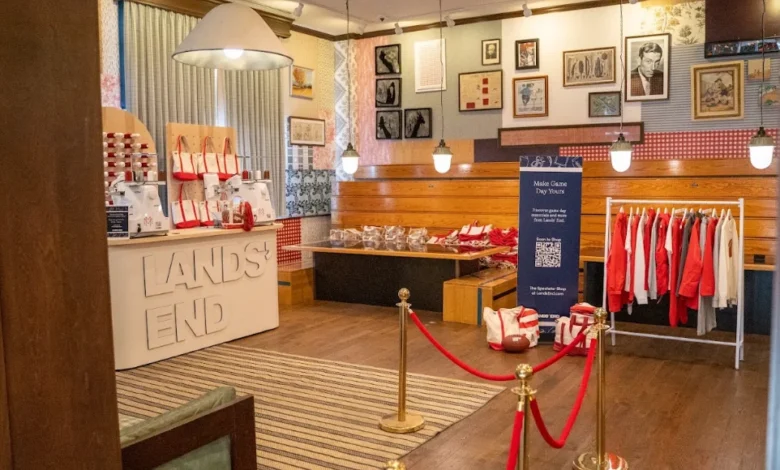
Central to Lands End’s autumn marketing strategy is a multifaceted experiential campaign highlighted by the "Tote Tailgate Tour." Executed in collaboration with Hilton’s Graduate Hotels line, the pop-up activation travels to select college towns during peak game days, stopping in Bloomington, Indiana; Ann Arbor, Michigan; and Oxford, Mississippi.
According to corporate announcements detailing the tour, the experiential activations feature curated on-site experiences developed in partnership with Graduate by Hilton. These include branded takeovers of Poindexter Coffee Shops—offering complimentary coffee to attendees—alongside merchandise customization stations and collegiate-inspired product displays. The physical footprint is engineered to showcase essential items color-coordinated to each host institution’s signature colorways, providing a tactile, localized introduction to the brand’s lifestyle offerings.
A primary catalyst for the football-focused campaign was the recent introduction of the clear pocket tote bag, launched last month. Engineered as a functional evolution of the company’s classic canvas tote, the clear variant is specifically designed to comply with the stringent bag policies implemented at modern sports stadiums and athletic complexes nationwide.
The product launch mirrors a previous experiential stunt executed earlier in the summer, when Lands End partnered with regional convenience store chain Wawa to release a specialized tote bag tailored to fit the retailer’s iconic Shorti hoagie for beachgoers. For Sylvester, these targeted product releases embody the ethos of a solutions-oriented brand.
"What I love about game day is it is a multi-generational event," Sylvester noted, discussing the strategic rationale behind the campaign. "I think that was a really guiding filter for us, because that is something we can do really well, supporting all the generations under your roof or in your family."
A Compressed Timeline and Agile Execution
The genesis of the college football campaign reflects a deliberate shift toward corporate agility under the new marketing leadership. Typically, large legacy retailers operate on rigid, long-term merchandising and promotional calendars that require six months to a full year of strategic foresight.
However, the collaboration with Graduate by Hilton and the associated campus activations were assembled in a remarkably compressed window of approximately two to three months. The initiative originated organically during cross-departmental discussions between Sylvester and the merchandising team as they reviewed upcoming product pipelines for the fall season, which included the aforementioned clear tote bags and newly colored iterations of the brand’s classic rugby shirts.
Recognizing an alignment between these seasonal products and the emotional resonance of autumn game days, Sylvester leveraged an existing professional connection within the Graduate by Hilton organization. The two entities rapidly formalized the partnership to capitalize on the momentum of the college football calendar.
"I like to be a little bit more planful and get ahead of things," Sylvester reflected on the rapid development cycle. "It’s nice to give yourself more like six months, but there’s a fine balance of being super strategic and planful, [and] then also seeing a good idea and just moving fast to make it happen."
This willingness to pivot represents a departure from traditional catalog-era pacing. Founded in 1963 as a direct-to-consumer mail-order enterprise, Lands End has spent the past several decades navigating the digital transition. Today, while the historic catalog remains an active component of the overarching marketing mix, executive leadership is prioritizing initiatives that meet consumers directly within their physical and digital environments.
The Evolution of Influencer Partnerships as Table Stakes
A critical pillar of the Tote Tailgate Tour strategy involves localized influencer marketing. Rather than relying solely on macro-influencers with broad, national audiences, Lands End has systematically targeted creators native to the specific campus markets where the tour activates.
For the Bloomington activation, the brand partnered with regional creators like Bosway, an Indiana University alumna whose content naturally resonated with local alumni and current students experiencing the homecoming traditions of game day. Sylvester describes the integration of social media creators as "table stakes" for modern retail marketing campaigns.
"We have been focused on finding authentic partners for each city," Sylvester explained, emphasizing the importance of geographic and cultural alignment between the creator and the brand narrative. By pairing localized digital endorsements with physical, experiential pop-ups, Lands End aims to manufacture high-intent digital content that can be repurposed across its social media channels throughout the holiday shopping season.
This approach reflects a broader modernization of the company’s marketing funnel. For years, the retailer maintained a heavy reliance on direct-response catalog marketing and traditional web advertising. Under Cole and Sylvester, the brand is deliberately cultivating a balanced approach that pairs bottom-funnel performance advertising with top-funnel brand equity building.
Broader Implications for Legacy Retailers
The strategic maneuvers undertaken by Lands End provide a clear case study in how heritage brands with deep archival roots are attempting to capture the attention of younger, experience-driven consumer demographics. College football weekends represent one of the few remaining cultural touchpoints that consistently draw multi-generational crowds, making them fertile ground for lifestyle brands seeking to expand their total addressable market beyond core loyalists.
By aligning functional utility—such as stadium-compliant clear bags and weather-appropriate apparel—with emotional cultural moments, Lands End is attempting to transition from a utility-driven apparel supplier to a relevant lifestyle choice for contemporary consumers.
As the brand looks ahead to the critical fourth-quarter holiday season, leadership has indicated that experiential, in-person activations will remain central to its growth strategy. The data and content generated from the campus tours will serve as the foundation for future digital marketing campaigns, illustrating a continuous feedback loop between physical retail experiences and digital consumer engagement.
For an organization that built its reputation on the quiet reliability of mail-order catalogs across the American Midwest, stepping onto the vibrant, highly competitive stage of college football marketing marks a profound evolution. Whether this nimble, experiential approach will successfully translate into sustained market share expansion remains to be seen, but the strategy underscores a clear corporate mandate: heritage brands must meet consumers where they gather, adapting their heritage products to fit the demands of modern spectator culture.
Related posts: