The Definitive Guide to Proving Causation in AI Search Visibility: seoClarity Webinar Reveals Crucial Testing Methodologies

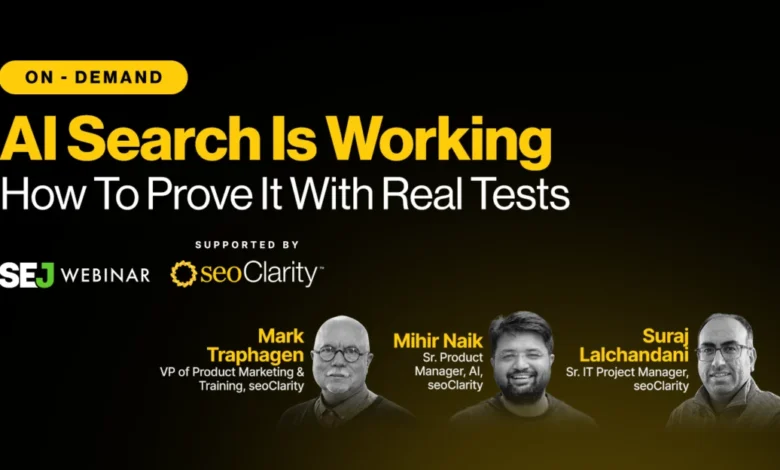
In the rapidly evolving landscape of artificial intelligence-driven search, distinguishing correlation from causation has become the paramount challenge for SEO professionals. A recent webinar hosted by seoClarity, featuring Mark Traphagen, Mihir Naik, and Suraj Lalchandani, aimed to bridge this critical gap, offering a robust methodology for measuring the true impact of website changes on AI search performance. The core takeaway from the session is clear: while visibility scores indicate presence, only rigorous page-level performance analysis and split testing can definitively prove that specific actions actually matter. This distinction is crucial for teams striving to move beyond mere observation to actionable insights in the AI search era.
The webinar presented a comprehensive approach to split testing across major AI search platforms, including ChatGPT, Claude, Perplexity, Gemini, and Google’s own AI surfaces. The presented methodology emphasizes building a "golden set" of prompts that span the entire user journey, from awareness to retention. Crucially, it addresses the unique challenge of conducting A/B tests when Large Language Models (LLMs) do not permit traditional live traffic splitting, instead advocating for the construction of control groups. The session also delved into the implications of Google’s newly released first-party Search Console data for AI visibility.
One of the most compelling case studies shared involved a simple yet profound change: the addition of FAQ sections to test pages. This modification demonstrably boosted AI citations, and importantly, when the FAQ sections were removed, the citations reverted to their previous levels. This precise reversal, the presenters argued, is the gold standard of proof, moving beyond simple correlation to establish a clear causal link. This level of empirical evidence is precisely what most organizations measuring AI search performance currently lack, creating a significant hurdle for strategic decision-making.
Google’s foray into AI search reporting within Search Console marks a significant milestone in the measurement capabilities available to website owners. As of June 3rd, dedicated reports for AI Overviews and AI Mode began providing page-by-page data on URL appearances within Google’s AI-generated search results. Suraj Lalchandani described this as "the biggest measurement upgrade AI search testing has received," noting the shift from widespread inferential analysis and sampling to direct, first-party data from the source. This influx of granular data is expected to empower SEO professionals with a more accurate understanding of their content’s performance within these emerging AI-driven search experiences.
However, the seoClarity team was quick to temper expectations, emphasizing that while Google’s first-party data is invaluable, it does not represent a complete solution. The new reports only address a portion of the AI search ecosystem, leaving platforms like ChatGPT, Claude, and Perplexity still reliant on structured third-party tracking and analysis. The webinar provided a detailed breakdown of precisely which measurement gaps the new Search Console reports fill and which remain open, along with a platform-by-platform reference guide for understanding the crawling and rendering capabilities of each AI engine. The actionable advice for businesses is to integrate this new first-party data into their existing testing programs strategically, understanding its limitations and augmenting it where necessary.
Strategic Prompt Testing: Targeting the "Almost Wins"
The webinar also offered practical guidance on prioritizing testing efforts within the AI search environment. The recommended approach is to focus on prompts where a brand is "almost winning" – that is, where the content is relevant, but the AI has not yet identified a specific URL worth citing. This strategy is built upon constructing a comprehensive "golden set" of prompts, meticulously categorized by their position within the AI search funnel, from initial awareness to sustained engagement.
These prompts are then tiered based on a brand’s current standing in AI responses. Tier 1 prompts represent "easy wins," where a brand’s relevance is established, but a direct citation opportunity is still nascent. Tier 2 prompts, conversely, require a more substantial effort. Intriguingly, the seoClarity team revealed that one bucket of prompts within Tier 2 was deliberately removed from their testing strategy, a decision that reportedly surprised many attendees. This strategic sequencing is designed to leverage early successes to build the "political capital" necessary for undertaking more ambitious and potentially resource-intensive tests later in the process. The methodology detailed in the session outlines how to construct and tag this golden prompt set, define these tiers, and establish a tracking unit that precisely links each prompt to the desired cited page.
Mastering LLM Split Testing: The Power of Control Groups
The challenge of conducting split tests within LLMs, where direct live traffic manipulation is impossible, was a central theme. The seoClarity solution lies in building a correlated control group. This group consists of a set of related pages that act as a crucial "noise filter," helping to isolate the impact of specific changes from the inherent volatility of model updates and algorithmic shifts.
"Without a control group, every result would be guesswork," explained Lalchandani. "With one, you can tell a real win from the background noise." A critical, often overlooked, discipline in this process is timing. The methodology mandates establishing a specific baseline period before any modification goes live and a minimum test window afterward. This is because AI search responses do not typically exhibit the rapid shifts seen in traditional SEO. Truncating this testing window, as Lalchandani cautioned, can lead to misinterpretations, where "you could be reading noise." The webinar detailed how to construct these correlated control groups, define precise baseline and test windows, and interpret the three distinct outcomes that every test can yield, thereby providing evidence-based insights rather than conjecture.
The FAQ Impact: A Case Study in Causation
The seoClarity team presented the results of three real-world client tests, underscoring the variability of outcomes and the importance of rigorous testing. The FAQ test emerged as the definitive success. Across approximately 1,000 prompts under measurement, the introduction of FAQ sections to test pages led to a measurable increase in AI citations when compared to control pages. Crucially, these citations remained elevated for the duration of the change. The subsequent reversion of the modification resulted in a predictable decline in citations, a pattern that cemented the causal relationship. "That’s the second half of proof," emphasized Traphagen. "Not that citations just went up when we added FAQs, but that they went back down when we took them away. That’s causation, not correlation."
The other two tests, one focusing on meta descriptions and another on listicle formatting, yielded less predictable results, offering valuable lessons for any organization considering similar tactical investments. The detailed analysis of these tests, including the specific reasons behind their outcomes, was shared in the full webinar. Mihir Naik framed every test result as a win, stating, "because you have evidence instead of guesses. That is more than most teams in AI search have today." The session also unveiled test blueprints for schema and markdown implementation, two highly debated topics in AI-driven SEO, along with rapid structural tests designed for high-value website templates that can be executed within a few weeks.
Addressing Key Questions in the AI Search Frontier
The webinar concluded with a Q&A session that tackled some of the most pressing questions facing SEO professionals in the AI search era.
Measuring AI Authority in a Metric-less Landscape
When asked about measuring AI authority in the absence of a clean, singular metric, Lalchandani explained that AI authority is essentially an indicator of how much a model trusts a source for a particular topic. While a single number doesn’t exist, he proposed stacking several signals to build a comprehensive understanding. These include citation share on top prompts, cross-engine consistency (which signifies becoming the go-to source for specific queries), and other proprietary metrics detailed in the full session.
Collapsible Content and AI Bot Readability
The question of whether AI bots can access FAQ answers hidden behind collapsible toggles elicited a nuanced response. Lalchandani clarified that the readability depends entirely on the implementation. Some collapsible designs ensure the content remains fully accessible to AI search engines and Google, while others render it invisible. He stressed that "even Google will not click around on your site," advising users to test their specific implementations if unsure.
The ROI of Non-Clicking AI Citations
The return on investment for an AI citation that doesn’t drive direct referral traffic was another key point of discussion. Naik argued that being cited is crucial for controlling the narrative and ensuring the accuracy of the information presented in AI answers. Even without a click, a citation shapes the perception of a brand, particularly in comparative queries. The focus shifts from traffic generation to brand representation, ensuring unique selling propositions are highlighted correctly and inaccuracies are mitigated. A cautionary tale from a restaurant client, illustrating the consequences of AI being unable to access content, was shared in the full recording.
The Enduring Relevance of Traditional SEO
The relationship between traditional SEO and AI search findability was definitively affirmed. Mark Traphagen stated emphatically, "Absolutely. It is foundational. It is the foundation." He observed that seoClarity’s long-standing clients, those with well-optimized content and technically sound websites, are consistently performing best in AI search, with AI optimization serving as an additional layer. Lalchandani concurred, noting that "When we run tests with our clients, we’ve rarely, if ever, found a situation where something works for SEO and does not work for AI search." This suggests that strong foundational SEO practices remain critical for success in the evolving AI search landscape.
Accessing the Full Webinar for In-Depth Insights
The on-demand recording of the seoClarity webinar offers a treasure trove of detailed information, expanding upon the insights presented in this recap. It includes comprehensive guides on building the golden prompt set, defining prompt tiers, constructing control groups with precise timing parameters, a platform-specific crawler reference, detailed results from meta description and listicle formatting tests, and blueprints for schema and markdown implementation. For those seeking to master the art of AI search testing and prove the causal impact of their optimization efforts, registering to watch the full session on demand is a crucial next step.