The Seismic Shift in Search: How Content Structure Becomes Paramount for AI Overviews

The digital landscape is undergoing a profound transformation as search engines increasingly integrate artificial intelligence to provide direct answers, fundamentally altering user search behaviors and compelling marketers to recalibrate their strategies. This evolution, marked by the rise of AI Overviews, ChatGPT, and Perplexity, necessitates a paradigm shift from optimizing for traditional "blue links" to mastering "writing for AI search." Data from HubSpot’s 2026 State of AEO Report reveals this urgency, with 58% of marketers actively optimizing their content for answer engines. This burgeoning field, known as Answer Engine Optimization (AEO), has rapidly transitioned from an experimental niche to a mainstream priority, driven by the imperative to be visible and cited in this new era of information retrieval.
Understanding the practical application of AEO is crucial, and the content most likely to be featured in AI-generated responses consistently exhibits a core set of structural characteristics. These traits primarily revolve around how information is organized, making it readily extractable and understandable for AI systems. This article delves into the specific content formats and structural elements that are proving most effective in AI search, including the strategic use of question-led headings, direct-answer summaries, structured data, and a meticulously planned site architecture designed for maximum impact and discoverability.
The Fundamental Reason: Why Content Structure Drives Citation Rates in Answer Engines
The core of the evolving search paradigm lies in its transition from a curated list of web page links to a singular, synthesized answer. Search engines like Google, through features such as AI Overviews, are no longer solely presenting users with a selection of potential sources to click through. Instead, they are actively extracting information directly from web pages to provide immediate, concise answers. This means that digital visibility is no longer solely about achieving top rankings within the traditional ten blue links. The new benchmark is whether an AI engine can seamlessly extract a coherent, self-contained passage from a webpage and accurately attribute it to the originating brand.
The mechanism that enables this extraction and attribution is, fundamentally, page structure. A well-organized page acts as a blueprint for AI, guiding it to the most relevant information. Without clear structural cues, AI models may struggle to parse the content accurately, leading to missed citation opportunities. Therefore, page structure is not merely an aesthetic consideration; it is the primary enabler of an AI engine’s ability to identify, extract, and cite information.
Structural Themes That Correlate with Citations: The Pillars of AEO
Across the spectrum of content that successfully gains citations in answer engines, several structural themes emerge as consistent predictors of success. These themes, when implemented effectively, form the bedrock of AEO:
- Clarity and Directness: Content that directly addresses a user’s query without unnecessary preamble is more likely to be extracted. This involves anticipating the user’s question and providing a straightforward answer.
- Organized Information: Information presented in a logical, hierarchical manner, often using headings, subheadings, and bullet points, is easier for AI to process and understand.
- Machine-Readable Data: The incorporation of structured data, such as schema markup, helps AI engines understand the context and nature of the content, facilitating accurate attribution and comprehension.
- Authoritative Signals: The presence of clear indicators of expertise, authorship, and credibility reassures AI engines about the reliability of the information, increasing the likelihood of citation.
- Interconnectedness: A well-defined internal linking strategy helps AI engines understand the relationships between different pieces of content, establishing topical authority and making it easier to navigate and synthesize information.
Schema and Entities: The Machine-Readable Layer for Confidence
The concept of "weak schema" and a lack of clear internal linking can hinder content from being recognized and cited by AI. Schema markup and entity consistency provide a machine-readable layer that explicitly defines what a page is about and who is responsible for its content. This explicit labeling is critical for AI engines to build confidence in the source.
Key Schema Types for Enhanced Visibility:
- Article Schema: This markup provides details about an article, such as its title, author, publication date, and publisher. It helps AI understand that the content is a piece of published work.
- Organization Schema: Essential for establishing brand identity, this schema defines your organization, its logo, contact information, and its relationship to other entities.
- Person Schema: When applicable, this markup details information about authors or key figures associated with the content, reinforcing expertise and authorship.
- FAQ Schema: This schema is particularly effective for question-and-answer content, clearly marking questions and their corresponding answers, making them prime candidates for direct extraction.
Measuring Success: Key Performance Indicators for AEO
Optimizing for AI-generated answers is only truly effective when its impact can be measured. To gauge progress in AEO, marketers should diligently track three primary signals:
- Citation Volume: The number of times your content is directly cited or referenced in AI Overviews, generative AI responses, or featured snippets. This is the most direct measure of AEO success.
- Search Impression Growth: An increase in impressions for queries where your content is being used to generate AI answers. This indicates that your content is being recognized as a valuable source.
- Brand Mentions and Attribution: The consistency and accuracy with which your brand is attributed when your content is used. This reflects the strength of your entity modeling and trust signals.
The Mechanics of AI: How Answer Engines Parse and Cite Content
Answer engines operate on a principle of comprehensive reading rather than mere ranking. Before a citation appears in an AI Overview or a standalone answer, the engine undertakes a series of steps:
- Crawling and Indexing: The engine first crawls and indexes web pages, similar to traditional search engines.
- Content Parsing: The AI then parses the content, breaking it down into manageable segments or passages. This involves identifying headings, paragraphs, lists, tables, and other structural elements.
- Relevance Scoring: Each parsed passage is then scored against the user’s query to determine its relevance and accuracy.
- Passage Extraction: The highest-scoring, most relevant passages are identified for potential extraction.
- Attribution and Synthesis: Finally, the extracted information is synthesized into an answer, with an emphasis on attributing the source accurately.
Understanding this parse-then-cite pipeline is fundamental to differentiating content that gets cited from content that is overlooked. This understanding forms the basis of AEO, providing a framework for consistently earning citations.
What is AEO? Defining the Discipline
Answer Engine Optimization (AEO) is the strategic practice of structuring and presenting content in a manner that enables answer engines to easily extract, understand, and cite it. It moves beyond traditional SEO by focusing on the specific needs of AI models that are designed to synthesize information.
Key Principles of AEO:
- Clarity: Content must be clear, concise, and directly answer user queries.
- Structure: Logical organization through headings, subheadings, and formatted lists is paramount.
- Attribution: Ensuring that the source of information is clearly identifiable and trustworthy is critical.
- Extractability: Content must be written in a way that allows individual passages to be lifted and understood in isolation.
How an Answer Engine Parses a Page: Deconstructing the Process
AI engines dissect a webpage into discrete chunks and evaluate each segment’s relevance to a given query. This process can be understood as follows:
- Segment Identification: The engine identifies logical segments within the page, such as paragraphs, list items, or table rows.
- Content Analysis: Each segment’s content is analyzed for keywords, context, and semantic meaning.
- Relevance Assessment: The engine determines how well each segment addresses the user’s query based on its analysis.
- Passage Selection: Segments that are deemed highly relevant and self-contained are selected for potential inclusion in an AI-generated answer.
What Makes a Passage Citable: The Core of AEO Content Strategy
The ability of a passage to be extracted and cited by an answer engine is the ultimate goal of AEO at the content level. As experienced content creators at HubSpot have observed, consistently producing citable content involves a specific approach:
- Standalone Paragraphs: Each paragraph should aim to answer a single, distinct question and be comprehensible without requiring reference to preceding or succeeding text.
- Clear and Concise Language: Avoiding jargon, complex sentence structures, and ambiguous pronouns ensures that the meaning is easily grasped.
- Direct Answers First: Presenting the answer to a question at the beginning of a passage, followed by supporting details, facilitates quick understanding.
- Structured Formats: Utilizing lists, tables, and definition boxes makes information easily scannable and extractable.
- Focused Content: Each passage should address a single, specific topic or question, avoiding tangential information.
Theme 1: Question-Led Headings and Direct-Answer Summaries
Question-led headings and direct-answer summaries are two of the most powerful structural tools in AEO. Research indicates that sequential heading structures can increase citation odds significantly, by as much as 2.8 times according to some reports. These formats directly map a passage to a query, providing AI engines with readily available answers.
Question-Led Headings: Mirroring the User’s Intent
A question-led heading directly reflects the query a user would type into a search engine. This approach helps AI engines immediately understand the topic of the following content. For example, instead of a heading like "Benefits of Content Marketing," a question-led heading would be "What are the benefits of content marketing?" This direct alignment makes it easier for AI to identify relevant content for specific queries.
Direct-Answer Summaries (TL;DR): The Immediate Gratification
A direct-answer summary, often presented as a "Too Long; Didn’t Read" (TL;DR) section, provides a concise answer to the main question in one or two sentences before delving into further detail. This format caters to users seeking quick information and provides AI with a pre-packaged, easily extractable answer.
Formatting Q&A Blocks for Maximum Citation Potential
Question-and-answer (Q&A) blocks, which pair an explicit question with a direct answer, are among the most citable structures. To maximize their potential:
- Explicit Question: Frame the question clearly, mirroring potential search queries.
- Immediate Answer: Provide a brief, direct answer immediately following the question.
- Supporting Detail: Expand on the answer with further explanation or context.
- Clear Formatting: Use distinct formatting (e.g., bolding for questions, standard text for answers) to delineate the Q&A structure.
Theme 2: Semantic Schema and Entity Modeling
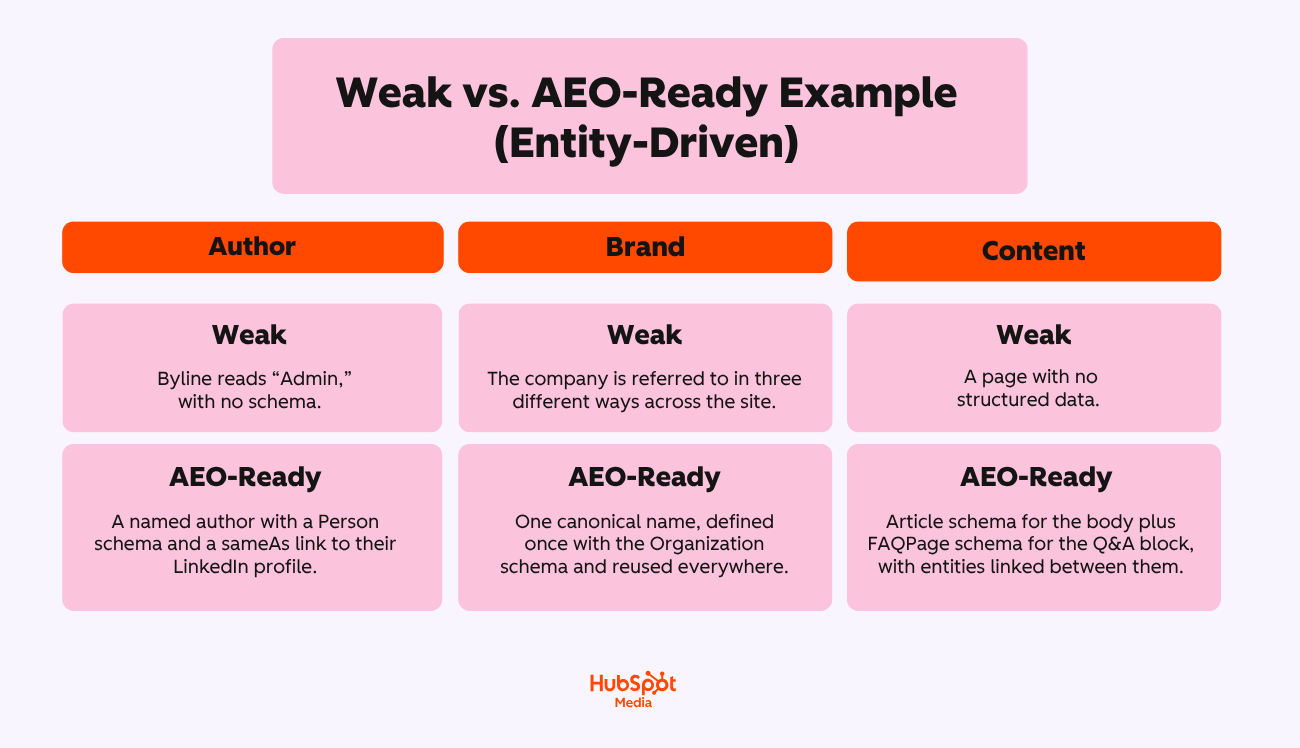
Schema and entity modeling form the machine-readable layer of AEO. They provide AI engines with explicit facts about the content, its author, and the brand behind it. This explicit data helps overcome the limitations of "weak schema" and unclear internal linking, which can prevent even well-written content from being cited.
The Schema Types That Describe Your Content
Structured data labels various components of a webpage, removing the need for AI to infer meaning. Key schema types for citation success include:
- Article Schema: Essential for news, blog posts, and opinion pieces, it identifies the content as an article and provides publication details.
- HowTo Schema: For instructional content, this schema breaks down steps, making the process clear and actionable for AI.
- FAQPage Schema: Ideal for pages dedicated to frequently asked questions, it explicitly marks questions and answers for direct extraction.
- VideoObject Schema: For video content, this markup provides metadata about the video, including its transcript, which is crucial for AI to understand the spoken content.
Modeling Entities for Recognition and Citation
Entity modeling involves defining people, brands, and products as consistent, interconnected entities, rather than just random words on a page. A deliberate entity model strengthens brand, product, and author relationships, which AI engines use to build confidence in a source.
Practical Sequence for Entity Modeling:
- Identify Key Entities: Determine the core people, brands, products, and concepts central to your content.
- Establish Consistent Naming: Use the same names and identifiers for these entities across all your content.
- Define Relationships: Explicitly define how these entities relate to each other (e.g., "John Doe is the author of this article," "Acme Corp is the manufacturer of this product").
- Implement Schema Markup: Use schema.org vocabulary to embed this entity information into your website’s code.
Theme 3: Authoritative Signals and Trust Markers
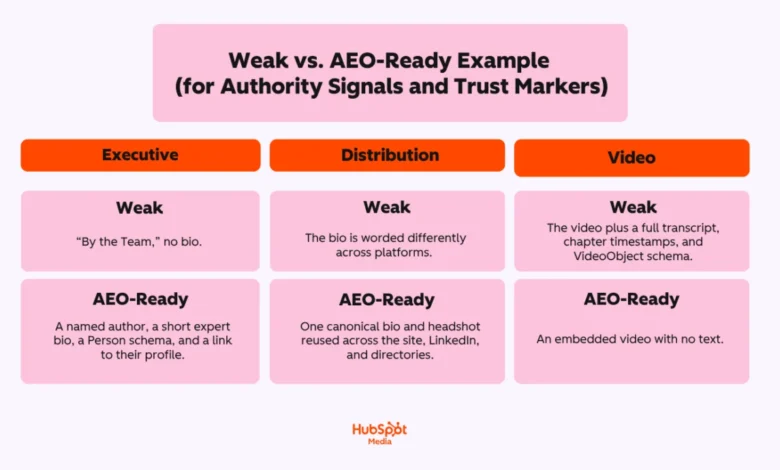
Answer engines prioritize trust when deciding which content to cite. When two pages provide equally accurate answers, the AI will favor the source it can verify. These signals of trustworthiness, known as authority signals, directly influence the quality and likelihood of a mention.

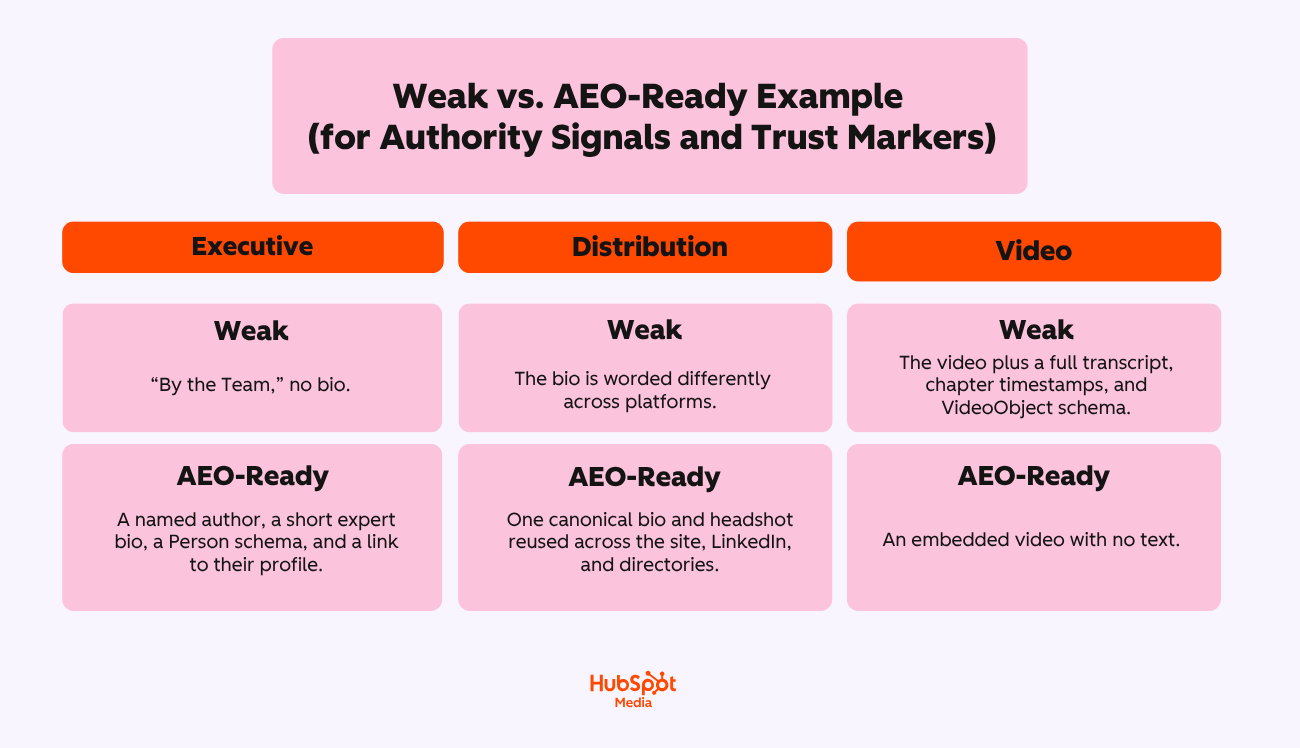
Authoritative Brand, Executive, and Product Profiles
A profile serves as a stable, well-described entity that an AI engine can recognize and trust. Strong profiles are explicit about who and what they represent. This includes:
- Author Bios: Detailed biographies for authors, including their credentials and expertise.
- Brand Pages: Comprehensive pages outlining the company’s mission, values, and history.
- Product Pages: Clear descriptions of products, their features, and benefits, linked to relevant organizational entities.
Distribution Across Trusted Ecosystems
The presence of your content and entities across reputable external sources acts as a powerful trust signal for AI engines. Corroboration from well-known and trusted platforms lends credibility to your own content. This can include:
- Industry Publications: Mentions or features in respected industry journals or websites.
- Review Sites: Positive reviews on established platforms.
- News Outlets: Coverage in reputable news organizations.
Video Transcripts, Timestamps, and VideoObject Schema
Video content, while engaging, is often difficult for AI engines to parse without assistance. Making video content accessible to AI involves:
- Comprehensive Transcripts: Providing accurate text transcripts for all video content.
- Timestamps: Incorporating timestamps within transcripts to pinpoint specific moments in the video.
- VideoObject Schema: Utilizing this schema to embed transcript and timestamp data, allowing AI to efficiently access and cite video content.
Theme 4: Strategic Internal Linking Architecture
Internal linking is the site-level manifestation of content structure and a critical, though often overlooked, factor in earning citations. Treating internal links as an architectural element of your website is paramount for optimizing content for AI Overviews. Strong internal linking helps AI engines crawl, group, and trust related content. Conversely, weak or random linking can isolate valuable answers, making them difficult for AI to associate with a broader topic.
Hub-and-Spoke Structure, Glossary Pages, and Sibling Links
A hub-and-spoke model organizes content around a central, authoritative page (the "hub") that links to more focused supporting pages (the "spokes"). This structure creates a clear topical hierarchy.
- Hub Pages: These pages provide a comprehensive overview of a broad topic and link to related sub-topics.
- Spoke Pages: These pages delve into specific aspects of the main topic, linking back to the hub page and to other relevant spoke pages.
- Glossary Pages: A dedicated glossary can define key terms within a niche, acting as a central resource for understanding related content.
- Sibling Links: Within a topic cluster, linking related pages together (siblings) helps AI understand the interconnectedness of information.
Clear Anchor Text and Early Link Placement
The anchor text of a link and its placement within the content signal to search engines what the linked page is about and its relative importance.
- Descriptive Anchor Text: Anchor text should be descriptive and relevant to the content of the linked page, providing context for AI.
- Early Placement: Placing internal links early in the content can indicate their importance and guide AI crawlers effectively.
Internal Link to Topic Clusters
A topic cluster is a group of interlinked pages that collectively cover a subject in depth. This approach signals comprehensive topical authority to AI engines, making it more likely for content within the cluster to be cited.
Theme 5: Passage-Level Optimization for Extraction
Passage-level optimization focuses on writing each segment of content so that it can be lifted and cited independently, without requiring the context of the entire page. A passage is any self-contained unit of information, such as a paragraph, a list item, or a table row. The goal is to ensure each passage makes complete sense on its own.
Stand-Alone Paragraphs That Answer One Question
Each paragraph should aim to answer a single, specific question and be comprehensible in isolation. This involves starting with the answer and then providing supporting details. It’s also crucial to avoid pronouns that refer to previous text, as these can break the passage when it’s extracted.
Lists, Tables, and Definition Boxes
Structured formats are highly conducive to AI extraction and snippet generation. Including:
- Bulleted Lists: Clearly demarcate distinct points or items.
- Numbered Lists: Ideal for sequential steps or ordered information.
- Tables: Organize data in rows and columns for easy comparison and extraction.
- Definition Boxes: Provide concise explanations of key terms.
Concise, Extractable Sentences
The length and clarity of sentences directly impact how cleanly an AI engine can quote your content. Shorter, more direct sentences are generally easier to parse and extract.
Aligning Structural Themes with Google’s Quality Guidelines
It is crucial to understand that structural optimization only yields citation benefits when the underlying content is genuinely helpful and high-quality. Google’s algorithms prioritize "people-first" content, and attempts to game the system through structure alone are likely to backfire. The structural themes that enhance AEO, such as clear headings and direct answers, amplify existing quality; they do not replace it.
Accuracy, Quality, Relevance, and User Context
Google evaluates content against several core dimensions. These should be considered prerequisites for any AEO efforts:
- Accuracy: Information must be factually correct and up-to-date.
- Quality: Content should be well-written, comprehensive, and insightful.
- Relevance: It must directly address the user’s search intent.
- User Context: The content should be presented in a way that is easily understood and useful to the target audience.
Disclosure When Automation Assists
Transparency regarding the use of AI in content creation is essential. Google permits AI-assisted content when it is helpful and not primarily intended to manipulate rankings. Disclosing the use of automation builds reader trust and aligns with ethical content practices.
Do / Do-Not Guardrails for Helpful Content
Establishing clear guidelines ensures consistency in content quality and structure across teams.
Do:
- Prioritize helpfulness and reader experience.
- Ensure accuracy and provide citations where necessary.
- Structure content logically for clarity.
- Be transparent about AI assistance.
Do Not:
- Create content solely to manipulate search rankings.
- Mislead users with inaccurate or incomplete information.
- Use AI to generate repetitive or nonsensical content.
- Obscure authorship or misrepresent expertise.
Measuring Citation Performance and Structural Impact
A significant challenge in AEO is quantifying its effectiveness. While it’s possible to implement structured content, demonstrating that these structural changes directly lead to more citations can be difficult. Measurement bridges this gap, confirming that structural preferences are yielding tangible results on your pages.
The Three KPIs That Matter
To effectively measure AEO success, track these three key performance indicators:
- Citation Volume: The number of times your content is cited by AI.
- Impression Growth: An increase in search impressions for queries related to your optimized content.
- Brand Attribution Consistency: The accuracy and frequency with which your brand is identified as the source.
The Measurement Loop: Diagnose, Test, Measure, Iterate
AEO should be approached as a continuous process of testing and refinement.
- Diagnose: Identify areas for structural improvement.
- Test: Implement specific structural changes.
- Measure: Track the impact of these changes on citation rates.
- Iterate: Refine your approach based on the measurement data.
This iterative loop is essential for optimizing content for answer engines, ensuring that changes lead to measurable improvements in citation frequency.
Operationalizing High-Citation Content Themes
To achieve consistent success in AEO, winning structural themes must be systematized. Operationalizing AEO transforms one-off wins into a repeatable workflow, ensuring that every page is published with a citation-ready structure, regardless of the author. This consistency is achieved through two primary systems: defining roles and creating reusable templates.
Role-Based Checklist
Assigning clear ownership for each stage of the AEO process prevents critical elements from being overlooked. This includes roles for content strategists, writers, editors, and SEO specialists.
Templates in Content Hub
Reusable templates embed structural themes directly into the content creation process, removing guesswork for writers. These templates can include pre-formatted sections for Q&A blocks, direct-answer summaries, and schema implementation.
Frequently Asked Questions (FAQs) About Structuring Content for Answer Engine Citations
Do I need a new page for AI overviews or can I optimize existing content?
You can almost always optimize existing content. Creating new pages is rarely necessary, as AI engines are adept at extracting information from well-structured existing content. This approach is more efficient and leverages established content authority.
Which schema types help most for B2B content citations?
For B2B content, prioritizing schema that establishes credibility and structure is key. This includes Article, Organization, and Person schema to define the content, the brand, and the authors, thereby strengthening AEO by making authority and structure explicit.
How often should I refresh content to maintain citation rates?
Refresh content based on how quickly the topic evolves, not on a fixed calendar. Update facts, reconfirm direct answers, and update structured data. Refreshing the modified date signals freshness to AI engines, and stale answers are likely to lose citations to more current sources.
Can I restrict LLMs and still perform in traditional search?
Yes, but understand the trade-off. Blocking AI crawlers can prevent content from appearing in some answer engines while it might still rank in traditional search. However, the structural elements that improve AI citations also enhance traditional SEO. Therefore, restricting LLMs forfeits citation opportunities without necessarily improving traditional rankings.
What’s the best way to align the answer engine structure with our CRM funnel?
Map content structure to funnel intent and connect it to your CRM for measurement. For example, top-of-funnel content might be structured for broad informational queries, while bottom-of-funnel content could focus on specific product features. This alignment ensures that citations contribute to pipeline progression and drive revenue, not just reach.
Winning in the AI Search Era
Mastering the transition to Answer Engine Optimization (AEO) boils down to a learnable discipline: structure. Large Language Models (LLMs) prioritize content that is clear and direct, and every format that earns citations is an expression of this principle. The objective is not to reinvent content but to make its best answers easily discoverable, extractable, and attributable.
Operationalizing AEO involves creating repeatable workflows. By implementing role-based checklists and reusable content templates, teams can ensure that citation-ready structures are consistently applied across all content. This systematic approach transforms AEO from a guessing game into a durable competitive advantage. The initial step is to assess your current standing by utilizing available tools and audits. By embracing structural optimization, businesses can ensure their content not only answers questions but also earns the recognition and citation it deserves in the evolving AI-powered search landscape.