Streamlining Enterprise Cloud Continuity: Automating the AWS Elastic Disaster Recovery Agent Lifecycle at Scale

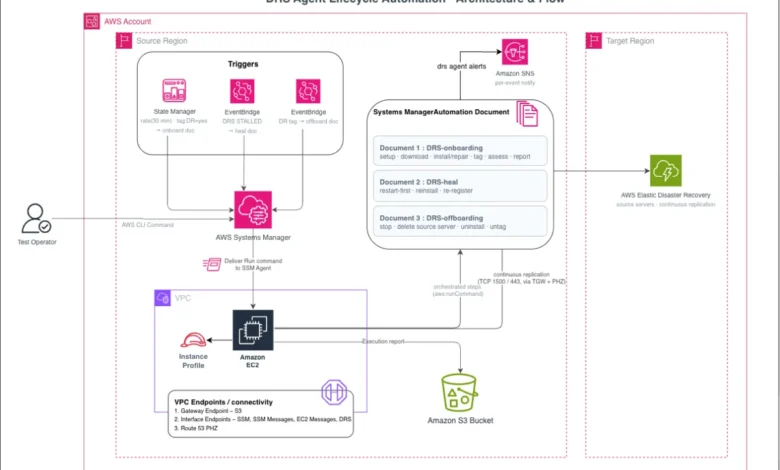
Managing enterprise cloud continuity across expansive modern infrastructures often introduces complex operational overhead, particularly when dealing with hundreds or thousands of virtual machines. For organizations utilizing Amazon Web Services (AWS), protecting large fleets of Amazon Elastic Compute Cloud (Amazon EC2) instances with AWS Elastic Disaster Recovery (AWS DRS) requires meticulous lifecycle management of the AWS Replication Agent. From initial installation and maintaining continuous operational health to safely removing agents when servers leave disaster recovery scope, IT teams face significant challenges in preventing configuration drift and unexpected cloud expenditures.
Recent enterprise implementations have highlighted critical vulnerabilities in manual or loosely managed disaster recovery processes. For instance, a major enterprise IT customer operating a mixed environment of over 300 Linux and Windows instances recently encountered severe scaling hurdles during scheduled disaster recovery drills. Network adjustments frequently caused replication agents to stall silently, while descoped servers continued to actively replicate data, needlessly inflating monthly operational expenditures. In disaster recovery scenarios, a stalled agent directly compromises the organization’s recovery point objective (RPO)—the maximum acceptable duration of data loss following a disruption. Because traditional workflows rely heavily on manual console checks between scheduled exercises, replication failures often go unnoticed until a live test or disaster strikes.
To address these vulnerabilities and eliminate the maintenance overhead associated with custom serverless functions, engineers and cloud architects have developed a fully automated, serverless framework. By leveraging AWS Systems Manager (SSM) Automation documents driven by Amazon EventBridge and scheduled events, enterprises can now manage the entire lifecycle of AWS DRS agents using a single, intuitive EC2 resource tag.
The Mechanics of Single-Tag Lifecycle Management
At the core of this automated framework is a declarative approach utilizing standard EC2 tagging practices. A single designated tag key—typically configured as DR—dictates the exact lifecycle state of an instance based on its assigned value.
Under this model, a value of "yes" identifies a protected state, automatically triggering agent installation, applying necessary failback tags, and executing health validations every 30 minutes. Conversely, assigning a value of "pause" engages a quiesced state, which maintains the installed agent while suppressing stall alerts and temporarily blocking automated offboarding. When an instance is descoped by assigning a value of "no" or by removing the tag entirely, the system initiates a comprehensive teardown procedure, halting replication, deleting the source server registration, and uninstalling the agent.
To prevent misconfigurations or accidental human errors from triggering unintended infrastructure modifications, the automation architecture incorporates a strict validation layer. Tag values are automatically normalized by trimming whitespace and converting characters to lowercase. Any unrecognized value—such as "DR=maybe" or "DR=true"—acts as a fail-safe mechanism, causing the automation to bypass the instance entirely, log a skipped status, and prevent erratic operational triggers.
A Three-Tiered Defense Protecting the Recovery Point Objective
Maintaining a strict RPO, such as a 15-minute target configuration, demands a multi-layered defense strategy capable of automatically identifying and mitigating failures across different operational layers without human intervention.
The first layer operates at the operating system level, utilizing native service recovery protocols such as systemd Restart=always on Linux distributions and Windows Service Recovery configurations on Windows Server instances. If the replication process unexpectedly terminates, the underlying operating system immediately attempts to restart the service, resolving transient process crashes within seconds without invoking external automation frameworks.
The second layer addresses more persistent disruptions through Amazon EventBridge and cross-Region event propagation. When AWS DRS detects that data replication has stalled in the disaster recovery Region, it emits a specific data replication stalled event. An EventBridge forwarding rule filters these occurrences and securely transmits them across Regions to the source Region event bus, which subsequently triggers an SSM Automation heal document. This document first attempts a service restart; if that fails, it executes an in-place re-installation of the agent. Crucially, the in-place installation preserves existing driver states, avoiding a resource-intensive full-disk rescan that could otherwise breach critical RPO thresholds.
The third layer functions as a systematic backstop through AWS Systems Manager State Manager. Operating on a scheduled 30-minute interval, State Manager reviews all instances marked with the protected tag, ensuring that configuration drift or edge cases missed by real-time event rules are systematically corrected.
Comprehensive Safeguards and Offboarding Transparency
Automated offboarding—the process of retiring servers from disaster recovery scope—requires rigorous safeguards to prevent accidental data loss or orphaned cloud resources. The framework implements several pre-checks, including a terminated-instance guard that distinguishes between a deliberate descope and an EC2 instance termination, thereby protecting recovery points from premature deletion. Furthermore, an approval gate can be enabled to require administrative confirmation before executing teardown procedures.
A significant innovation within this framework is its honest billing status reporting. During bulk descoping operations, API throttling and dependency locks can occasionally cause partial teardowns where replication is successfully halted, but the source server registration remains active. The automation evaluates the precise outcome of each teardown request, categorizing results into distinct states such as completed, billing stopped orphan, failed, or no server. This granular visibility ensures that cloud administrators receive accurate compliance reporting, clearly distinguishing between fully terminated resources and orphaned workloads requiring manual intervention.
Security, Deployment, and Observability Best Practices
Security architecture within the solution strictly adheres to the principle of least privilege. The framework utilizes specialized IAM roles, such as the DRS-Automation-Role and DRS-EventBridge-Forward-Role, which are provisioned automatically via AWS CloudFormation templates. These roles restrict permissions exclusively to necessary Systems Manager, EC2, EventBridge, and SNS actions, utilizing temporary credentials and avoiding long-lived static secrets. Furthermore, by utilizing AWS TransitGateway and Amazon VPC private endpoints, all cross-Region communication remains securely confined to the AWS global backbone without exposing traffic to the public internet.
To assist enterprise adoption, the deployment model encourages a staged rollout. Administrators can initially deploy the solution in audit mode—where onboarding activities generate comprehensive JSON audit reports stored in Amazon S3 and dispatch notification alerts via Amazon SNS without making active modifications to the infrastructure. Once administrators validate the accuracy of these audit logs, automated installation and offboarding capabilities can be progressively enabled.
Broader Implications for Enterprise Cloud Resilience
The transition toward tag-driven, automated disaster recovery management represents a maturation in enterprise cloud operations. By codifying operational best practices into native AWS SSM Automation documents, organizations can eliminate custom maintenance burdens, reduce human error during high-stress operational events, and gain predictable financial visibility into disaster recovery expenditures. As cloud environments continue to scale in complexity, frameworks that intelligently balance strict RPO protection with automated resource governance will become foundational pillars of resilient enterprise IT architecture.
Related posts: