Borderlands Mexico: Avocado Imports Fuel U.S. Trucking, GLS Expands to El Paso, and Jetco Scales Heavy-Haul Fleet

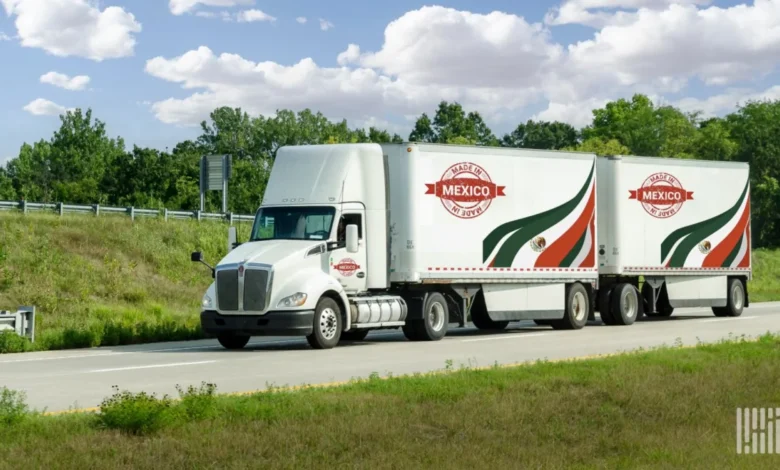
The robust economic engine driving trade between the United States and Mexico continues to expand, sustaining critical supply chains, heavy-haul logistics networks, and regional freight markets across the Southwest. According to a landmark study released by the Avocado Institute of Mexico and compiled by researchers at Texas A&M University, Mexican Hass avocado imports are generating hundreds of millions of dollars for the U.S. transportation and warehousing sectors while supporting thousands of domestic jobs. Concurrently, major logistics players are reinforcing their operational footprints. Regional parcel delivery provider GLS US has widened its geographic reach into the critical El Paso trade corridor, and Houston-based trucking and logistics provider Jetco has launched a specialized division to cater to an industrial and infrastructure boom along the Gulf Coast.
These developments underscore the deep, structural integration of the North American supply chain. Far from being isolated border transactions, trade flows originating south of the Rio Grande provide the lifeblood for distribution networks that stretch deep into the American interior, touching grocery store shelves, industrial manufacturing sites, and e-commerce distribution hubs alike.
The Macroeconomic Footprint of Mexican Hass Avocado Imports
The fiscal year 2025-26 economic analysis published by the Avocado Institute of Mexico quantifies the immense scale of the agricultural trade corridor connecting Michoacán and other growing regions in Mexico to consumer markets across the United States. Researchers at Texas A&M University found that Mexican Hass avocado imports alone generated an estimated $641.5 million in direct U.S. transportation and warehousing activity. Furthermore, this specific segment of the agricultural trade supported more than 4,150 jobs dedicated exclusively to moving, storing, and handling the fruit.
When examining the broader macroeconomic impact, the statistics grow exponentially. The analysis estimates that total Mexican Hass avocado imports contributed approximately $7.1 billion in overall U.S. economic output and sustained 37,163 jobs across multiple interconnected industries during the fiscal year ending June 2026. Within that overarching figure, the baseline valuation of $3.2 billion in imported Mexican Hass avocados directly contributed an estimated $4.4 billion to the U.S. gross domestic product (GDP), while driving $2.4 billion in labor income and generating roughly $1 billion in federal, state, and local tax revenues.
These figures illustrate that agricultural imports function as a vital catalyst for domestic economic health, driving demand for fuel, equipment purchasing, logistics software, maintenance services, and cold-chain infrastructure.
Texas and California as Gateway and Destination Superpowers
While the economic benefits of Mexican avocado imports disperse nationwide, the geographic core of this trade remains anchored in Texas and California. Texas acts as the primary physical gateway for perishable goods entering the United States from Mexico. According to United States Department of Agriculture (USDA) data cited in the Texas A&M report, nearly 98% of all Mexican avocados entering the U.S. in 2024 arrived via truck through Texas land ports.
The Pharr international bridge served as the dominant port of entry, handling approximately 58.2% of all Mexican avocado imports. Meanwhile, the World Trade Bridge and other crossings in Laredo accounted for an additional 39.4%. Once customs clearance is achieved, these perishable shipments transition immediately into a highly coordinated, temperature-controlled logistics network consisting of refrigerated trucking fleets, specialized cold-storage facilities, wholesale distribution hubs, and food processing plants.
Within the Lone Star State itself, the trade generated tangible economic dividends. An estimated $245.1 million in direct Mexican Hass avocado imports catalyzed $428.9 million in localized economic output, contributed $265.5 million to the state’s gross domestic product, and supported 2,402 jobs across various logistics and trade services.
In contrast, California functions primarily as the nation’s premier consumption and secondary distribution super-hub. As the largest avocado-consuming state in the country, California generated $968.2 million in economic output and supported 5,325 jobs directly associated with the processing, wholesaling, and retail distribution of Mexican avocados.
Significantly, the Texas A&M study points out that combined economic contributions from Texas and California accounted for only 19% to 22% of the national totals measured. This disparity highlights a crucial reality of modern supply chains: the vast majority of the economic value, employment generation, and logistical activity occurs far beyond the borderlands, spreading evenly across the American Midwest, East Coast, and Pacific Northwest.
Industry Leadership Responds to Integrated Supply Chains
The findings of the Texas A&M study have drawn positive reactions from trade organizations and agricultural leaders who have spent decades fostering cross-border cooperation. Ron Campbell, executive director of the Mexican Hass Avocado Import Association, emphasized that the data validates the intentional design of bilateral trade frameworks.
"This report demonstrates the value of a deeply integrated North American supply chain built over decades between Mexico and the U.S.," Campbell stated. "Mexican avocados don’t simply cross the border; they generate economic activity throughout the U.S. economy, supporting transportation and distribution networks, retailers, restaurants, and communities across the country."
Industry analysts note that maintaining this momentum requires continuous investment in cross-border infrastructure, customs modernization, and cold-chain capacity. With border crossings such as Pharr and Laredo operating near peak capacities during peak harvest seasons, regional logistics providers are constantly adapting to prevent bottlenecks and ensure that perishable goods reach market without compromising quality or shelf life.
GLS US Expands Parcel Delivery Network to the El Paso Border Market
Beyond agricultural trade, the broader logistics ecosystem along the U.S.-Mexico border is seeing strategic investments designed to capture rising manufacturing and e-commerce volumes. Regional parcel delivery provider GLS US announced a major expansion into El Paso, Texas, reinforcing its footprint across the Western United States and securing another strategic foothold along the international boundary.
The operational expansion provides businesses in West Texas with comprehensive first-, middle-, and final-mile delivery capabilities. Furthermore, the new El Paso hub is equipped to handle international shipping protocols and parcel transportation for commercial and residential shipments weighing up to 150 pounds.
El Paso represents one of the most critical twin-plant manufacturing and logistics ecosystems in North America, acting as an industrial counterpart to Ciudad Juárez, Mexico. The region serves as a massive magnet for automotive components, medical devices, electronics, and consumer goods. By integrating El Paso into its broader network, GLS US aims to service manufacturers, distributors, retailers, and e-commerce companies seeking seamless shipping connectivity throughout Texas and the wider Western states.
This move builds upon a calculated, multi-year expansion strategy by GLS US. The company entered the Dallas-Fort Worth market in 2025 and subsequently rolled out operations in Houston, Austin, and San Antonio earlier this year. The addition of El Paso completes a comprehensive Lone Star State network, positioning the regional carrier to compete more aggressively for business-to-business (B2B) and business-to-consumer (B2C) parcel volumes originating from cross-border manufacturing operations.
Jetco Launches Specialized Heavy-Haul Division to Serve Gulf Coast Industrial Boom
While parcel and perishable carriers vie for space along the western and central border corridors, heavy-industrial logistics providers are turning their attention eastward to capitalize on an infrastructure and energy boom along the U.S. Gulf Coast. Houston-based trucking and logistics provider Jetco has formally launched a dedicated specialized cargo division to address soaring demand for oversized, overweight, and out-of-gauge transportation.
The new division strategically merges Jetco’s legacy heavy-haul operations—which were originally established in 2008—with its rapidly scaling freight brokerage business. The goal is to provide end-to-end logistics management for complex, massive industrial components destined for data centers, power generation facilities, chemical plants, and heavy manufacturing sites across the Gulf Coast region.
Jetco President Kyle Kristynik highlighted the forward-looking strategy behind the creation of the division. "Three years ago, we started positioning ourselves to capitalize on the accelerated growth of domestic power, manufacturing, and infrastructure, specifically data centers," Kristynik said in a corporate statement.
To support the heavy-haul division, Jetco has aggressively upgraded its equipment fleet. The company added four specialized trailers over the course of the year, including two Faymonville Multimax trailers capable of hauling up to 125,000 pounds each, a heavy-duty Goldhofer trailer rated for 180,000 pounds, and a Fontaine hydraulic removable gooseneck trailer boasting a 55-ton capacity within a compact 16-foot footprint.
Operationally, the division will deploy a hybrid model combining Jetco’s company-owned tractors and specialized trailers with a vetted network of prequalified third-party motor carriers. This scalable approach allows Jetco to absorb sudden surges in project-based freight demands. Additionally, the company plans to leverage cross-border synergies with its Canadian sister companies, Precision Specialized and Scott Woods Transport, both operating under parent entity The GTI Group. Headquartered in Houston with strategic facilities in Pasadena, Freeport, and Dallas, Jetco is uniquely positioned to serve the dense industrial petrochemical and energy corridors of Texas.
Broader Implications for North American Trade and Logistics
The concurrent milestones achieved across the U.S.-Mexico trade landscape—ranging from the multi-billion-dollar economic ripple effects of agricultural commodities to targeted parcel expansions in El Paso and heavy-haul infrastructure investments in Houston—paint a clear picture of a dynamic, evolving freight market.
As supply chains continue to realign in response to nearshoring trends, regional economic shifts, and surging demand for localized warehousing, the interdependence between the United States and Mexico remains a cornerstone of domestic economic stability. Whether moving temperature-sensitive produce through Laredo, sorting e-commerce parcels in El Paso, or hauling massive power generation transformers across the Gulf Coast, the logistics industry continues to prove that cross-border trade is not merely an exchange of goods, but a foundational driver of employment, infrastructure development, and long-term economic growth across North America.