How Gallup Transformed Decades of Workplace Science into Real-Time AI Coaching with Amazon Bedrock

For nearly a century, the global analytics and advisory firm Gallup has served as a cornerstone for organizational development, amassing a monumental repository of proprietary research detailing human behavior, employee engagement, and workplace performance. Yet, despite the depth and breadth of this invaluable data—collected over 90 years across diverse global markets—turning academic-grade workplace science into immediate, actionable solutions for managers on the ground historically presented a formidable operational bottleneck. Leaders seeking guidance on pressing human resources challenges, team dynamics, or retention strategies were often forced to manually navigate extensive archives of reports, academic papers, and proprietary frameworks. They had to interpret complex insights independently and translate them into real-world management strategies without direct, real-time consultation. This reliance on manual research meant that organizational challenges were frequently addressed in a reactive manner rather than proactively.
Recognizing the urgent need to bridge the gap between academic research and real-time execution, Gallup embarked on a transformative technological journey. The objective was clear yet ambitious: convert decades of accumulated intellectual property into an intelligent, highly personalized, and conversational generative artificial intelligence assistant. This digital companion needed to be embedded directly into the daily workflows of organizational leaders through the Gallup Access platform. To achieve this monumental feat, Gallup turned to Amazon Bedrock, an enterprise-grade fully managed service from Amazon Web Services (AWS), setting off a chain of architectural innovations that would forever alter how corporate leaders interact with workplace science.
The Genesis and Architectural Blueprint of Gallup AI
The conceptualization and eventual deployment of Gallup AI marked a paradigm shift in enterprise software design. Gallup evaluated several competing approaches for developing a generative AI assistant, ultimately selecting Amazon Bedrock due to its unique combination of foundational model choice, enterprise-grade data security, and seamless integration capabilities. By leveraging Amazon Bedrock alongside Anthropic’s advanced Claude models, Gallup bypassed the need to assemble a massive, dedicated machine learning operations team, successfully transitioning from initial conceptual prototypes to a production-ready application within a matter of weeks.
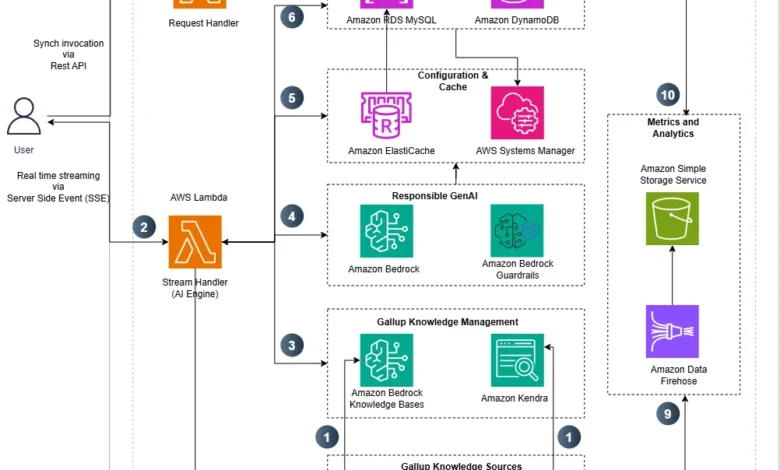
The underlying infrastructure of Gallup Access AI was architected as a robust, highly scalable serverless ecosystem capable of supporting thousands of distinct organizations simultaneously while maintaining strict data isolation and security protocols. At the core of the data retrieval mechanism lies a sophisticated dual-ingestion pipeline. Historical archives comprising decades of employee engagement studies, performance metrics, and organizational psychology data are stored securely in Amazon Simple Storage Service (Amazon S3) and systematically ingested into Amazon Bedrock Knowledge Bases. Concurrently, an automated web-crawling system continuously scans the Gallup digital ecosystem to capture the latest published research papers, editorial insights, and methodological updates, indexing these real-time publications into Amazon Kendra.
When a corporate leader inputs a query into Gallup AI, the system initiates a multi-layered retrieval process. Relevant documents are surfaced from both Amazon Bedrock Knowledge Bases and Amazon Kendra, meticulously evaluated against stringent confidence thresholds, filtered for relevance, and consolidated before being routed to Anthropic’s Claude models. This ensures that every piece of advice generated is deeply rooted in verified, scientifically validated workplace data rather than relying on generic, unverified internet knowledge.
Ensuring Enterprise Security, Performance, and Observability
To deliver a conversational experience that feels both instantaneous and completely natural, Gallup engineered a high-performance backend using AWS Lambda integrated with FastAPI. This architecture seamlessly manages both real-time streaming for web clients and synchronous backend processing requests. Session continuity and conversation history are managed via Amazon ElastiCache Serverless, which provides sub-millisecond response times, ensuring that multi-turn interactions flow smoothly without perceptible lag. Meanwhile, Amazon Relational Database Service (Amazon RDS) for MySQL acts as the durable system of record, securely storing comprehensive logs of conversations, user prompts, generated responses, and exact source citations.
Enterprise deployment of generative AI inherently demands rigorous guardrails to prevent harmful outputs, hallucinations, or policy violations. Gallup integrated Amazon Bedrock Guardrails directly into the generation pipeline. These guardrails continuously monitor content safety parameters in real time, possessing the technical capability to intervene mid-stream if a potential policy infraction is detected. Furthermore, to preserve absolute transactional integrity even in the event of unexpected network interruptions, all user interactions and session states are safely persisted before the response-streaming phase begins.
Centralized configuration management is handled efficiently through AWS Systems Manager Parameter Store. This repository oversees critical operational dials, including AI model hyper-parameters, content safety enforcement policies, and system performance thresholds. Consequently, Gallup’s engineering teams retain the agility to adjust application behavior instantly without requiring complex code redeployments or causing service interruptions for active users. Contextual data and product-specific insights are managed via Amazon DynamoDB, enabling the application to dynamically tailor its guidance based on the unique role, organizational context, and workflow of each individual user.
Operational observability and cost optimization are maintained through Amazon Data Firehose, which streams comprehensive operational metrics—such as input and output token counts, cached token metrics, time-to-first-byte (TTFB) latencies, and generation stop reasons—directly into Amazon S3. This telemetry provides Gallup engineers with granular visibility into financial overhead, system performance curves, and evolving usage trends across the global user base.
Adoption Metrics and Empirical Impact Since Launch
Since its official commercial launch in June 2024, Gallup AI has experienced exponential enterprise adoption, rapidly scaling across diverse industrial sectors and profoundly changing how managers interact with data-driven insights. Tasks that previously demanded hours of manual document review, cross-referencing, and workshop attendance are now resolved in a matter of seconds through intuitive, conversational prompts.
Empirical data gathered by Gallup highlights the remarkable scale of user engagement and system performance achieved within a relatively brief operational window. Total user prompts processed by the platform surged by approximately sevenfold, while active user counts expanded by roughly 5.5 times. Furthermore, the total volume of distinct user conversations grew by approximately 4.5 times.
Crucially, qualitative indicators of engagement depth demonstrated a profound shift in user behavior. The average number of prompts per conversation increased by roughly 55 percent, signaling that leaders are not merely asking one-off, transactional questions, but are instead engaging in sustained, multi-turn strategic dialogues with the AI assistant. On the technical front, the system maintains sub-second time-to-first-byte performance for real-time streaming responses, complemented by sub-millisecond session retrieval times facilitated by Amazon ElastiCache Serverless. Millions of tokens flow through the production infrastructure daily, reaffirming the stability, scalability, and practical utility of the AWS-powered architecture.
Industry Analysis: The Broader Implications for Enterprise AI
The successful deployment of Gallup AI offers a compelling case study for the broader enterprise software and management consulting industries. For decades, traditional advisory firms operated under a high-touch, human-centric delivery model where specialized insights were bottlenecked by the availability of human experts, consultants, and proprietary literature. By successfully encapsulating 90 years of empirical research into a dynamic, generative AI application, Gallup has redefined the economics of knowledge distribution.
This shift carries profound implications for the future of enterprise leadership training and human capital management. As artificial intelligence models become increasingly sophisticated at parsing unstructured proprietary data, the competitive advantage in the corporate advisory space is shifting away from mere data accumulation toward data synthesis, contextual grounding, and workflow integration. Organizations that can successfully marry proprietary, scientifically validated frameworks with low-latency generative interfaces will increasingly dominate the market for professional services. Gallup’s implementation demonstrates that enterprises no longer need to choose between the rigorous accuracy of academic science and the speed of modern cloud computing; through serverless architectures and managed foundational models, both can be achieved simultaneously.
Executive Perspectives on the Future of Workplace Science
Reflecting on the strategic importance of this technological leap, Andrew Bridger, Director of Product at Gallup, emphasized the fundamental transformation occurring in how organizational leaders consume and apply management theory.
"Gallup AI represents a fundamental shift in how leaders access workplace science," stated Bridger. "For decades, our research helped organizations make better decisions, but it often required leaders to search, interpret, and apply those insights themselves. By building on Amazon Bedrock, we’re embedding scientifically grounded guidance directly into the flow of work, giving managers real-time support that is both personalized and actionable."
This sentiment underscores Gallup’s core philosophy: that data possesses little intrinsic value unless it is easily accessible, contextually relevant, and directly applicable to the daily challenges faced by front-line supervisors and executive leaders alike.
Future Horizons: Guided Coaching and Agentic Workflows
Building upon the robust foundation established by Gallup AI, the firm’s product and engineering roadmaps are heavily focused on expanding the functional capabilities of the platform. A primary near-term initiative involves the development of an AI-curated prompt library designed to capture the most frequent, high-impact inquiries submitted by managers and organizational leaders worldwide. This library aims to lower the barrier to entry, empowering users to immediately engage with complex workplace science through pre-vetted, highly optimized prompt structures.
In parallel, Gallup is rolling out sophisticated guided coaching experiences. Unlike open-ended conversational prompts, these structured workflows are engineered around predefined coaching scenarios—such as navigating organizational restructurings, mitigating employee burnout, enhancing team engagement scores, or accelerating individual employee development. By systematically sequencing prompts and responses into purposeful, outcome-driven pathways, the application acts as an active digital mentor, guiding managers step-by-step through complex leadership challenges.
Looking further ahead, Gallup is laying the groundwork for agent-based system architectures utilizing Amazon Bedrock AgentCore. This evolutionary step will enable Gallup AI to transcend its current status as a primarily user-facing assistant. By exposing underlying tools, specialized workflows, and proprietary knowledge bases programmatically, the system will be capable of autonomously interacting not only with human users but also with external enterprise software systems, HR management platforms, and organizational analytics dashboards across the entire application ecosystem.
Conclusion
The convergence of Gallup’s proprietary workplace science and Amazon Bedrock’s scalable generative AI infrastructure has established a new benchmark for enterprise knowledge management. By bridging the historical gap between static academic research and dynamic, real-time leadership execution, Gallup has delivered an intelligent assistant that empowers thousands of organizations to make faster, better-informed, and scientifically validated decisions. As Gallup continues to expand its technological capabilities through guided coaching frameworks and agentic architectures, the firm remains at the forefront of the digital transformation sweeping the global workplace advisory industry.