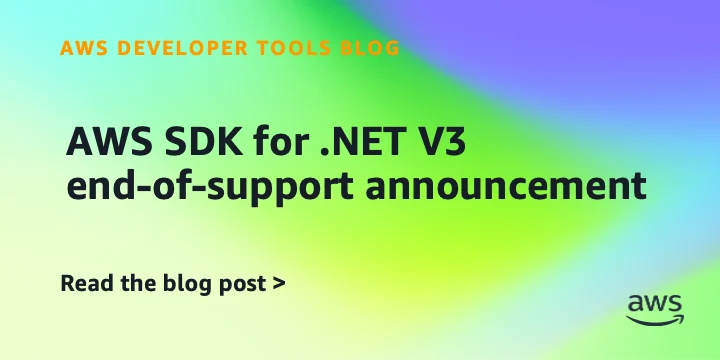
The AWS SDK for .NET, version 3, officially reached its end-of-support status on June 1, 2026, marking a critical transition point for countless developers and enterprises relying on Amazon Web Services. This move follows an earlier announcement that the SDK entered maintenance mode on March 1, 2026, aligning with AWS’s established SDKs and Tools Maintenance Policy. With this change, AWS has stated there are no further plans for updates or new releases for V3, a cessation that includes vital security fixes and bug resolutions. While previously published releases of V3 will remain accessible via NuGet and the source code will continue to reside on GitHub, the implications of this end-of-support status are profound for any application still utilizing this version.
The AWS SDK for .NET serves as a crucial bridge, enabling .NET developers to seamlessly integrate their applications with the extensive suite of AWS cloud services. It abstracts away the complexities of making direct API calls, providing a familiar object-oriented interface for interacting with services like Amazon S3, EC2, Lambda, DynamoDB, and many others. For years, the AWS SDK for .NET V3 has been a cornerstone for building robust, scalable, and secure cloud-native applications within the .NET ecosystem. Its widespread adoption across various industries underscores its importance, from startups to large enterprises that have built mission-critical systems on its foundation. The lifecycle management of such a fundamental tool is a standard practice in the software industry, ensuring that developers are always working with the most secure, performant, and feature-rich versions. Cloud providers regularly update their SDKs to keep pace with rapid innovation, introduce new features, enhance security, and optimize performance, making these end-of-life announcements a necessary part of the development cycle.
A Chronology of Support and Transition
The journey to the end-of-support for AWS SDK for .NET V3 has been a structured process, designed to provide developers with ample time to plan and execute their migrations. The initial signal came with the announcement that V3 would enter maintenance mode on March 1, 2026. This phase typically signifies a shift in development focus, where an SDK receives only critical updates, primarily for security vulnerabilities or severe bugs, with new feature development ceasing. It acts as a transitional period, allowing users to stabilize their existing V3 deployments while preparing for an upgrade to the next major version. The purpose of a maintenance mode is to facilitate a smooth deprecation process, giving developers a window to avoid immediate disruption while also clearly communicating the future trajectory of the software.
The subsequent and definitive step occurred on June 1, 2026, when AWS SDK for .NET V3 officially transitioned from maintenance mode to end-of-support. This date marks the cessation of all planned development, including any further security patches, bug fixes, or compatibility updates. While the existing binaries will remain available on package managers like NuGet, and the source code will be archived on GitHub, these resources will no longer be actively maintained by AWS. This clear timeline underscores AWS’s commitment to its SDKs and Tools Maintenance Policy, which outlines the expected support duration and lifecycle for its developer tools, providing transparency and predictability for the developer community.
Understanding the Implications for V3 Users
For organizations and developers still leveraging AWS SDK for .NET V3, the end-of-support status carries several significant implications that demand immediate attention, even though existing applications will continue to function. The most critical concern revolves around security. Without ongoing security fixes, V3 applications become increasingly vulnerable to newly discovered exploits and attack vectors. This exposure can lead to severe consequences, including data breaches, unauthorized access to AWS resources, service disruptions, and reputational damage. In regulated industries such as finance, healthcare, or government, operating applications on unsupported software can also lead to non-compliance with various industry standards and governmental regulations (e.g., GDPR, HIPAA, PCI DSS), potentially resulting in hefty fines and legal repercussions.
Beyond security, the lack of updates means V3 will not support new AWS services, new regions, or new features within existing services. As AWS continues its relentless pace of innovation, introducing hundreds of new capabilities annually, V3 users will find their applications increasingly isolated from these advancements. This can hinder the ability to leverage cutting-edge cloud technologies, optimize costs, or enhance user experiences with the latest features. For instance, if a new, more efficient database service or a crucial AI/ML capability is launched, V3 applications will be unable to natively integrate with it, forcing developers to implement cumbersome workarounds or forgo the benefits entirely.
Furthermore, the absence of bug fixes means that any existing or newly discovered functional issues within V3 will remain unresolved. This can lead to application instability, unexpected behavior, and increased operational overhead as developers spend more time troubleshooting problems that would otherwise be addressed in a supported version. Compatibility issues may also arise over time with updates to the underlying .NET runtime, operating systems, or other third-party libraries that V3 applications depend on. As the broader software ecosystem evolves, an unsupported SDK can become a bottleneck, creating technical debt that becomes progressively more challenging and costly to address. Lastly, while the SDK is open source, official AWS technical support for issues directly attributable to V3 will be significantly limited, pushing developers to resolve problems independently or, more likely, to accelerate their migration plans.
The Compelling Case for AWS SDK for .NET V4
AWS strongly advocates for all customers currently using V3 to migrate to AWS SDK for .NET V4 as expeditiously as possible. V4 represents a significant evolutionary step, incorporating a host of improvements designed to enhance performance, bolster security, and ensure continued compatibility with the ever-expanding AWS ecosystem. The benefits of upgrading are multifaceted and directly address the risks associated with remaining on V3.
One of the primary advantages of V4 is its focus on performance enhancements. Modern SDKs are often optimized for speed and efficiency, leading to faster API call execution, reduced latency, and lower resource consumption. This can translate into more responsive applications, improved scalability, and potentially lower operational costs due to more efficient use of compute and network resources. These enhancements often stem from improved network handling, optimized serialization and deserialization processes, better memory management, and more efficient use of asynchronous programming patterns that align with modern .NET best practices.
Ongoing bug fixes and security updates are paramount. V4 ensures that any discovered vulnerabilities are promptly patched, and functional bugs are resolved, maintaining the integrity and reliability of applications. This proactive approach to security is critical in the current threat landscape, where new vulnerabilities are constantly emerging. Regular updates mean developers can build with confidence, knowing their applications are protected by the latest security measures and are less susceptible to operational disruptions caused by software defects.
Crucially, V4 guarantees continued support for all new AWS services and regions. As AWS expands its global footprint and introduces innovative cloud capabilities, V4 will be updated to include support for these advancements. This allows developers to leverage the latest tools, services, and infrastructure, unlocking new possibilities for their applications and ensuring they remain competitive and future-proof. Whether it’s integrating with a new machine learning service, deploying to a newly launched AWS Region, or utilizing the latest features of an existing service, V4 provides the necessary interfaces and functionalities.
Moreover, V4 aligns with modern .NET standards and paradigms, offering better integration with contemporary .NET frameworks like .NET Core and .NET 5+. This includes support for features such as dependency injection, asynchronous programming models (async/await), and other language enhancements that improve developer productivity and code quality. Migrating to V4 can also be an opportunity to modernize the application’s underlying .NET framework, further improving performance, security, and maintainability.
Streamlining the Migration Process
Recognizing that migration can be a complex undertaking, especially for large and intricate applications, AWS has provided comprehensive resources to facilitate the transition to V4. The official Migration Documentation is a cornerstone of this support, offering detailed guides, code examples, and best practices to help developers navigate the upgrade process. These documents typically cover breaking changes, recommended update paths, and strategies for testing migrated code, aiming to minimize friction and potential pitfalls.
Beyond documentation, AWS encourages developers to utilize the GitHub repository’s discussion forums for any questions or issues that arise during the update process. These forums provide a platform for community support, where developers can share experiences, ask for advice, and receive guidance from AWS engineers and other experienced users. For more specific problems or identified bugs, developers are encouraged to open GitHub issues, ensuring that critical feedback and technical challenges are directly addressed by the AWS SDK development team. This collaborative approach underscores AWS’s commitment to supporting its developer community through major transitions.
A common challenge in large-scale migrations is dealing with upstream dependencies that might prevent a direct update to V4. AWS has specifically requested that developers communicate any such dependencies, stating, "If you find dependencies that are preventing you from updating to V4, please let us know to see if we can help." This indicates a willingness from AWS to potentially assist in resolving these complex dependency issues, either through direct guidance, by coordinating with third-party vendors, or by offering alternative solutions.
Best practices for migration often involve a phased approach. Starting with less critical applications or modules allows teams to gain experience and refine their migration strategy before tackling core systems. Thorough testing, including unit, integration, and end-to-end tests, is indispensable to ensure that migrated applications function correctly and maintain their expected performance characteristics. Automated testing frameworks can significantly streamline this process, helping to quickly identify any regressions or new issues introduced by the SDK upgrade.
Broader Industry Context and the Developer’s Role
The end-of-support for AWS SDK for .NET V3 is not an isolated event but rather a standard practice within the broader cloud computing and software development industries. Major cloud providers like AWS, Microsoft Azure, and Google Cloud Platform continually evolve their SDKs and APIs to support new services, improve performance, and enhance security. This constant evolution necessitates a lifecycle management strategy that includes deprecation of older versions. This approach ensures that developer efforts are focused on maintaining and enhancing modern, secure, and feature-rich tools, rather than indefinitely supporting legacy systems.
From a developer’s perspective, keeping dependencies updated is a fundamental responsibility that contributes significantly to the overall health and security of software projects. Neglecting SDK updates can lead to accumulating technical debt, which refers to the implied cost of additional rework caused by choosing an easy solution now instead of using a better approach that would take longer. Over time, this technical debt can become overwhelming, making future updates even more challenging and expensive, potentially forcing a complete rewrite of applications.
For enterprises, these end-of-support announcements often trigger significant project initiatives. Large organizations with extensive portfolios of applications built on older SDK versions must allocate resources, time, and budget for migration efforts. While initially seen as a cost, such migrations are often opportunities for modernization, allowing organizations to refactor code, improve architecture, and adopt newer cloud patterns that can lead to long-term benefits in terms of scalability, resilience, and cost-efficiency. It also reinforces a culture of continuous improvement and proactive security management within the organization.
Conclusion
The official end-of-support for AWS SDK for .NET V3 on June 1, 2026, marks a pivotal moment for the .NET development community working with AWS. While existing applications will continue to operate, the cessation of security updates, bug fixes, and new feature support poses substantial risks related to security vulnerabilities, compatibility issues, and the inability to leverage future AWS innovations. AWS’s strong recommendation for immediate migration to V4 is underpinned by the tangible benefits of enhanced performance, ongoing security, and comprehensive support for the latest AWS services and regions.
AWS has demonstrated a clear commitment to facilitating this transition by providing extensive migration documentation and active support channels through GitHub discussion forums and issue tracking. The proactive engagement with developers regarding complex dependencies further illustrates AWS’s dedication to ensuring a smooth upgrade path. Developers and organizations are urged to prioritize this migration to AWS SDK for .NET V4 not merely as a compliance requirement but as an essential step towards fortifying their applications against evolving threats, unlocking new capabilities, and ensuring the long-term viability and performance of their cloud-native solutions. The transition to V4 is an investment in future-proofing applications, aligning them with the forefront of cloud technology and maintaining a robust, secure, and efficient presence in the AWS ecosystem.
Related posts: