Enterprise SaaS Platforms Redefine Multi-Tenant Cloud Security with the Four Walls Isolation Model on Amazon EKS

The modern enterprise software landscape is characterized by an escalating paradox: organizations demand the cost efficiencies and operational agility of shared, multi-tenant cloud environments, yet they simultaneously face unprecedented regulatory, legal, and operational pressures to safeguard sensitive data. For cloud-native platforms processing critical workloads—such as payroll, human resources hierarchies, and operational analytics for Fortune 100 enterprises—a single security misconfiguration or data spill is not merely an IT incident; it is a catastrophic breach of trust capable of triggering widespread regulatory penalties across multiple jurisdictions.
Addressing this core tension, ReadyOn, an AWS Partner and leading provider of intelligent labor orchestration solutions, has unveiled its comprehensive multi-tenant architecture on Amazon Elastic Kubernetes Service (Amazon EKS). Built around a proprietary framework designated the "Four Walls" model, the architecture aims to resolve one of the most persistent vulnerabilities in enterprise computing: the inherent limitations of multi-tenant security in upstream Kubernetes environments.
The Underlying Vulnerability of Multi-Tenant Kubernetes
Kubernetes has rapidly become the foundational orchestration layer for modern enterprise IT, celebrated for its scalability, automation capabilities, and vibrant ecosystem. However, default Kubernetes deployments are historically not engineered for strict security out-of-the-box. Upstream configurations have long permitted anonymous requests to reach the API server—where they rely exclusively on Role-Based Access Control (RBAC) for denial—allowed pods to execute as root users by default, and omitted native network segmentation until explicitly configured by administrators.
While hardening a single-tenant Kubernetes cluster is a well-documented and manageable challenge, shifting the paradigm to a multi-tenant environment fundamentally alters the underlying threat model. In a single-tenant deployment, the primary objective is preventing unauthorized external actors from breaching the perimeter. In a multi-tenant architecture, the existential threat transforms entirely: the core concern shifts to whether Tenant A can maliciously or accidentally access the sensitive data of Tenant B.
Historically, the vast majority of multi-tenant Kubernetes platforms have relied on a single primary isolation mechanism: the namespace. However, Kubernetes architects never intended namespaces to serve as an impenetrable security boundary. Relying solely on logical namespaces leaves systems vulnerable to privilege escalations, container escapes, and misconfigured API permissions. Recognizing that its Harmony platform processes sensitive organizational hierarchies and payroll data for hundreds of thousands of employees, ReadyOn determined that standard, single-barrier architectures were inadequate for enterprise-grade compliance.
The Evolution of the Four Walls Architecture
To neutralize the risk of cross-tenant data exposure, ReadyOn designed a compound defense strategy that integrates four independent isolation layers operating across different strata of the technology stack. Under this model, an unauthorized user attempting to bridge the tenant boundary cannot rely on defeating a single security gate; instead, they must simultaneously compromise the Kubernetes API, the container node scheduler, the software-defined cloud network, and the underlying data storage layer.
The architecture systematically divides isolation into four distinct barriers:
- Namespace Isolation on Amazon EKS: Operating at the Kubernetes API level, this layer establishes the logical foundation, enforced strictly through automated GitOps pipelines rather than manual operator intervention.
- Compute Isolation via Karpenter: Operating at the physical machine layer, this barrier ensures that tenant workloads never share underlying compute nodes, utilizing a dual-taint strategy and strict admission controller validation.
- Network Isolation at the Amazon VPC Layer: Operating completely below the Kubernetes abstraction layer, this tier leverages Amazon Virtual Private Cloud (VPC) security groups and default-deny network policies to segment traffic at the infrastructure level.
- Data Isolation with Amazon Aurora: Acting as the final, innermost line of defense, this layer assigns dedicated relational database clusters and unique AWS Key Management Service (AWS KMS) encryption keys to every individual tenant.
Wall 1: GitOps-Driven Namespace Consistency and API Control
The first barrier of the Four Walls model utilizes Kubernetes namespaces as a logical baseline, but removes human error from the provisioning and enforcement process. ReadyOn leverages Argo CD and ApplicationSets to govern the lifecycle of every tenant environment.
When onboarding a new enterprise client, engineers simply add a single entry to a centralized configuration manifest maintained within a Git repository. Automation scripts instantly generate all necessary accompanying resources, including the namespace itself, granular network policies, RBAC bindings, resource quotas, and secret configurations. This pipeline ensures that "legacy" tenants with weaker security baselines cannot exist; every client receives an identical, hardened security posture by construction.
Furthermore, the platform enforces self-healing drift correction. The continuous-reconciliation engine evaluates the live cluster state against the declared state stored in Git. Should an unauthorized user gain limited API access and execute manual modifications, or should a misconfiguration occur, the GitOps controller automatically reverts the change within seconds. Production clusters are strictly isolated from direct operator interventions, meaning human engineers never execute manual commands like kubectl apply directly against live environments.
Wall 2: Compute Isolation and Karpenter-Managed Node Pools
While namespaces govern logical access within the Kubernetes control plane, Wall 2 addresses the physical hardware where application code executes. In the Harmony architecture, tenants are strictly segregated onto dedicated compute nodes.
ReadyOn utilizes Karpenter, an open-source, high-performance Kubernetes node autoscaler built for AWS, to provision dedicated node pools governed by a rigorous dual-taint strategy. Every node created by Karpenter features two distinct taints: a tenant-identifier taint (e.g., tenant=enterprise-client-alpha) and a workload-type taint (e.g., workload=frontend). Consequently, for any pod to be successfully scheduled, it must explicitly tolerate both criteria. Tenant A’s frontend workloads run on infrastructure completely separated from its own batch-processing tasks, and both are entirely isolated from Tenant B’s computational footprint.
To prevent bypasses via forged configurations, admission controllers validate that submitted pods possess tolerations matching their precise namespace identity. Additionally, all application nodes enforce IMDSv2 (Instance Metadata Service Version 2) with minimized hop limits, preventing containerized workloads from querying instance metadata. Attached IAM roles are strictly scoped to a single tenant’s unique resources, limiting the blast radius of any theoretical container escape.
Wall 3: Infrastructure-Level Network Segmentation
Transcending the Kubernetes abstraction layer entirely, Wall 3 enforces rigorous boundaries at the Amazon VPC and security group level. This infrastructure is managed directly by AWS software-defined networking rather than the Kubernetes control plane, making it impervious to manipulation from compromised container workloads.
Each tenant’s dedicated Amazon Aurora database cluster is protected by an individualized security group that permits inbound connections exclusively from the security group attached to that specific tenant’s application nodes. Consequently, even if an attacker achieved arbitrary code execution within a Tenant A application pod, those workloads lack the network path, credentials, and security group permissions required to open a TCP connection to Tenant B’s database.
The underlying VPC is partitioned into four explicit tiers:
- Public Perimeter Tier: Restricted strictly to external load balancers.
- Application Tier: Comprising Amazon EKS worker nodes deployed across private subnets.
- Database Tier: Housing isolated Aurora database clusters with zero internet accessibility.
- Control Plane Tier: Featuring private EKS API endpoints accessible exclusively via secure VPN connections integrated with OIDC and Multi-Factor Authentication (MFA).
Additionally, Kubernetes network policies enforce a strict default-deny posture for all inter-namespace traffic, complemented by Amazon VPC Flow Logs for real-time anomaly detection.
Wall 4: Per-Tenant Data Isolation and Cryptographic Separation
The fourth and final wall targets the ultimate repository of enterprise value: the underlying data stores. In traditional multi-tenant architectures relying on shared databases, isolation is dangerously dependent on application-layer query logic. A single developer omission—such as a missing WHERE tenant_id = ? clause—can result in catastrophic data leakage.
ReadyOn eliminates this vulnerability by provisioning dedicated Amazon Aurora clusters for every single tenant. Because databases are physically separated, application code simply lacks the database endpoint, credentials, and network routing required to query another client’s tables. There are no shared rows and no reliance on row-level security filters.
Furthermore, every tenant’s data-at-rest is encrypted using a unique, dedicated AWS Key Management Service (AWS KMS) customer managed key. Even in the highly improbable event of raw storage media exposure, an attacker possessing one tenant’s decryption key would find it entirely useless for unlocking neighboring tenant data.
To govern interactions with external cloud services, workloads utilize IAM Roles for Service Accounts (IRSA), authenticating via short-lived credentials issued through OIDC federation between the EKS cluster and AWS Security Token Service (AWS STS). Workloads hold zero long-lived static access keys, and session credentials expire within minutes.
Threat Modeling and Continuous Adversarial Validation
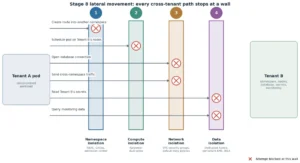
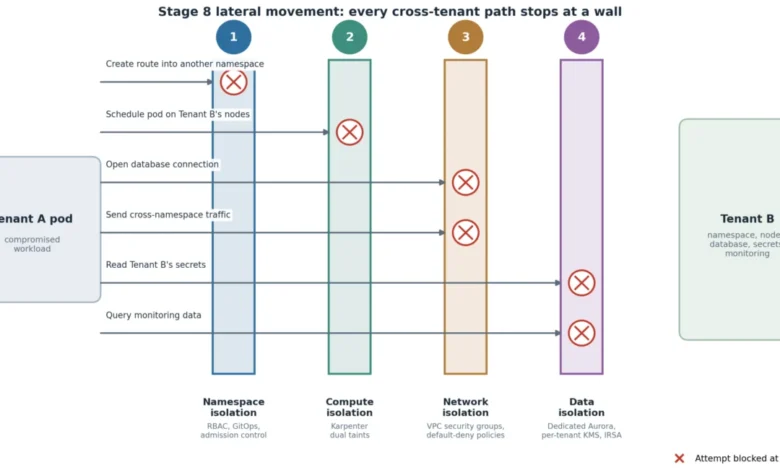
ReadyOn maps its defense-in-depth architecture against comprehensive multi-tenant threat models and standard frameworks such as MITRE ATT&CK. The critical stress test for the architecture occurs during Stage 8 (Lateral Movement), wherein an imaginary attacker compromises a container within a Tenant A pod and attempts to pivot toward Tenant B resources.
The Four Walls model successfully halts these adversarial movements across six distinct vectors:
- Attempts to establish network routes into foreign namespaces are blocked by Namespace and Network Policies (Wall 1).
- Attempts to schedule malicious pods onto foreign compute nodes are rejected by Karpenter scheduling constraints and admission validators (Wall 2).
- Attempts to initiate cross-namespace database connections or bypass VPC boundaries are dropped by AWS security groups and VPC routing tables (Wall 3).
- Attempts to query monitoring telemetry or extract encrypted secrets are thwarted by per-tenant observability backends and distinct KMS encryption boundaries (Wall 4).
To ensure these theoretical defenses hold up under real-world conditions, ReadyOn routinely conducts rigorous adversarial security exercises. Security teams simulate fully compromised tenant pods armed with elevated local privileges and attempt to breach neighboring environments. To date, internal and third-party penetration testing has yielded zero successful cross-tenant data access paths.
Broader Industry Implications and Future Outlook
The deployment and public documentation of the Four Walls model arrive at a pivotal moment for cloud-native enterprise architecture. As regulatory frameworks such as the European Union’s GDPR, HIPAA, and industry-specific financial compliances grow increasingly stringent, enterprises can no longer accept "soft" logical multi-tenancy models that rely primarily on application compliance and software promises.
Industry analysts note that while monolithic multi-tenancy offers undeniable financial and operational efficiencies, the reputational and financial fallout of cross-tenant data spills far outweighs the infrastructure savings of shared compute models. By demonstrating that robust zero-trust principles can be successfully engineered into Kubernetes through native cloud services—without sacrificing developer velocity or platform economics—ReadyOn’s architecture provides a valuable reference blueprint for engineering teams operating mission-critical SaaS platforms across the globe.
Ultimately, the Four Walls model illustrates that enterprise-grade security in containerized environments is not achieved through a single silver bullet, but through the disciplined, multi-layered intersection of API management, compute scheduling, cloud networking, and cryptographic data isolation.