ReadyOn Deploys Revolutionary Four Walls Security Architecture on Amazon EKS to Protect Enterprise Workforce Intelligence Data

The escalating complexity of enterprise cloud infrastructure has long presented a formidable challenge for multi-tenant platform architects, particularly in sectors managing highly sensitive workforce and payroll data. ReadyOn, a prominent AWS Partner specializing in intelligent labor orchestration for Fortune 100 enterprises, has formally introduced an innovative multi-tenant security framework. Operating on Amazon Elastic Kubernetes Service (Amazon EKS), the company’s Harmony platform processes intricate organizational hierarchies, global payroll metrics, and deep operational analytics for hundreds of thousands of employees. To safeguard this sensitive information against increasingly sophisticated cyber threats, ReadyOn has engineered a comprehensive defense system known as the "Four Walls" model, establishing a new benchmark for zero-trust tenant isolation within containerized environments.
Understanding the Vulnerabilities of Default Kubernetes Deployments
For decades, upstream Kubernetes has served as the backbone of modern cloud-native application deployment, offering unmatched scalability and microservices orchestration. However, security experts have long noted that a default Kubernetes deployment is inherently insecure out of the box. Historically, upstream configurations permit anonymous requests to reach the API server—where they rely exclusively on Role-Based Access Control (RBAC) for denial—allow pods to run with root privileges by default, and lack built-in network policies until administrators explicitly define them.
While securing single-tenant clusters remains a well-documented technical challenge, the introduction of multi-tenancy fundamentally alters the overarching threat model. In a shared environment, the core security concern shifts dramatically. Administrators must no longer focus solely on whether an unauthorized external user can penetrate the cluster perimeter; instead, they must rigorously prevent lateral movement where Tenant A could potentially access the data or resources of Tenant B. Historically, the vast majority of multi-tenant Kubernetes platforms have relied on a single isolation mechanism: the namespace. Yet, software architects and security engineers acknowledge that Kubernetes namespaces were never originally designed to function as robust security boundaries.
For ReadyOn, the stakes could not be higher. The Harmony platform handles mission-critical corporate functions where a cross-tenant data breach would instantly trigger severe regulatory compliance obligations across multiple international jurisdictions and permanently erode the hard-earned trust of enterprise clients. Recognizing that a single barrier was insufficient, engineering leadership at ReadyOn mandated a multi-layered security architecture that eradicates single points of failure.
The Genesis of the Four Walls Architecture
The development of the Four Walls model represents a paradigm shift in how cloud architects approach container security on Amazon Web Services (AWS). Rather than trusting any single layer of the software stack, ReadyOn’s architecture interlocks four completely independent barriers. Each barrier operates at a fundamentally different layer of the enterprise technology stack and requires an entirely distinct exploitation technique to bypass.
To achieve a true compound defense, an unauthorized actor attempting a breach must simultaneously compromise the Kubernetes API, the underlying node scheduler, the AWS software-defined network, and the isolated data storage tier. This defense-in-depth strategy ensures that even if one layer experiences a zero-day vulnerability or a configuration drift, the remaining three walls hold firm against lateral movement.
Wall 1: Namespace Isolation and GitOps-Enforced Consistency
At the outermost logical layer, ReadyOn utilizes Kubernetes namespaces as the foundation upon which all other security controls are constructed. While acknowledging the inherent limitations of namespaces as standalone security perimeters, the company uses them as an essential administrative grouping mechanism.
To eliminate human error and configuration drift, ReadyOn implements a strict GitOps methodology powered by Argo CD ApplicationSets. When onboarding a new enterprise tenant, systems engineers simply add a single entry into a centralized configuration manifest stored securely within Git. Automation scripts immediately generate all requisite infrastructure components, including the dedicated namespace, associated network policies, RBAC bindings, strict resource quotas, and specific secrets configurations. Consequently, the organization maintains zero "legacy" tenants burdened with weaker security postures. Every tenant receives an identical, hardened security configuration by construction.
Furthermore, fine-grained RBAC and admission controllers restrict API access so that tenant principals can exclusively view and modify resources residing within their assigned namespace. Automated self-healing mechanisms continuously reconcile the live cluster state against the declared state in Git. Any unauthorized modification or manual intervention via command-line tools is automatically detected and reverted within seconds, ensuring that production clusters remain impervious to ad-hoc administrative tampering.
Wall 2: Compute Isolation Powered by Karpenter
Moving downward from the Kubernetes API layer, Wall 2 addresses the physical and virtual compute machines where tenant container workloads execute. Within the Harmony platform architecture, tenants are strictly prohibited from sharing underlying compute nodes.
ReadyOn leverages Karpenter—an advanced, high-performance Kubernetes node autoscaler built for AWS—to enforce a rigorous dual-taint provisioning strategy. Karpenter-managed provisioners spin up dedicated EC2 instances stamped with two distinct taints: a unique tenant-identifier taint (such as tenant=acme-corp) and a precise workload-type taint (such as workload=frontend). To be successfully scheduled, a pod must actively tolerate both taints. Consequently, Tenant A’s frontend worker nodes are completely separated from its batch processing nodes, and both are entirely isolated from Tenant B’s physical compute infrastructure.
To prevent malicious actors from forging tolerations, admission controllers validate that every pod’s requested tolerations match the precise tenant identity defined in its namespace. Additionally, all application nodes enforce Instance Metadata Service Version 2 (IMDSv2) with a reduced network hop limit to block unauthorized container access to instance metadata. IAM roles attached to individual nodes are strictly scoped to a single tenant’s resource ARN, effectively containing the potential impact of any hypothetical container escape scenario.
Wall 3: Network Isolation at the Amazon VPC Layer
While the first two walls operate entirely within the Kubernetes abstraction layer, Wall 3 drops significantly deeper into the infrastructure by enforcing ironclad isolation at the Amazon Virtual Private Cloud (Amazon VPC) and security group level. This infrastructure operates independently of the Kubernetes control plane, meaning that a compromised pod possessing limited API access cannot manipulate or rewrite these network rules.
Every enterprise tenant’s Amazon Aurora database cluster is shielded by a dedicated security group that explicitly permits inbound connections solely from the specific security group attached to that tenant’s designated application nodes. For example, Tenant A’s worker nodes are cryptographically and network-wise incapable of establishing a TCP connection to Tenant B’s database. This isolation is enforced directly by the AWS software-defined network.
The underlying VPC architecture is partitioned into four distinct tiers: a public perimeter tier dedicated exclusively to load balancers; an application tier housing EKS worker nodes within private subnets; an isolated database tier hosting Aurora clusters completely disconnected from the public internet; and a heavily secured control plane tier featuring a private EKS API endpoint accessible exclusively via VPN connections utilizing OpenID Connect (OIDC) and Multi-Factor Authentication (MFA). Furthermore, default-deny Kubernetes network policies ensure that inter-namespace traffic is categorically blocked unless explicitly authorized.
Wall 4: Absolute Data Isolation via Amazon Aurora and AWS KMS
The innermost barrier of the Four Walls model targets the most critical asset: the enterprise data itself. While the preceding three layers systematically prevent unauthorized users from reaching another tenant’s environment, Wall 4 ensures data-level segregation even in the unlikely event that all perimeter defenses fail.
Many multi-tenant architectures rely on shared databases, placing the entire burden of data isolation on complex application-layer query logic. In such environments, a single omitted WHERE clause can lead to catastrophic data leakage. ReadyOn completely avoids this risk by provisioning dedicated Amazon Aurora clusters for every individual enterprise tenant. Because there are no shared tables, developers do not have to rely on row-level security filters. Tenant A’s code literally lacks the database endpoint, the authentication credentials, and the network routing path required to communicate with Tenant B’s database.
Moreover, these dedicated Aurora clusters integrate seamlessly with AWS Key Management Service (AWS KMS) to provide unique, per-tenant encryption keys. Every tenant’s data at rest is encrypted using a distinct KMS customer managed key (CMK). Even if raw physical storage media were somehow compromised, an attacker possessing Tenant A’s key would find it mathematically impossible to decrypt data belonging to Tenant B.
To eliminate long-lived credentials entirely, workloads authenticate to AWS APIs using temporary security tokens issued via AWS Security Token Service (AWSSTS) through IAM Roles for Service Accounts (IRSA). Credentials expire automatically within minutes, ensuring that application pods hold no permanent access keys that could be exfiltrated.
Rigorous Adversarial Testing and Threat Modeling
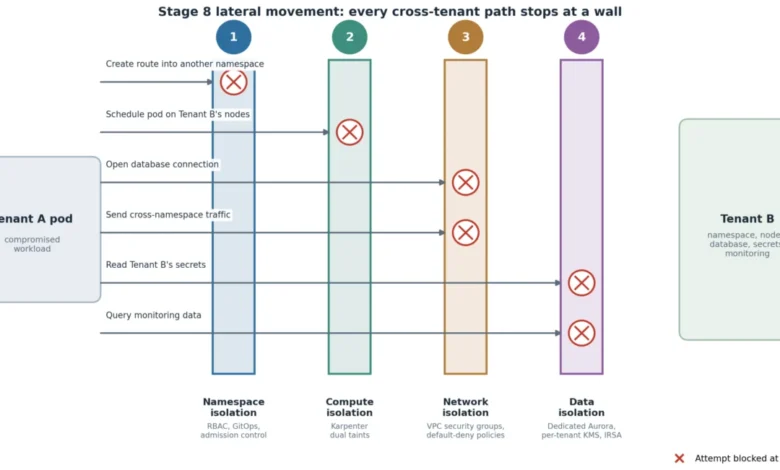
ReadyOn maps its defense mechanisms directly against a comprehensive 10-stage multi-tenant threat model aligned with MITRE ATT&CK techniques. The most critical inflection point within this model occurs during Stage 8: Lateral Movement. In this scenario, an unauthorized process operating inside a compromised Tenant A pod attempts to breach the boundary to access Tenant B’s resources.
To prove the efficacy of the Four Walls model, ReadyOn subjects its infrastructure to regular, rigorous adversarial red-team exercises. During these simulations, testers assume a compromised pod with elevated privileges and attempt to break through all four isolation layers. To date, internal and external audits have confirmed that zero test scenarios have successfully established a cross-tenant breach path. Every simulated attack vector—whether attempting cross-namespace API calls, unauthorized pod scheduling, cross-tenant database connections, or secret retrieval—is definitively terminated at the specific numerical wall designed to block it.
Workload Hardening and the GitOps Security Control Plane
Complementing the Four Walls architecture, ReadyOn enforces strict workload hardening across all container deployments. Every container executing within the Harmony platform adheres to Kubernetes Pod Security Standards configured at the "restricted" profile level. Containers are explicitly mandated to run as non-root users, root filesystem modifications are disabled, privilege escalation is strictly forbidden, and dangerous Linux kernel capabilities are systematically dropped.
By treating the Git repository as the single source of truth for the entire cluster state, ReadyOn eliminates manual configuration errors. Secrets are never committed to version control; instead, the External Secrets Operator dynamically resolves references to secure storage in AWS Secrets Manager at deployment time.
Broader Industry Implications and Future Outlook
The introduction of ReadyOn’s Four Walls model offers a vital architectural blueprint for organizations seeking to scale multi-tenant software-as-a-service (SaaS) applications on Amazon EKS without compromising security, operational velocity, or cost efficiency. As enterprises increasingly migrate highly regulated workloads—spanning financial services, healthcare, and human resources—into cloud-native environments, traditional perimeter defenses are no longer sufficient.
Industry analysts note that ReadyOn’s methodology bridges the historic gap between the rapid deployment benefits of Kubernetes multi-tenancy and the rigorous isolation demands of enterprise compliance frameworks. By proving that defense-in-depth can be systematically engineered by layering native AWS and Kubernetes services, ReadyOn sets a new standard for cloud security architecture. As cyber threats continue to evolve in sophistication, models that combine hardware-level networking controls, dedicated compute scheduling, and isolated data tiers will likely become the mandatory industry standard for mission-critical enterprise platforms.
Related posts: