How Markus Eder’s The Ultimate Run is Revolutionizing Video AI and Granular Media Analysis


The intersection of extreme sports cinematography and artificial intelligence has yielded a groundbreaking framework for digital media processing. Markus Eder’s critically acclaimed ten-minute ski film, The Ultimate Run, has emerged as the definitive benchmark for engineers developing automated video analysis systems. By analyzing how artificial intelligence systems parse complex visual media, computer vision researchers and video infrastructure platforms are redefining the foundational building blocks of digital video architecture.
The Complexity of Visual Data Processing
In the modern digital landscape, the volume of video data generated daily demands unprecedented computational efficiency. A standard one-hour video recording captured at 30 frames per second contains approximately 108,000 individual frames. Feeding every single image into a heavy vision model is economically unviable and technically inefficient, leading to massive latency and redundant processing of static pixels that add no contextual value.
Engineers at video infrastructure and artificial intelligence platforms have spent the past year confronting this core challenge. The overarching objective in video AI workflow design is deceptively simple yet technically demanding: provide the foundational machine learning model with the smallest possible slice of video data while retaining absolute context required to answer a specific query.
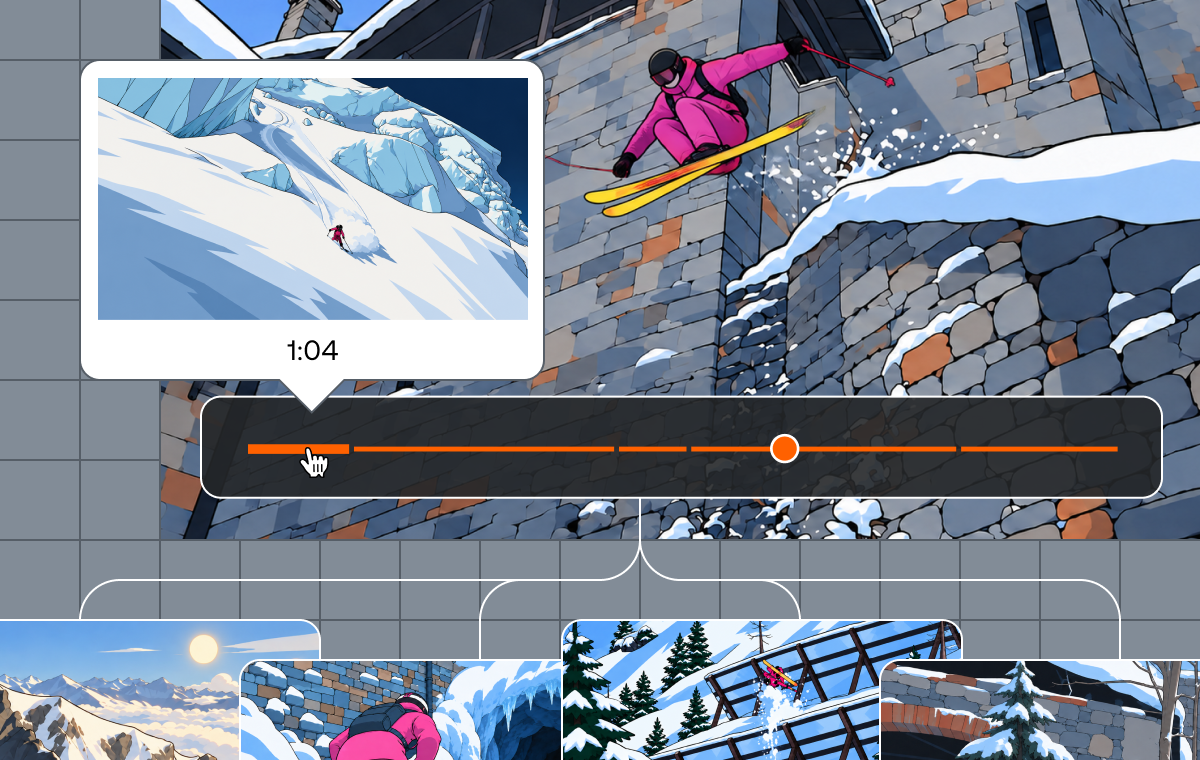
To achieve this, developers break down video assets into hierarchical layers—frames, shots, scenes, moments, and chapters. Each tier serves a distinct computational and functional purpose, ensuring that systems do not treat a fast-paced sports montage the same way they treat a static corporate lecture or a long-form audio podcast.
Granular Building Blocks: From Individual Frames to Complex Scenes
The architecture of modern video intelligence relies on selective sampling, beginning with the individual frame. A single frame is sufficient for atomic queries, such as identifying a brand logo, evaluating safety compliance through automated content moderation, or selecting optimal video thumbnails. However, frames fail entirely when the query depends on temporal sequence, trajectory, or motion dynamics. A single frame can capture a skier mid-air during a backflip, but it cannot confirm whether the athlete successfully landed or navigated out of a hazard.

To capture visual state changes without incurring the prohibitive cost of analyzing every frame, systems utilize shot detection algorithms. A shot represents a continuous take bounded by two camera cuts. By mapping these boundaries, automated workflows create an ordered index of visual transitions. This methodology prevents fixed-interval sampling from completely missing rapid artistic cuts, abrupt terrain shifts, or fast-paced athletic maneuvers.
Moving higher up the structural hierarchy, scenes aggregate neighboring shots that share thematic, narrative, or environmental cohesion. While a shot identifies a pixel change, a scene recognizes that disparate camera angles within a glacial ice cave or a snow park belong to a single, unified geographic or narrative sequence. By combining visual boundaries with auxiliary data streams—such as audio transcripts and metadata—multimodal AI models can group complex stretches of media into coherent, searchable segments.

Product-Facing Intelligence: Key Moments and Dynamic Chapters
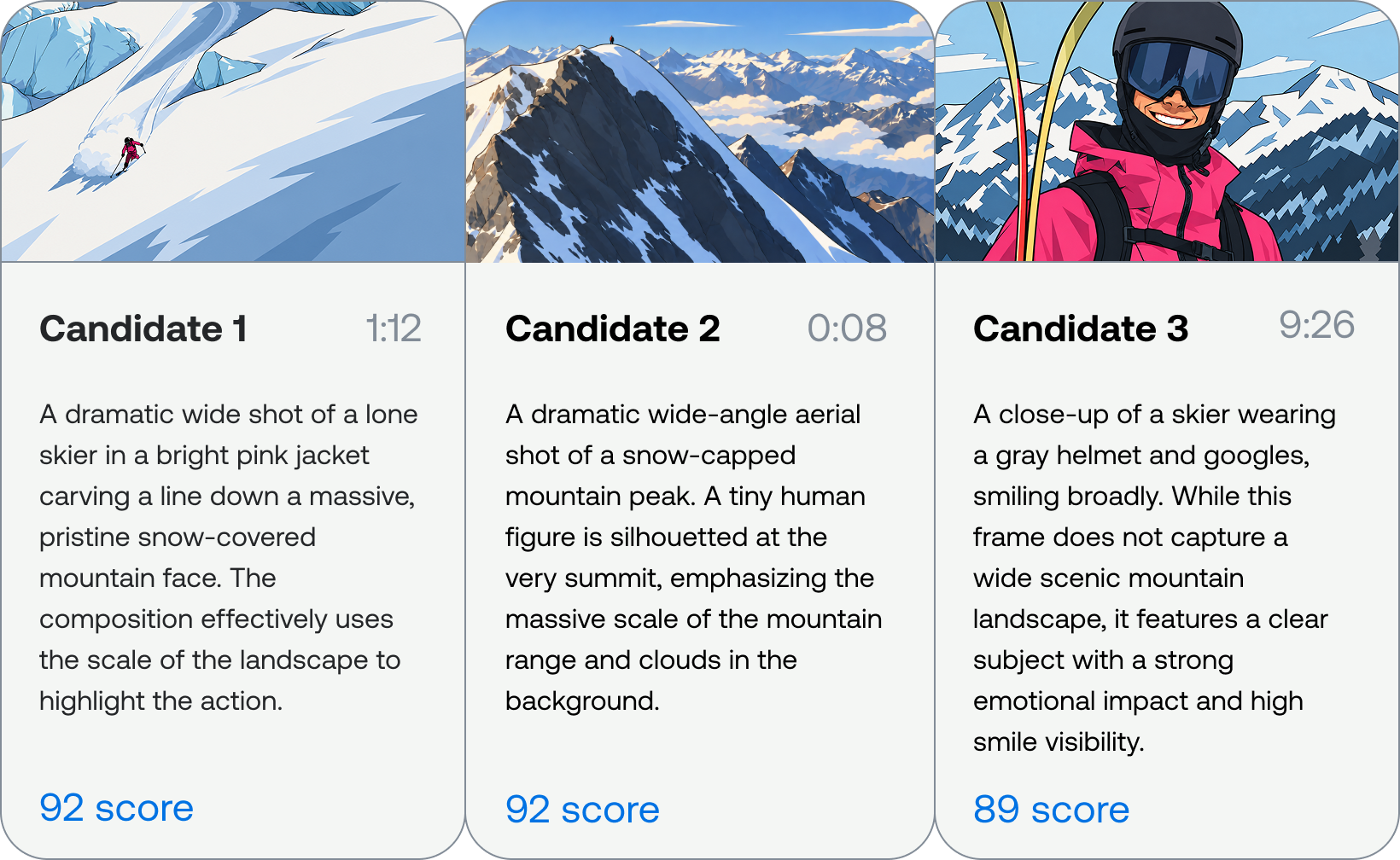
While frames, shots, and scenes describe the intrinsic technical properties of a media asset, moments and chapters cater directly to user experience and navigation. Automated systems designed to find key moments evaluate continuous ranges of video to isolate standalone highlights, such as the complete approach, takeoff, and landing of an extreme skiing trick. These snippets are meticulously formatted for downstream consumer applications, including automated clip generation and social media highlight reels.
Conversely, chapter generation addresses the structural navigation of long-form content. By dividing assets into logical, named sections, platforms provide viewers with an interactive table of contents. While transcript data traditionally drives chapter segmentation in speech-heavy content like podcasts, visually dominant media relies heavily on environmental shifts and scene-detection models to establish meaningful chapter demarcations.

Broader Industry Implications and the Future of Embeddings
The implications of hierarchical video parsing extend far beyond extreme sports documentation. Media enterprises, streaming networks, and digital archives face mounting pressure to make vast libraries instantly searchable. The methodology of starting with inexpensive, low-level signals—such as shot boundaries—to narrow search spaces before deploying resource-intensive models fundamentally changes the economics of video processing at scale.
This granular approach directly impacts vector embeddings, which convert text, images, and multimodal inputs into mathematical vectors for semantic retrieval. When a user queries a video database for a specific event—such as a skier navigating an underground ice tunnel—the retrieval system must determine the appropriate granularity of the result. Returning an entire feature-length film lacks precision, whereas returning a single millisecond frame lacks necessary context. Balancing these parameters ensures that search results are both semantically broad enough to make narrative sense and precise enough for direct application.

Ultimately, the technical analysis of high-motion visual content demonstrates that automated video intelligence is not a monolithic task. By strategically deploying frames, shots, scenes, moments, and chapters based on the specific question at hand, modern AI workflows achieve unprecedented efficiency. As digital video consumption continues to expand exponentially, these structured frameworks will form the absolute bedrock of how machines understand, organize, and interact with visual media.