High-Severity Vulnerability in Elementor Website Builder Exposes Over Two Million WordPress Sites to Unauthorized Administrative Takeover

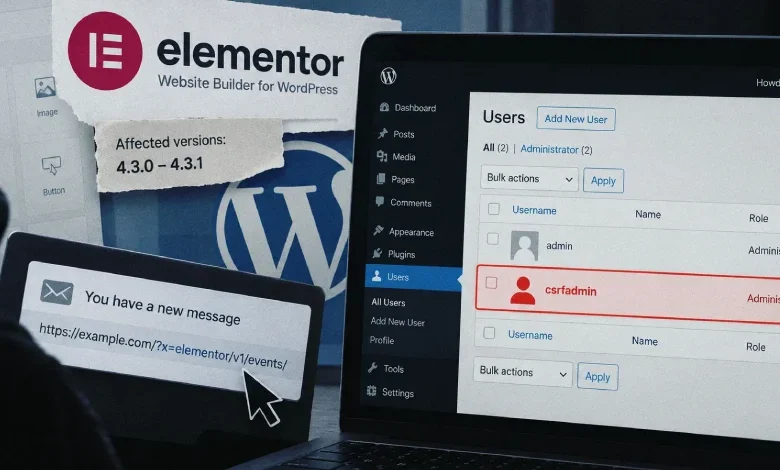
A critical security vulnerability has been identified within the Elementor Website Builder, one of the most widely utilized plugins in the WordPress ecosystem. This flaw, classified as a Cross-Site Request Forgery (CSRF), potentially allows unauthenticated attackers to hijack administrative privileges on affected websites. Given Elementor’s massive install base, which spans over 10 million active sites, the discovery has prompted urgent calls for administrators to update their software immediately to mitigate the risk of site compromise.
The vulnerability, which carries a CVSS severity score of 8.8, is limited to specific iterations of the plugin: versions 4.3.0 and 4.3.1. Security researchers estimate that more than 2 million websites were operating on these vulnerable versions at the time of discovery. The flaw effectively bypasses the standard security measures intended to verify that actions performed on a site were explicitly authorized by an authenticated user.
Technical Mechanics of the CSRF Flaw
The root cause of the vulnerability lies within the plugin’s "Editor Events" module, which was introduced to streamline communication between the WordPress backend and the Elementor editor interface. Security analysis conducted by the vulnerability research firm Patchstack revealed that this module contains a flawed logic implementation regarding REST API request validation.
In a standard, secure WordPress environment, CSRF protection mechanisms ensure that sensitive actions—such as creating a new user or changing site settings—require a unique, non-guessable token. However, the Editor Events module was configured to explicitly bypass these security checks if the string "elementor/v1/events/" appeared anywhere within the request URI.
Because the request URI is processed in a way that includes user-controllable query parameters, an attacker can craft a malicious link that forces a logged-in administrator to execute unintended actions. By appending the bypass string to the end of a legitimate-looking URL, the attacker effectively tricks the WordPress REST API into ignoring CSRF protections for that specific request.
The simplicity of the exploit is particularly concerning. The malicious payload does not require the attacker to host a malicious website or inject complex JavaScript into the target server. Instead, the exploit can be delivered through a standard anchor tag embedded in an email, a forum post, or even a comment section. If an administrator with an active session clicks the link, their browser automatically transmits the request to the WordPress API with their elevated credentials, enabling the attacker to perform actions such as creating a new administrator account, altering page content, or installing malicious plugins.
Chronology of Discovery and Remediation
The timeline of this incident reflects the standard practices of responsible disclosure in the cybersecurity industry. The vulnerability was discovered and reported by a security researcher operating under the alias "Saggre."
Following the disclosure, the development team behind Elementor began the process of auditing the affected code module. By the week of September 26, 2026, the company officially released version 4.3.2, which introduced a patch that tightened the validation logic for the Editor Events module.

- Version 4.3.0–4.3.1 (Pre-Patch): The vulnerable versions were distributed, introducing the flawed logic that permitted the CSRF bypass.
- Discovery Phase: Independent researchers identified the logic error while investigating the security posture of the Editor Events module.
- Disclosure and Coordination: The vulnerability was reported to the Elementor team, initiating the development of a security update.
- Remediation (September 2026): Elementor released version 4.3.2, effectively closing the loophole by ensuring that the REST API properly enforces CSRF tokens regardless of the presence of specific URI strings.
Implications for the WordPress Ecosystem
The scale of this vulnerability highlights the inherent risks associated with the modular nature of WordPress. With over 40% of the internet powered by WordPress, the plugins that extend its functionality become high-value targets for threat actors. Elementor, as a market leader in the page builder category, is an attractive target because it is installed on a diverse range of sites, from small personal blogs to high-traffic corporate portals.
The implications of a successful exploit are severe. If an attacker creates an administrative account, they gain full control over the site’s database and file system. This level of access is often the precursor to more damaging cyberattacks, such as the deployment of ransomware, the redirection of site traffic to phishing pages, or the mass distribution of malware to unsuspecting visitors.
Furthermore, this incident underscores the importance of the "least privilege" principle and the need for constant monitoring. Even when using reputable plugins, the sheer complexity of modern web development means that logic errors can occur. For site administrators, the primary defense remains a rigorous update schedule. Patchstack’s analysis confirms that websites running versions prior to 4.3.0 are not affected, as those versions did not include the flawed Editor Events module, yet these legacy versions likely lack other security improvements, making regular updates the only viable path to long-term security.
Broader Cybersecurity Context
Cross-Site Request Forgery has remained a persistent challenge for web developers for decades. While browsers have introduced features such as the SameSite cookie attribute to help mitigate these attacks, the implementation of these protections within complex plugins often leaves gaps.
The Elementor case serves as a textbook example of how a seemingly minor "convenience" feature—in this case, an event listener designed to simplify API communication—can create a massive security hole if not properly sandboxed. When developers prioritize the speed or ease of communication between components over strict security boundary enforcement, the result is often a vulnerability that can be weaponized by anyone with basic web literacy.
Security analysts emphasize that this event should not be viewed as a failure of Elementor alone, but as a reminder of the "shared responsibility" model in web hosting. Plugin developers are responsible for writing secure code, but site administrators are ultimately responsible for the maintenance of their installations. Relying on automated update services or security-focused plugins that alert administrators to pending patches is now considered a mandatory best practice.
Expert Recommendations and Next Steps
For administrators who suspect their sites may have been running a vulnerable version of Elementor during the window of exposure, the following steps are recommended:
- Immediate Update: Ensure that Elementor is updated to version 4.3.2 or the latest available stable release immediately.
- Audit User Accounts: Review the "Users" section of the WordPress dashboard to identify any unauthorized accounts created recently. Look for unfamiliar usernames, suspicious email addresses, or accounts with administrative privileges that were not explicitly created by the site owner.
- Check Logs: Review access logs for unusual POST requests directed at the
/wp-json/endpoint, particularly those involving user creation or permission modifications. - Review Permissions: If a breach is suspected, reset passwords for all existing administrative accounts and ensure that Multi-Factor Authentication (MFA) is enabled for all users.
- Monitor for Persistence: Even after deleting a rogue account, check for backdoors, such as hidden admin users, modified theme files, or unauthorized API keys that may have been generated during the period of compromise.
The speed at which Elementor responded to the report from Saggre is a positive indicator of the maturity of the plugin’s security team. However, the challenge for the WordPress community remains the "long tail" of site maintenance—thousands of websites are often left unmanaged, running outdated software for years. As automated scanning tools used by malicious actors become more sophisticated, the window of time between the announcement of a vulnerability and the exploitation of unpatched sites continues to shrink.
Ultimately, this incident highlights that the security of a WordPress site is only as strong as its most vulnerable component. As the digital landscape continues to evolve, the ability to rapidly identify, disclose, and patch such flaws will remain the defining characteristic of a secure web environment. For now, the focus is on universal adoption of the latest security patch, ensuring that the 2 million affected sites regain their integrity and defend against potential exploitation attempts.
Related posts: