ReadyOn Unveils the Four Walls Architecture to Revolutionize Multi-Tenant Security on Amazon EKS

The modern enterprise software landscape increasingly relies on multi-tenant cloud platforms to optimize infrastructure costs, maximize resource utilization, and accelerate operational deployment. However, scaling these shared environments while maintaining uncompromising data security remains one of the most formidable challenges in enterprise IT. Addressing this critical vulnerability, ReadyOn, an AWS Partner specializing in intelligent workforce orchestration for Fortune 100 enterprises, has officially detailed its advanced multi-tenant isolation framework known as the "Four Walls" model. Operating atop Amazon Elastic Kubernetes Service (Amazon EKS), the architecture establishes a multi-layered defense-in-depth strategy designed to protect highly sensitive data—such as national payroll records, intricate organizational hierarchies, and large-scale workforce analytics—spanning hundreds of thousands of corporate employees.
For years, cloud architects have wrestled with the inherent security limitations of Kubernetes. Designed originally for flexibility and developer velocity rather than hard multi-tenancy, default Kubernetes deployments present a notoriously complex attack surface. Historically, upstream configurations have permitted anonymous requests to reach the API server, allowed pods to execute with root privileges out of the box, and lacked native network policies until explicitly provisioned by administrators. While hardening single-tenant clusters is a well-established engineering challenge, transitioning to a multi-tenant paradigm fundamentally alters the core threat model. The primary security objective shifts dramatically from preventing external perimeter breaches to ensuring absolute internal isolation—specifically, guaranteeing that a compromise of Tenant A can never result in unauthorized access to Tenant B’s data or infrastructure.
Historically, the cloud-native ecosystem has relied heavily on Kubernetes namespaces as the primary logical boundary for multi-tenancy. Yet, Kubernetes designers never intended namespaces to serve as a robust, standalone security barrier. For enterprises like ReadyOn, whose Harmony platform processes mission-critical human resources data for the world’s largest companies, relying on a single isolation layer carries unacceptable business and regulatory risks. A cross-tenant data breach would not only shatter client trust but also trigger complex, multi-jurisdictional regulatory compliance mandates and severe legal liabilities. Recognizing that the stakes demanded a fortification far superior to a single defensive wall, ReadyOn engineering teams formulated a compound security architecture that integrates four independent barriers operating across disparate layers of the technology stack.
The Genesis and Evolution of the Four Walls Model
The development of the Four Walls model emerged from a rigorous internal evaluation of ReadyOn’s ten-stage multi-tenant threat model, which aligns closely with standardized frameworks such as MITRE ATT&CK. As cloud-native applications scale, the attack vectors targeting container orchestration platforms grow exponentially. ReadyOn’s leadership recognized that any single layer of security—no matter how rigorously configured—remains susceptible to zero-day vulnerabilities, human misconfigurations, or sophisticated privilege escalation techniques.
To mitigate these systemic risks, the engineering team designed an architecture where four distinct, independent security layers must be simultaneously compromised to breach a tenant boundary. These layers span the Kubernetes API, the underlying compute scheduler, the AWS software-defined networking layer, and the discrete data persistence tier. By decoupling these controls, ReadyOn ensures that even if an attacker successfully breaches the outermost layer, subsequent barriers immediately halt lateral movement, effectively neutralizing the threat sequence at its earliest stages.
Wall 1: Namespace Isolation and GitOps-Enforced Consistency
The first barrier in ReadyOn’s model operates at the most visible boundary in Kubernetes: the namespace. While acknowledging the inherent limitations of namespaces as security perimeters, ReadyOn utilizes them as the logical foundation upon which all subsequent isolation layers are built. To eliminate configuration drift and human error, the entire provisioning lifecycle is governed by Argo CD and an automated GitOps pipeline.
When ReadyOn onboards a new enterprise tenant, engineers introduce a single declarative entry into a centralized configuration manifest stored securely within a Git repository. This automated workflow instantly generates all required namespace resources, network policies, Role-Based Access Control (RBAC) bindings, resource quotas, and secret configurations. Consequently, the concept of a "legacy" tenant with weaker security parameters is entirely eliminated; every single tenant receives an identical, hardened security posture by direct construction.
Furthermore, RBAC policies enforce strict least-privilege access, ensuring that tenant principals cannot list, get, or modify resources residing in foreign namespaces. Advanced admission controllers validate all incoming resource definitions against stringent security baselines, systematically blocking privileged configurations and unauthorized object types such as DaemonSets or ClusterRoles. To maintain continuous compliance, the GitOps controller executes continuous reconciliation loops, automatically reverting any manual cluster modifications or configuration drifts within seconds. Under this operational model, human operators are strictly prohibited from executing manual commands like kubectl apply against production environments.
Wall 2: Compute Isolation via Karpenter-Managed Dedicated Node Pools
Moving below the Kubernetes API layer, Wall 2 addresses compute isolation, ensuring that tenant applications never share physical or virtual worker nodes. ReadyOn achieves this hardware-level segregation by leveraging Karpenter, an open-source, high-performance Kubernetes cluster autoscaler built for AWS.
ReadyOn’s Karpenter provisioners enforce a strict dual-taint strategy for node provisioning. Every compute node is stamped with two distinct taints: a unique tenant-identifier taint (e.g., tenant=acme-corp) and a specific workload-type taint (e.g., workload=frontend). For a containerized pod to successfully schedule, it must explicitly tolerate both taints. Consequently, Tenant A’s frontend workloads are physically separated from Tenant A’s batch processing workloads, and both remain completely isolated from Tenant B’s underlying infrastructure.
To prevent malicious actors from bypassing this control, admission controllers validate that a pod’s requested tolerations precisely match its assigned namespace identity, entirely preventing the scheduler from executing cross-tenant pod placement. At the operating system level, all application nodes enforce Instance Metadata Service Version 2 (IMDSv2) with strict hop limits, effectively neutralizing container escape attempts targeting the instance metadata endpoint. Moreover, instance IAM roles are tightly scoped to single-tenant resource boundaries, while dedicated platform nodes run on managed node groups isolated by platform-specific taints that tenant workloads cannot tolerate.
Wall 3: Network Isolation at the Amazon VPC and Security Group Layer
While the first two walls operate primarily within the Kubernetes abstraction layer, Wall 3 drops entirely below the container orchestrator, enforcing rigid boundaries at the Amazon Virtual Private Cloud (Amazon VPC) and AWS security group level. This infrastructure tier operates independently of the Kubernetes control plane, meaning that a compromised pod possessing limited API access cannot manipulate or disable these network boundaries.
Every individual tenant’s Amazon Aurora database cluster is shielded by a dedicated security group that explicitly permits inbound connections exclusively from the security group attached to that specific tenant’s application worker nodes. As a result, Tenant A’s compute nodes are physically incapable of opening a TCP connection to Tenant B’s database. This network-level isolation is enforced directly by the AWS software-defined network, requiring an attacker to compromise the underlying cloud networking infrastructure itself to traverse the boundary.
The underlying VPC architecture is meticulously segmented into four distinct tiers: a public perimeter tier housing only load-set load balancers; an application tier containing EKS worker nodes residing in private subnets; a database tier comprising isolated Aurora clusters completely devoid of internet access; and a highly secure control plane tier housing private EKS API endpoints restricted strictly to VPN access authenticated via OIDC and multi-factor authentication (MFA). Additionally, strict default-deny Kubernetes network policies govern inter-pod communication, ensuring that tenant pods communicate exclusively within their designated namespace and with explicitly authorized platform services, with all anomalous traffic captured via Amazon VPC Flow Logs.
Wall 4: Data Isolation and the Ultimate Defense with Amazon Aurora
The final and most critical barrier in ReadyOn’s architecture addresses the ultimate asset: the data persistence layer. While the preceding three walls collectively prevent unauthorized users from reaching foreign environments, Wall 4 ensures absolute data segregation even in the hypothetical event that all perimeter defenses fail.
Many multi-tenant architectures utilize shared database topologies, placing the entire burden of data isolation on application-layer query logic. In such environments, a single overlooked WHERE tenant_id = ? clause can result in catastrophic data leakage. To eliminate this systemic risk entirely, ReadyOn deploys dedicated Amazon Aurora clusters for every individual tenant. There are no shared tables, and consequently, no row-level filters to inadvertently omit. Tenant A’s application code physically lacks the endpoint credentials, network routing paths, and database drivers required to establish a connection to Tenant B’s data store.
Furthermore, this dedicated database model enables granular cryptographic separation through unique AWS Key Management Service (AWS KMS) encryption keys assigned per tenant. Data at rest for each enterprise client is encrypted using a distinct KMS key, ensuring that even in the unlikely event of raw storage exposure, one tenant’s key cannot decrypt another client’s information.
Complementing this database isolation is the implementation of IAM Roles for Service Accounts (IRSA). Workloads entirely eliminate long-lived access keys, authenticating instead to AWS APIs using short-lived credentials issued dynamically by the AWS Security Token Service (AWS STS) via OIDC federation between the EKS cluster and IAM. Credentials expire within minutes, drastically reducing the window of opportunity for credential theft. Finally, per-tenant observability pipelines route all logs, metrics, and traces through OpenTelemetry to dedicated backends, ensuring that operational telemetry data remains strictly compartmentalized.
Threat Analysis and Adversarial Validation
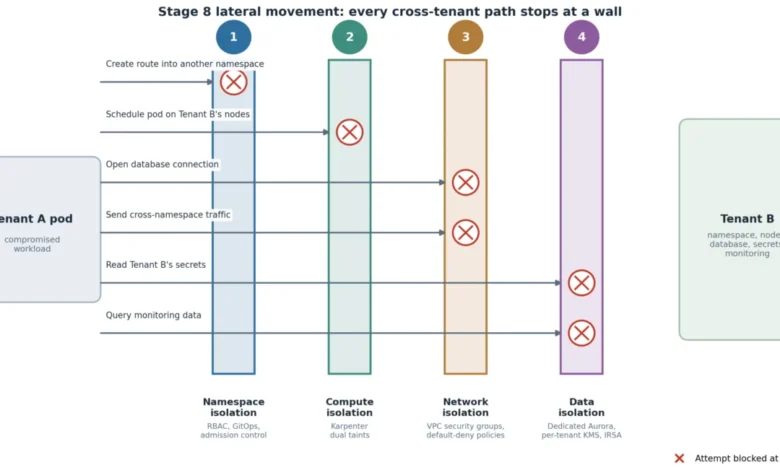
ReadyOn’s comprehensive defensive posture undergoes continuous empirical validation through rigorous adversarial testing exercises. During simulated red-team engagements, security operators assume a worst-case scenario: a compromised tenant pod operating with elevated internal access attempting to execute lateral movement across the environment.
In these controlled simulations, every attempted attack vector systematically terminates at the corresponding defensive wall. An adversary attempting to route traffic into a foreign namespace is blocked at Wall 1. Attempts to schedule malicious pods onto neighboring compute nodes are rejected at Wall 2. Unauthorized cross-namespace network requests and database connection attempts are instantly dropped at Wall 3. Finally, any efforts to query monitoring telemetry or exfiltrate encrypted data secrets are thwarted at Wall 4. To date, internal adversarial audits and penetration testing exercises have yielded a zero-failure rate, with no test successfully breaching the multi-tenant boundaries.
Industry Implications and Future Outlook
The publication of ReadyOn’s Four Walls reference architecture arrives at a pivotal moment for enterprise cloud computing. As organizations increasingly migrate mission-critical, highly regulated workloads to Kubernetes-driven environments, the industry-wide demand for verifiable, zero-trust multi-tenancy has never been more acute.
Security analysts and cloud architects note that ReadyOn’s methodology successfully resolves the historical dichotomy between operational efficiency and uncompromising security. By demonstrating that native cloud services—such as EKS, Karpenter, Amazon VPC, and Amazon Aurora—can be systematically orchestrated to build defense-in-depth constructs, ReadyOn provides a blueprint for scalable, secure enterprise software delivery. As regulatory scrutiny intensifies globally, frameworks that eliminate single points of failure and enforce cryptographic and network-level isolation will undoubtedly establish the benchmark for modern cloud-native engineering.