Redefining Multi-Tenant Cloud Security: How ReadyOn Implemented a Four-Wall Isolation Model on Amazon EKS

As enterprise software adoption accelerates across the Fortune 100, the technical challenges of securing multi-tenant cloud environments have reached a critical threshold. ReadyOn, an AWS Partner specializing in intelligent labor orchestration platforms, has unveiled a comprehensive architectural framework designed to address the inherent security vulnerabilities of shared infrastructure. Operating a multi-tenant platform on Amazon Elastic Kubernetes Service (Amazon EKS) that manages highly sensitive enterprise data—such as payroll records, organizational hierarchies, and operational analytics for hundreds of thousands of employees—ReadyOn developed a compound defense mechanism known as the "Four Walls" model. This architecture establishes rigid, independent barriers across multiple abstraction layers to eliminate cross-tenant data exposure risks.
The evolution of enterprise cloud computing has long favored multi-tenancy due to its superior operational velocity and cost efficiency. However, the foundational design of Kubernetes presents significant security hurdles out of the box. Historically, upstream Kubernetes permitted anonymous requests to reach the API server, defaulted to running pods with root privileges, and lacked inherent network policies unless explicitly provisioned by administrators. While securing single-tenant clusters is a well-documented engineering challenge, introducing multi-tenancy fundamentally alters the threat model. The primary concern shifts from preventing external unauthorized access to ensuring absolute isolation between tenants, such as preventing Tenant A from accessing Tenant B’s data assets.
Conventionally, multi-tenant Kubernetes platforms have relied heavily on namespaces as a primary isolation boundary. However, Kubernetes architects never designed namespaces to serve as robust security boundaries. For ReadyOn’s Harmony platform, which processes mission-critical workforce data, a single breach or cross-tenant data leak could trigger severe regulatory obligations across multiple jurisdictions and irrevocably damage the trust placed in the technology by enterprise clients. Recognizing that standard namespace partitioning was insufficient, the engineering team engineered a multi-layered security paradigm to enforce zero-trust principles without sacrificing operational performance.
The Chronology and Architecture of the Four Walls Model
The development of the Four Walls model represents a systematic maturation of ReadyOn’s cloud security infrastructure, evolving from standard container orchestration practices to an advanced, multi-tiered defense-in-depth strategy. The architecture places four independent barriers between tenants, each operating at a distinct layer of the stack and requiring fundamentally different attack vectors to breach.
Wall 1 operates at the Kubernetes API layer through namespace isolation enforced by GitOps. While acknowledging the limitations of namespaces as standalone security features, ReadyOn uses them as the logical foundation for all subsequent defenses. Every tenant namespace is automatically provisioned via Argo CD ApplicationSets linked directly to a centralized configuration repository in Git. When a new tenant is onboarded, a single entry in the configuration manifest triggers the automated generation of namespaces, network policies, RBAC bindings, resource quotas, and secret configurations. This eliminates the risk of "legacy" tenants operating under weaker security policies. Furthermore, a self-healing GitOps controller continuously reconciles the live cluster state against the declared state, automatically reverting any manual modifications or configuration drifts within seconds.
Wall 2 shifts the security paradigm from the API layer down to the compute layer, ensuring that tenant workloads do not share underlying physical or virtual machines. Utilizing Karpenter, an automated Kubernetes cluster autoscaler, ReadyOn implements a dual-taint strategy. Karpenter provisioners create nodes characterized by two distinct taints: a tenant-identifier taint (e.g., tenant=acme-corp) and a workload-type taint (e.g., workload=frontend). Consequently, pods must possess tolerations for both taints to successfully schedule, ensuring that Tenant A’s frontend nodes are physically and logically segregated from its batch nodes, and entirely separated from Tenant B’s infrastructure. Additional hardening includes IMDSv2 enforcement with reduced hop limits, scoped instance IAM roles, and admission controller validation that blocks unauthorized toleration claims.
Wall 3 descends below the Kubernetes abstraction layer entirely, enforcing strict network security at the Amazon Virtual Private Cloud (Amazon VPC) and security group levels. The architecture divides the VPC into four distinct tiers: a public perimeter tier for load balancers, an application tier housing EKS worker nodes in private subnets, a database tier containing isolated Aurora clusters with no internet access, and a control plane tier restricted to private EKS API endpoints accessible solely via VPN with multi-factor authentication (MFA). Each tenant’s Amazon Aurora database is guarded by a dedicated security group that accepts inbound connections exclusively from the application security group tied to that specific tenant’s worker nodes. Additionally, default-deny Kubernetes network policies and Amazon VPC Flow Logs ensure that all unauthorized inter-namespace traffic is systematically blocked and recorded.
Wall 4 addresses the ultimate data layer, maintaining absolute isolation even if the preceding three layers were somehow compromised. Rather than utilizing a shared database architecture—which places the entire security burden on application-level query logic and leaves systems vulnerable to missing filter clauses—ReadyOn provisions dedicated Amazon Aurora clusters for every tenant. This eliminates the possibility of cross-tenant database access, as separate tenants lack the endpoints, credentials, and network paths to reach external data stores. Moreover, each tenant’s data-at-rest is encrypted using unique AWS Key Management Service (AWS KMS) keys, ensuring cryptographic segregation. Workloads authenticate to AWS services using short-lived credentials issued via AWS Security Token Service (AWS STS) through OIDC federation, entirely removing long-lived access keys from application containers.
Industry Implications and Security Analysis
Cybersecurity analysts and cloud architecture experts have closely monitored the deployment of advanced defense-in-depth frameworks like ReadyOn’s Four Walls model, noting its alignment with modern zero-trust mandates outlined by organizations such as the National Institute of Standards and Technology (NIST) and the Cybersecurity and Infrastructure Security Agency (CISA).
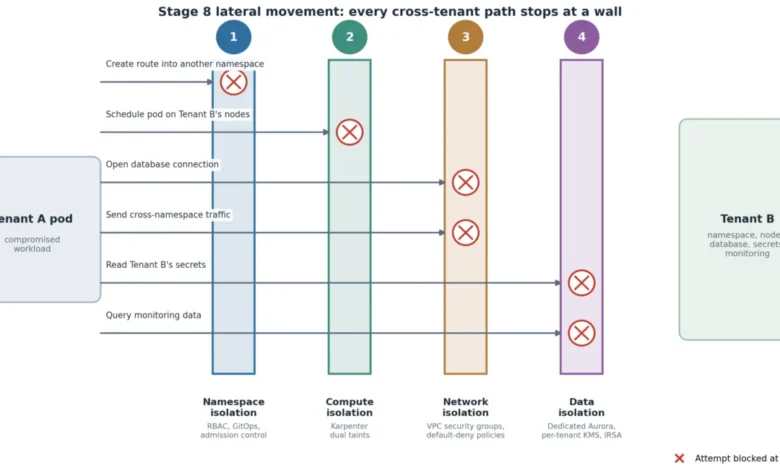
By mapping internal defenses against standardized frameworks such as the MITRE ATT&CK matrix, ReadyOn’s engineering leadership evaluated critical threat vectors, specifically focusing on lateral movement stages (such as Stage 8 in their internal threat models). In simulated adversarial exercises where security testers assumed compromised tenant pods with elevated local privileges, the compound architecture consistently intercepted and neutralized unauthorized cross-tenant pathways. Attempts to create routes into foreign namespaces were halted at Wall 1; scheduling pods on foreign worker nodes failed at Wall 2; opening unauthorized database connections or routing cross-namespace traffic was blocked at Wall 3; and attempts to retrieve sensitive secrets or query isolated monitoring backends were terminated at Wall 4.
The broader market implications of this architectural approach suggest a significant shift in how enterprise software vendors will design multi-tenant systems moving forward. As regulatory frameworks regarding data privacy and residency tighten globally—exemplified by stringent compliance mandates in financial services, healthcare, and human resources—relying on software-level tenancy boundaries is increasingly viewed as an unacceptable enterprise risk. By leveraging native cloud primitives across independent service domains on Amazon EKS, organizations can achieve physical and logical isolation levels previously thought exclusive to single-tenant deployments, all while preserving the cost efficiencies and operational agility of multi-tenancy.
Conclusion and Future Outlook
ReadyOn’s implementation of the Four Walls model demonstrates that robust multi-tenant security on cloud infrastructure is achievable through disciplined engineering and rigorous defense-in-depth principles. By combining Kubernetes RBAC, Karpenter-managed compute pools, VPC-level network controls, and dedicated database encryption tiers, the platform establishes a comprehensive barrier against complex attack chains. As enterprises continue migrating sensitive workloads to cloud-native environments, reference architectures of this caliber provide a vital blueprint for balancing uncompromising security with high-performance operational scaling.