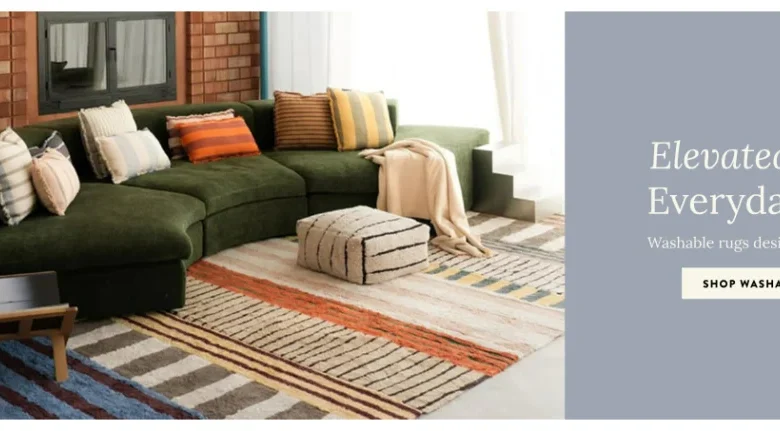
The logistics of online home furnishings retail have long been defined by the cumbersome nature of shipping oversized items. For years, the industry standard for transporting area rugs—particularly large, hand-tufted pieces—has been to roll them tightly, creating long, heavy cylinders that logistics experts often describe as "Tootsie Rolls." However, Elevated Brands Group, the parent company of retailers Rugs Direct and Lightopia, has recently moved to dismantle this industry convention. By transitioning to a folded shipping model for its hand-tufted inventory, the retailer has achieved significant operational efficiencies, reduced shipping overhead, and mitigated the impact of volatile carrier surcharges.
Sharon Gautschi, chief merchandising officer at Elevated Brands Group, characterizes this procedural shift as a fundamental change in how the company approaches the intersection of supply chain logistics and customer experience. While the move from rolling to folding may appear purely operational, the financial and logistical implications are substantial, reflecting a broader trend among e-commerce retailers to optimize packaging for cost-efficiency and environmental sustainability.
The Logistics of the "Tootsie Roll" Problem
The traditional method of rolling rugs has historically been preferred by vendors to avoid creasing, yet it creates a specialized set of challenges for carriers and retailers. A standard 9-by-12-foot hand-tufted rug, when rolled, produces a package that is exceptionally long and unwieldy.
From a shipping perspective, these dimensions trigger "dimensional weight" pricing and "oversized" surcharges, which are among the most aggressive fees levied by major logistics providers. Furthermore, these packages are prone to "telescoping," where the rug slides partially out of its protective packaging during transit. This not only risks damaging the product but also leads to additional penalties from carriers, who often assess surcharges based on the length and weight of the package.
Gautschi notes that the psychological barrier to this transition was significant for many vendors who feared that folding would result in permanent damage to the structural integrity of the rugs. However, after extensive collaboration with the retailer’s supplier network, it was determined that the majority of hand-tufted rugs, regardless of backing stiffness, possess sufficient pliability to be folded safely. By standardizing the folding process, Rugs Direct has effectively eliminated the most egregious shipping penalties, turning a logistical liability into a measurable cost-saving initiative.
Chronology of Operational Evolution
The initiative to overhaul shipping procedures did not occur in a vacuum but is part of a multi-year effort by Elevated Brands Group to refine its drop-ship model. Rugs Direct, which ranks No. 622 in the Digital Commerce 360 Top 1000 database, relies exclusively on a drop-shipping architecture. In this model, the retailer maintains the customer relationship and the digital storefront, while the vendors are responsible for the physical fulfillment of orders.
The chronology of this shift can be traced through the following phases:
- Vendor Assessment: Beginning in late 2023, the merchandising team conducted an audit of its entire vendor catalog to categorize rugs by material, pile density, and backing composition to determine which could withstand folding.
- Procedural Implementation: Throughout early 2024, the company initiated direct negotiations with every supplier to mandate new packaging standards. This required a re-education process for warehouse staff at various vendor sites.
- Validation and Scaling: By mid-2024, the company monitored return rates and quality control reports. Data indicated that the cost savings achieved through lower shipping fees significantly outweighed the negligible increase in returns caused by potential folding creases, which are generally temporary and dissipate once the rug is laid flat.
- Integration of AI Tools: Simultaneously, the company integrated AI-driven support systems, such as "Ask Cleo," to address customer inquiries regarding shipping lead times, effectively bridging the communication gap created by the drop-ship model.
Data-Driven Efficiency and Market Positioning
The impact of this shift is best viewed through the lens of modern retail metrics. In the competitive landscape of home furnishings, where Rugs Direct is also recognized as No. 492 in Digital Commerce 360’s AI Rankings, operational efficiency is a primary driver of profitability.
Shipping costs are one of the most volatile variables in the e-commerce equation. By controlling the dimensions of the final package, Rugs Direct has stabilized its shipping expenses. The retailer’s strategy is a direct response to the rising cost of last-mile delivery. When a parcel exceeds standard dimensions, carriers frequently impose "additional handling" surcharges. By forcing a shift to folding, the retailer has brought its packaging into a standard, manageable range that avoids these penalties.
Furthermore, the retailer’s commitment to transparency regarding shipping times is a strategic effort to manage consumer expectations. Unlike retailers with massive, centralized inventory systems like Walmart, which can guarantee precise delivery windows, drop-ship retailers often face variability in fulfillment. By choosing to market its products as "in stock and ready to ship," Rugs Direct focuses on the reliability of the vendor connection rather than the speed of a generic warehouse.
The Role of Artificial Intelligence in Customer Experience
Beyond physical logistics, Rugs Direct has invested heavily in the digital customer journey. The introduction of "Ask Cleo," an AI agent powered by large language models (LLMs), represents a strategic move to reduce the "buying lead time"—the period between a customer’s first interaction with a product and the final purchase.
The retail industry has observed that high-ticket home decor purchases are characterized by "conversational" shopping. Customers frequently require assistance with technical specifications, such as slope-ceiling requirements for lighting or the compatibility of materials. By feeding its comprehensive return policies and product-specific data into the LLM, Rugs Direct has enabled its AI to act as a virtual consultant.
Gautschi emphasizes that the goal is not merely to answer questions, but to encourage confident decision-making. If a customer at Lightopia understands the nuance of "color temperature" or the requirements for a slope-ceiling kit, they are statistically less likely to initiate a return. Given that the current average buying cycle for Rugs Direct is approximately eight days, and 14 days for Lightopia, the AI agent is tasked with compressing this timeline by providing immediate, accurate information.
Implications for the Home Furnishings Industry
The success of the folding initiative at Rugs Direct provides a template for other e-commerce retailers operating in the home furnishings space. The industry-wide reliance on drop-shipping often leads to a "logistics blind spot," where retailers are beholden to the packaging habits of their vendors.
By taking an active role in dictating the physical handling and boxing procedures of their partners, retailers can exercise a degree of control usually reserved for firms with proprietary supply chains. The move also underscores a broader shift in the sector toward "intelligent logistics," where packaging design is treated as a core component of the business model rather than an afterthought.
Looking ahead, the integration of AI to handle customer support while simultaneously optimizing the physical supply chain positions Rugs Direct as a case study in mid-market retail agility. As shipping costs continue to fluctuate and consumer demand for instant, accurate information grows, the combination of smart packaging and automated customer service will likely become the standard for successful online retailers. For Rugs Direct, the transition away from the "Tootsie Roll" era is not just about saving on shipping fees; it is about establishing a more resilient, scalable, and customer-centric operation in an increasingly complex digital economy.