The High-Stakes Clash Over AI Infrastructure: Why American Communities Are Rejecting the Data Center Boom

The rapid expansion of artificial intelligence has sparked a nationwide debate regarding utility infrastructure, environmental protection, and community sovereignty. As technology firms race to secure land and energy for massive AI data centers, a significant counter-movement is taking shape across the United States. Recent polling from Gallup indicates that a majority of Americans oppose the construction of large-scale data centers in their local areas, driven primarily by anxieties surrounding energy consumption, water usage, noise pollution, and environmental degradation. While corporate developers and their enterprise customers routinely pitch these projects as engines of local job creation and economic revitalization, skepticism runs deep—particularly in historically overburdened industrial neighborhoods.
The Shadow of Industrialization in Grays Ferry
For community organizers like Shawmar Pitts, the promises of economic growth tied to heavy industrial projects ring hollow. A lifelong resident of the Grays Ferry neighborhood in Southwest Philadelphia, Pitts grew up adjacent to what was once the largest oil refinery on the East Coast—the Philadelphia Energy Solutions (PES) facility. For decades, the massive refinery processed hundreds of thousands of barrels of crude oil daily, shaping the local economy while quietly imposing severe health tolls on the surrounding community.
The turning point for the neighborhood came in June 2019, when a catastrophic series of explosions ripped through the PES refinery, shooting towering fireballs into the Philadelphia skyline and raining metal debris over nearby streets. Although the disaster miraculously resulted in no fatalities, it forced the permanent closure of the facility, removing a massive industrial polluter but leaving behind a complicated legacy of environmental contamination and economic transition.
Pitts recalls that chronic health conditions were a normalized part of daily life for his friends, family, and neighbors. Asthma, respiratory ailments, and various cancers were viewed as tragic commonalities rather than systemic consequences. It was not until 2018, when members of the local environmental justice advocacy group Philly Thrive set up a table in his neighborhood to protest a proposed refinery expansion, that Pitts connected the dots between localized industry and public health.
"I read the information they had on the table about how living near the refinery affects you, and I’m looking at all the sicknesses on this paper, and I’m like, ‘My mother has this, my sister has that, my next-door neighbor suffers from this’ — every house, someone has something on that list," Pitts said. "From that point, I was all the way in."

Today, Pitts serves as the managing co-director of Philly Thrive. Alongside other local leaders, he is spearheading an aggressive campaign to enact a municipal moratorium on data center construction in Philadelphia. While city officials have not yet approved formal construction plans, municipal planners have identified two potential zones for future data center development: one in Northeast Philadelphia and the other in Pitts’ home neighborhood of Grays Ferry.
A National Wave of Pushback and Municipal Moratoriums
Philadelphia is far from alone in its resistance to the digital infrastructure boom. Across the United States, grassroots opposition to data centers has surged, particularly in municipalities with constrained electrical grids and finite natural resources. Neighborhood groups, environmental advocates, and municipal governments are increasingly pushing back against the speed at which tech giants are acquiring real estate for server farms.
This local friction has translated into concrete policy action at both the state and municipal levels. In New York, Governor Kathy Hochul signed a high-profile executive order temporarily halting the issuance of state permits for large-scale data center projects.
"Progress shouldn’t arrive with a higher utility bill, deleted water supply, or noise pollution," Hochul stated during a press conference addressing the executive order. "These data centers can only be built, should only be built in places that want them."
Similar regulatory pauses have swept across the American landscape. Municipalities including Denver, Indianapolis, Asheville, Charlotte, and Reno have enacted official data center moratoriums. These legislative pauses are primarily designed to give local governments breathing room to study the long-term resource implications of AI infrastructure, update outdated zoning laws, and establish stringent environmental guardrails before developers lock in permits.
The Environmental Toll of the Generative AI Boom
To understand the intensity of the pushback, experts point to the staggering scale of resource consumption demanded by modern artificial intelligence. While a data center does not emit crude oil or flare gases in the manner of a petroleum refinery, its insatiable appetite for electricity and water creates a different kind of environmental strain.

The international race for AI dominance has escalated utility demands to unprecedented levels. According to projections by BloombergNEF, U.S. data centers are on track to consume more natural gas by 2035 than the combined totals of Germany and Japan. This latest projection nearly doubles the firm’s utility forecasts issued just nine months prior, illustrating how quickly generative AI deployment is outpacing energy planning.
Although natural gas burns cleaner than traditional petroleum products, it is far from carbon-neutral. Burning a single cubic foot of natural gas releases approximately 60 grams of carbon dioxide. Analysts estimate that surging data center demand could inject an additional one million metric tons of greenhouse gas emissions into the atmosphere daily—amounting to roughly 12% of total present-day U.S. greenhouse gas emissions.
Public health advocates emphasize that these emissions carry severe human costs. Groundbreaking research published by Harvard University in 2021 revealed that fossil fuel air pollution is responsible for roughly one in five deaths globally. Critics argue that feeding the energy demands of the AI sector with fossil fuels will inevitably exacerbate this public health crisis.
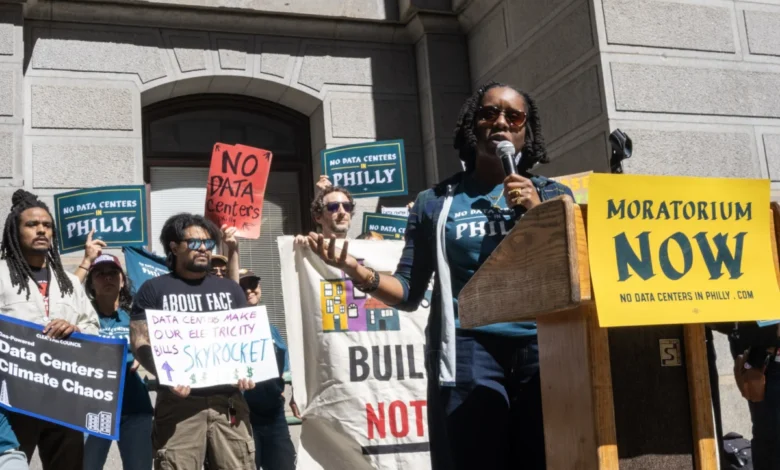
During a recent rally outside Philadelphia’s City Hall, Clean Air Council attorney Annie Fox highlighted another alarming aspect of modern data center design: backup power generation.
"A typical data center planned in Pennsylvania has hundreds of diesel engines that spew air pollution, and even if they’re supposedly reserved for emergencies, the government has already said that the data center should use those rather than drawing from an overstressed electrical grid during some heat waves," Fox told the crowd. "We can expect that to get more frequent… Fossil fuel-hungry data centers will worsen climate change, making those heatwaves more frequent and severe."
Community Trauma and the Fight for Clean Air
The economic and psychological scars left by legacy industries heavily influence how communities view new technological proposals. For Sonya Sanders, board president of Philly Thrive, the threat of an incoming data center reawakens deep-seated trauma regarding corporate prioritization of profit over human life.

Sanders’ husband, a lifelong resident of Grays Ferry, passed away in 2020 after battling a rare form of bone cancer. A non-smoker and non-drinker, he lived his entire life in the shadow of the PES refinery. Sanders firmly believes that toxic industrial emissions were the direct cause of his fatal illness.
"In my eyes, they killed him," Sanders declared during the City Hall rally, which drew more than 100 local residents chanting for a permanent data center ban. "The pollution killed him. I believe he would be here today if he wasn’t silently murdered, because it was the pursuit of profit that killed him."
Beyond air pollution, residents have raised concerns regarding resource equity. Donna Greenberg, a Philadelphia resident who participated in the demonstration, voiced anxieties shared by many urban communities facing technological development.
"I’m worried about pollution," Greenberg said. "I’m worried about surveillance and the fact that they’re going to have access to information they have no business knowing, and I’m concerned that they’re going to be using water and electricity that takes away from the people and the neighborhoods who need it."
Looking Ahead: The Intersection of Tech Policy and Climate Justice
As tech companies search for reliable power sources—ranging from restarting retired nuclear reactors to building dedicated natural gas turbines—the friction between digital infrastructure and local communities will likely intensify.
For grassroots networks like Philly Thrive and the Clean Air Council, the strategy moving forward is clear: mobilize local constituents, pressure municipal lawmakers, and demand comprehensive legislative protections before infrastructure footprints become permanent.

"I just think that our community standing up and fighting back is tremendous," Shawmar Pitts reflected as the rally concluded outside City Hall. "It takes a lot of effort and a lot of people."
The unfolding debate in Philadelphia and across the United States highlights a fundamental question for the digital age: Can the rapid scaling of artificial intelligence proceed without sacrificing the health, safety, and self-determination of the communities asked to host its physical foundation? For millions of Americans living near prospective data center sites, the answer from city halls to state capitals is that the expansion must be halted until those questions are satisfactorily answered.
Related posts: