Digg Reinvents Itself Again: Kevin Rose Returns with AI-Focused News Aggregator Driven by Social Signals

The digital landscape is witnessing the return of a once-pivotal name in social news, as Digg attempts yet another transformation under the direct leadership of its original founder, Kevin Rose. Just months after a high-profile relaunch intended to challenge Reddit’s dominance, the platform underwent a swift shutdown in March 2026 to facilitate a radical shift in strategy. The latest iteration of Digg, which entered a public beta phase this week, abandons the community-forum model entirely, returning to its roots as a news aggregator but with a modern, data-centric twist: it now utilizes real-time social signals from X, formerly Twitter, to curate and rank news specifically within the artificial intelligence sector.
This pivot comes after the company’s previous attempt to build a Reddit rival faltered due to an inability to differentiate itself in a crowded market and a persistent struggle with automated bot traffic. Recognizing that the platform had failed to gain traction as a general-interest discussion hub, the startup laid off a significant portion of its staff and returned to the drawing board. Kevin Rose, who had been serving as a partner at True Ventures, returned to a full-time role at Digg in April 2026 to spearhead this new direction, moving the site away from manual user submissions and toward an algorithmic approach that prioritizes "signal" over "noise."
A Brief Chronology of Digg’s Evolutionary Cycles
To understand the significance of this relaunch, one must look at the turbulent history of Digg, which was founded in 2004 and quickly became the primary gateway to the internet for millions of users. At its peak in the mid-to-late 2000s, a "Digg effect"—a surge of traffic from being featured on the front page—could crash servers and define the news cycle. However, the 2010 launch of "Digg v4" proved disastrous, alienating its core user base by stripping away popular features and favoring corporate publishers over individual curators. This exodus directly fueled the meteoric rise of Reddit.
In 2012, the remnants of Digg were sold to the technology studio Betaworks for a reported $500,000, a fraction of the $160 million valuation it once commanded. Betaworks successfully retooled it as a curated editorial site for several years before the brand changed hands again. The most recent saga began in June 2025, when plans for a "rebooted" Digg were first teased. By January 2026, the site launched as a direct Reddit competitor, only to be shuttered three months later in March 2026. Rose’s return in April 2026 marked the beginning of the current "AI-first" pivot, leading to the beta release observed this Friday.
Technical Architecture: Ingesting the Pulse of X
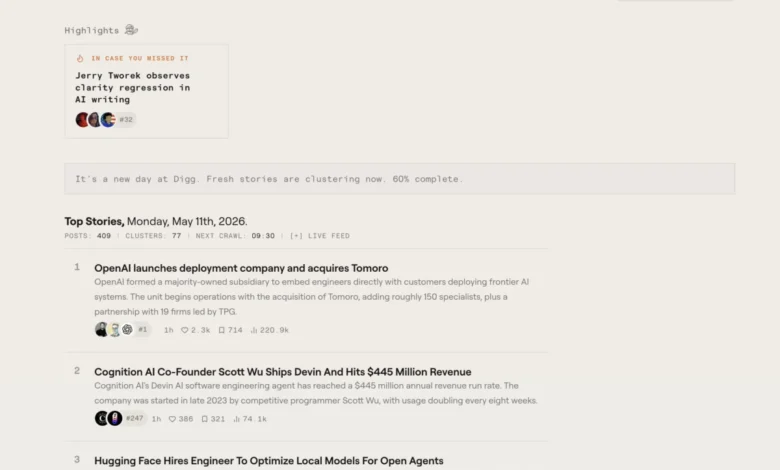
The new Digg interface, currently hosted at a specific AI-focused subdomain, is a stark departure from the "Reddit clone" aesthetics of the early 2026 version. The design is clean and minimalist, focusing on a ranked list of top stories. At the top of the homepage, the site highlights four distinct categories: the most viewed story, a "rising discussion" headline, the fastest-climbing story in terms of engagement, and a curated "In case you missed it" section.

The underlying technology represents a significant shift in how news is aggregated. Rather than relying on users to "Digg" (upvote) stories on the platform itself, the new system ingests content from X in real time. The platform employs a sophisticated stack involving sentiment analysis, clustering algorithms, and signal detection to determine which topics are gaining genuine traction among influential voices.
According to communications sent to beta testers, the goal is to "track the most influential voices in a space" and surface news that is genuinely worth "paying attention to." By monitoring how industry leaders, such as OpenAI CEO Sam Altman, interact with specific links, Digg can predict and track the "chain reaction" of deep discussion and propagation that follows. This data-driven approach allows the site to display engagement metrics—views, comments, likes, and saves—that reflect global conversation rather than just the activity of a small, internal user base.
Strategic Focus on the Artificial Intelligence Vertical
The decision to launch with a strict focus on artificial intelligence is a calculated move. AI is currently the most volatile and high-velocity news sector in technology, with major breakthroughs and policy shifts occurring daily. Furthermore, the AI community remains one of the few professional cohorts that still utilizes X as its primary "town square" for real-time debate and dissemination of research.
Beyond just ranking articles, the new Digg provides deep-dive metrics into the ecosystem. The site currently features rankings for:
- Top 1,000 Influencers: A list of the most impactful individuals in the AI space based on their social reach and the weight of their engagement.
- Top Companies: A leaderboard of organizations—from giants like Google and Microsoft to startups like Anthropic—ranked by the volume and sentiment of the discussion surrounding them.
- Political Figures: A tracking system for politicians and regulators who are shaping AI policy, reflecting the increasing intersection of technology and governance.
By offering charts and graphs that visualize how a story moves through the social web, Digg aims to appeal to "data nerds" and industry professionals who need to distinguish between fleeting hype and substantive developments.
Market Context and the Publisher Crisis
The relaunch of Digg occurs against a backdrop of significant distress for digital publishers. For over a decade, publishers relied on Google Search and social media platforms for the lion’s share of their referral traffic. However, recent shifts in Google’s algorithms and the introduction of "AI Overviews" (formerly Search Generative Experience) have severely curtailed click-through rates. AI Overviews provide comprehensive summaries at the top of search results, often satisfying the user’s query without requiring them to visit the source website.

If Digg can successfully aggregate an audience of high-value readers and direct them to original reporting, it could serve as a vital lifeline for publishers. Unlike the previous "Reddit-rival" version, which sought to keep users on the platform for discussion, the new Digg’s aggregator model is fundamentally built on outbound links. This could position Digg as a "pro-publisher" alternative in an era where most platforms are attempting to build "walled gardens" that discourage users from leaving.
Challenges and Industry Implications
Despite the pedigree of its founder and the sophistication of its data ingestion, the new Digg faces substantial hurdles. The most immediate challenge is the lack of native community. Currently, there is no facility for users to comment or discuss stories on Digg itself; the site acts purely as a mirror for activity happening elsewhere. It remains to be seen if users will habitually visit a standalone aggregator when they could ostensibly find the same information on their X "For You" feed or via specialized RSS readers and newsletters.
Furthermore, the reliance on X as the primary data source carries inherent risks. Since the acquisition of Twitter by Elon Musk, the platform has seen a fragmentation of its user base. While AI news remains centered on X, other verticals like journalism, academia, and general politics have increasingly migrated to competitors like Meta’s Threads, Bluesky, or Mastodon. For Digg to expand beyond AI into other topics, it will likely need to integrate signals from these disparate platforms, a task that involves significant technical complexity and API costs.
Industry analysts also point out that "signal detection" is a crowded field. Professional tools already exist for tracking social trends, and many newsrooms use internal dashboards to monitor viral content. Digg’s success will depend on its ability to package this complex data into a user-friendly format that appeals to the "everyday" professional who is overwhelmed by the sheer volume of AI news.
Looking Ahead: The Path to Public Release
In its current state, Digg remains a "raw and buggy" beta product, as cautioned in Rose’s recent communications. The startup is using this period to refine its clustering algorithms and ensure that the sentiment analysis can accurately distinguish between positive breakthroughs and negative controversies.
The return of Kevin Rose to the helm suggests a long-term commitment to restoring the brand’s relevance. By moving away from the "social media" ambitions of its recent past and leaning into "data-driven aggregation," Digg is attempting to carve out a niche as a high-signal filter for the modern web. Whether this "AI-first" strategy can scale to other industries—and whether it can convince users to return to a 20-year-old brand—will be the defining test for Digg’s latest resurrection. If successful, Digg may finally move past its legacy as a fallen giant and become a foundational tool for navigating the increasingly complex information age.