AMD Unleashes Helios: A Gigawatt-Scale AI Rack System Challenging Nvidia’s Dominance

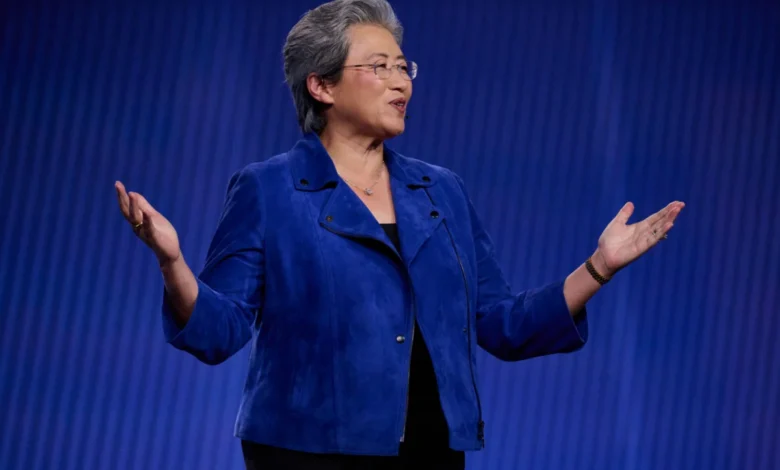
At the highly anticipated Advancing AI conference, held in a sold-out venue in San Francisco on Thursday, Advanced Micro Devices (AMD) unveiled a formidable new weapon in its arsenal against rival Nvidia: Helios, a revolutionary rack-scale system engineered to meet the colossal computing demands of the world’s largest artificial intelligence laboratories. AMD Chair and CEO Dr. Lisa Su presented Helios as a cornerstone of the company’s strategy to capture a significant share of the burgeoning AI hardware market, announcing that the system is slated for shipment later this year and already boasts a growing roster of high-profile clients, including tech giant Microsoft.
The Advancing AI conference itself served as a critical platform for AMD to showcase its latest innovations and articulate its vision for the future of AI compute. The event, characterized by its intense focus on the rapidly evolving landscape of artificial intelligence, drew industry leaders, researchers, and developers eager to witness the advancements shaping the next generation of AI capabilities. Dr. Su’s keynote address, delivered to an enthusiastic audience, underscored AMD’s commitment to providing comprehensive, full-stack compute solutions for the "agentic AI era," a period defined by AI systems capable of independent reasoning, task execution, and tool utilization.
The Architecture of Ambition: Helios and the Rise of AI Racks
Rack systems represent a pivotal evolution in high-performance computing, consolidating numerous powerful processors into a single, densely packed unit. These sophisticated infrastructures are the backbone of modern data centers, providing the immense processing power required for the training and deployment of complex AI models, as well as other computationally intensive workloads that push the boundaries of digital innovation.
Dr. Su boldly declared Helios to be the technology industry’s "highest-performance AI rack," emphasizing its design and capability to "train and run the most demanding frontier models in the world at massive scale." The company further revealed that Helios will be deployed by leading AI enterprises at a "gigawatt-scale," a testament to the sheer magnitude of power and compute capacity the system is designed to deliver. This ambitious scale signifies a significant shift in the infrastructure requirements for cutting-edge AI research and development, where the need for raw computational power is escalating at an unprecedented rate.
Challenging the Incumbent: AMD’s Strategic Play Against Nvidia
For years, Nvidia has held a commanding position in the AI rack system market, largely due to its established technologies such as the Vera Rubin and Grace Blackwell systems. AMD’s introduction of Helios marks a direct and deliberate challenge to this long-standing dominance. Early indications and performance benchmarks suggest that Helios is not merely an incremental improvement but a significant contender. The Register, a respected technology publication, reported that Helios exhibits performance metrics that rival and, in some areas, surpass those of Nvidia’s Vera Rubin system, positioning AMD as a serious disruptor in this critical market segment.
The strategic importance of this market cannot be overstated. The demand for specialized hardware capable of accelerating AI workloads has exploded, driven by the rapid advancements in large language models (LLMs), generative AI, and the increasing complexity of AI applications across various industries. By introducing a high-performance rack system, AMD is directly addressing the needs of the most demanding AI organizations, aiming to become an indispensable partner in their pursuit of AI innovation.
A Growing Clientele and Strategic Partnerships
Helios, which was initially revealed in 2025 and subsequently showcased at CES 2026, has already garnered substantial interest and secured commitments from some of the most influential players in the AI ecosystem. The list of prominent customers planning to deploy the Helios system includes OpenAI, Meta, Oracle, Anthropic, and Microsoft. This broad adoption by industry titans underscores the perceived value and competitive advantage that AMD’s new offering is expected to bring.
A particularly noteworthy endorsement came from Microsoft, with CEO Satya Nadella announcing on Monday that the tech behemoth would be significantly expanding its Azure cloud infrastructure with the integration of Helios. This strategic move by Microsoft signals a strong vote of confidence in AMD’s ability to deliver the scale and performance required for its vast cloud computing operations.
Furthermore, AMD announced a strategic partnership with Anthropic on Wednesday, a leading AI safety research company. This collaboration aims to deploy up to two gigawatts of AMD Instinct MI450 series GPUs through the new Helios rack system. Such a substantial deployment highlights the commitment of both companies to advancing AI capabilities through a robust and scalable hardware foundation. The "gigawatt-scale" commitment suggests a long-term vision for AI infrastructure development, where power consumption and compute capacity are measured in unprecedented magnitudes.
The Future of Compute: AMD’s Venice-X CPU and the AI Accelerator Market
Beyond the Helios rack system, AMD also used the Advancing AI conference to introduce its Venice-X CPU. Designed with data centers and high-computing workloads in mind, the Venice-X is slated for a 2027 launch and represents AMD’s ongoing efforts to provide a comprehensive suite of processing solutions for demanding computational tasks. This dual focus on both specialized AI accelerators and general-purpose high-performance CPUs demonstrates AMD’s holistic approach to powering the future of computing.
Dr. Su articulated a compelling vision for the trajectory of the chip industry during her remarks, predicting that chips powering AI will constitute a "massive part" of the overall computing market by 2030. She attributed this forecast to a "step change in compute demand," primarily driven by the burgeoning field of agentic AI.
The Agentic AI Imperative: Driving Unprecedented Compute Needs
The concept of agentic AI, as explained by Dr. Su, involves AI systems that can perform complex tasks autonomously, often requiring multiple steps, reasoning, tool utilization, and data access. "When you ask the agent to do something," she elaborated, "it actually has dozens of steps, and it has to reason, and it has to call tools, and it has to access data, and it has to keep doing it over and over until it solves the problem, and so you need lots of GPUs to do all that." This intricate, iterative process inherently demands immense parallel processing power, a domain where GPUs have proven exceptionally adept.
This escalating demand for specialized AI compute power has led AMD to project that the AI accelerator market will reach approximately $1.4 trillion by 2030. "What that means is, by the end of the decade, the AI accelerator market is going to approach the size of the entire semiconductor market today," Dr. Su stated, underscoring the transformative economic impact of AI on the semiconductor industry.
The Dominance of GPUs and the Role of Programmability
The company’s analysis further suggests that GPUs will continue to be the dominant force within this rapidly expanding AI accelerator market. Dr. Su explained this projection by noting that "the algorithms are still very much in their infancy, and we’re still continuing to see the workloads change, and that favors programmability in the overall silicon ecosystem." The inherent programmability of GPUs makes them highly adaptable to the evolving nature of AI algorithms and workloads, providing the flexibility necessary for researchers and developers to innovate and push the boundaries of AI capabilities.
This emphasis on programmability aligns with AMD’s broader strategy of offering flexible and powerful solutions that cater to the dynamic needs of the AI research community. By investing in both high-performance hardware like Helios and versatile processing units such as their CPUs and GPUs, AMD aims to equip its customers with the tools they need to tackle the most complex AI challenges of today and tomorrow. The successful adoption of Helios by major AI players signals a significant shift in the competitive landscape, potentially ushering in a new era of innovation and pushing the boundaries of what artificial intelligence can achieve. The implications of this intense competition are likely to drive further advancements in AI hardware, benefiting the entire field and accelerating the pace of AI development across industries.