Abbott Laboratories Investigates Dual Cyberattacks Targeting Cancer Diagnostics and LabCentral Portal


Abbott Laboratories, a global leader in medical devices and healthcare diagnostics, has initiated comprehensive investigations into two separate and distinct cybersecurity incidents following claims of unauthorized access to its internal infrastructure. The Illinois-based multinational confirmed a breach involving legacy systems within its Cancer Diagnostics business, which has been linked to the notorious ShinyHunters extortion group. Simultaneously, the company is evaluating a second claim from a threat actor known as ShadowByt3$, who alleges a breach of the LabCentral customer portal, a hub for the company’s core laboratory diagnostics business.
The dual nature of these incidents highlights a growing trend of "double-dipping" by cybercriminal entities against high-value targets in the medical technology (MedTech) sector. While Abbott has maintained that the incidents have not disrupted business operations or patient care, the sheer volume of data allegedly exfiltrated—ranging from sensitive patient records to proprietary business documentation—has raised significant concerns regarding the security of legacy infrastructure and the efficacy of modern identity management systems.
The ShinyHunters Breach: Target and Methodology
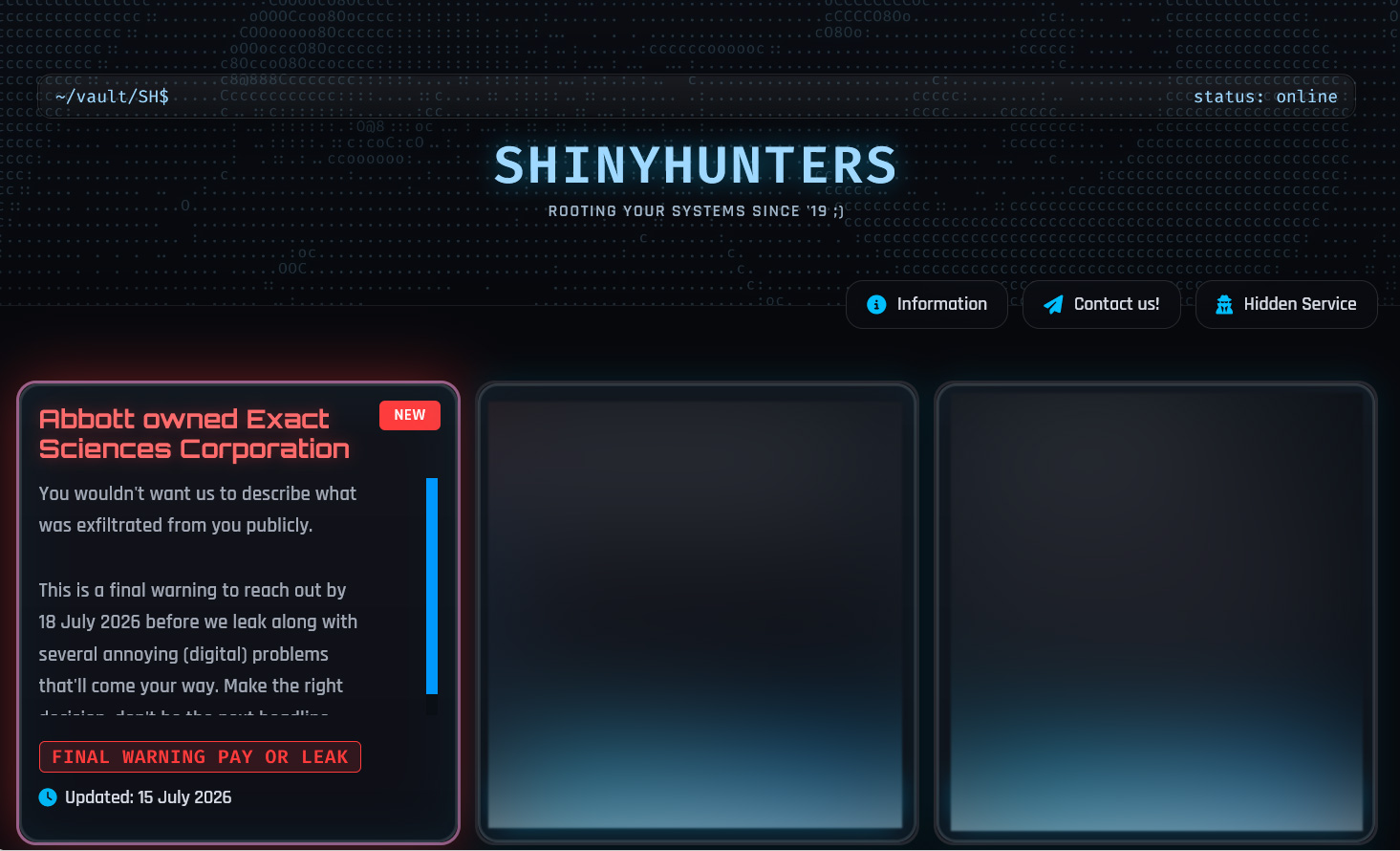
The first and more extensive incident involves Abbott’s Cancer Diagnostics business. The breach was brought to public attention after the ShinyHunters extortion gang listed Abbott on its data leak site. The group initially set a deadline of July 18, 2026, for the company to enter negotiations, later extending the ultimatum to July 21.
According to claims made by ShinyHunters to cybersecurity researchers, the entry point was not a sophisticated software exploit but rather a human-centric "vishing" (voice phishing) campaign. In mid-June, attackers reportedly targeted several Abbott employees via telephone, posing as IT support or administrative personnel. Through these social engineering tactics, the group successfully compromised a Microsoft Entra (formerly Azure AD) single sign-on (SSO) account.
The compromise of an SSO account is particularly damaging in a modern corporate environment. Once the attackers gained control of the identity provider, they were able to pivot into a variety of connected Software-as-a-Service (SaaS) applications. ShinyHunters claims to have exfiltrated data from a wide array of platforms used by Abbott, including:

- ServiceNow: Used for IT service management and internal workflows.
- SharePoint: A repository for internal documents and collaboration.
- Databricks: A platform used for data engineering and analytics.
- Coupa: A business spend management and procurement platform.
By moving laterally through these systems, the threat actors allegedly gained access to internal documents, contracts, and a massive trove of customer information.
Alleged Data Exfiltration: 30 Million Rows of PII
The scale of the data theft claimed by ShinyHunters is staggering, though it remains independently unverified. The group asserts that it exfiltrated multiple datasets containing over 30 million rows of customer personally identifiable information (PII). This data reportedly includes full names, email addresses, physical addresses, telephone numbers, and dates of birth. Most critically, the group claims the haul includes more than one million Social Security numbers (SSNs).
In addition to standard PII, the extortionists claim to have obtained sensitive medical and professional records, including:
- 22 million client notes: Allegedly containing detailed doctor-patient conversations and clinical observations.
- 20 million medical orders: Documentation related to diagnostic tests and patient prescriptions.
- Corporate Legal Data: A collection of customer agreements and non-disclosure agreements (NDAs).
Abbott’s official response has sought to downplay the scope of the exposure. In a statement, the company clarified that the "unauthorized access" was limited to a small number of internal systems within the Cancer Diagnostics business. Crucially, Abbott noted that the affected legacy systems are separate from the company’s primary network infrastructure and that the incident has not impacted manufacturing, lab operations, or the availability of products.
The Second Front: ShadowByt3$ and the LabCentral Portal
As Abbott managed the fallout from the ShinyHunters claim, a second threat actor, ShadowByt3$, emerged with claims of a separate intrusion. This incident allegedly targeted the LabCentral customer portal, which serves Abbott’s Core Laboratory diagnostics business.
ShadowByt3$ claims to have breached the environment on July 4, 2026, utilizing compromised customer credentials. The attacker described finding a "weak point" in the environment that allowed for the slow exfiltration of files via API (Application Programming Interface) endpoints. Unlike ShinyHunters, ShadowByt3$ explicitly stated that they did not target customer PII. Instead, the focus was on intellectual property and technical documentation.
The data allegedly stolen from LabCentral includes:
- CE Manufacturing Certificates: Regulatory documents required for selling medical devices in the European Economic Area.
- Technical Specifications and Assay Files: Detailed blueprints and chemical compositions used in diagnostic testing.
- Operational Manuals and Troubleshooting Guides: Comprehensive documentation for laboratory diagnostic systems.
- Calibrator Value Assignments: Data essential for the accuracy of medical testing equipment.
Abbott has contested the severity of this second claim. A company spokesperson clarified that LabCentral is an externally facing, third-party hosted portal. According to the company, the portal is designed to house publicly available technical reference documents for customers. Abbott maintains that the environment does not contain proprietary business information or sensitive customer data, effectively characterizing the "stolen" data as information that was already intended for public or semi-public consumption.
Chronology of the Incidents
The timeline of these events suggests a period of sustained pressure on Abbott’s digital perimeter throughout the summer of 2026:
- Mid-June 2026: ShinyHunters initiates a vishing campaign against Abbott employees, successfully compromising a Microsoft Entra SSO account.
- Late June 2026: Attackers move laterally through Abbott’s SaaS environment, exfiltrating data from SharePoint, Databricks, and ServiceNow.
- July 4, 2026: ShadowByt3$ allegedly gains access to the LabCentral portal via compromised credentials.
- Early July 2026: Abbott identifies unauthorized activity in its Cancer Diagnostics legacy systems and activates incident response procedures.
- July 17, 2026: ShinyHunters publicly lists Abbott on its extortion site, threatening to leak data.
- July 18, 2026: Initial deadline set by ShinyHunters expires; Abbott confirms the investigation into the Cancer Diagnostics incident.
- July 19, 2026: ShadowByt3$ contacts media outlets with proof of the LabCentral intrusion.
- July 21, 2026: The extended deadline for the ShinyHunters extortion demand.
Background: The Rise of MedTech Extortion
The targeting of Abbott Laboratories is part of a broader, more aggressive campaign by cybercriminal groups against the healthcare and medical technology sectors. ShinyHunters, in particular, has developed a reputation for targeting MedTech giants. The group has previously been linked to incidents involving Medtronic, OneMedical, AdaptHealth, and iRhythm.
The group’s shift toward vishing and SSO compromise reflects a maturation of their tactics. By bypassing traditional firewalls and exploiting the "human element," these attackers can circumvent multi-factor authentication (MFA) through techniques like MFA fatigue or social engineering. Once inside an SSO environment, the "keys to the kingdom" allow for the silent exfiltration of data across multiple cloud platforms, often before the victim is even aware of a breach.
For MedTech companies, the stakes are uniquely high. Beyond the financial cost of a breach—which the IBM "Cost of a Data Breach" report identifies as being highest in the healthcare sector, averaging nearly $11 million per incident—there is the risk to patient safety and trust. While Abbott states that its products remain safe and available, the potential exposure of 22 million doctor-patient conversations represents a massive violation of privacy that could have long-term regulatory and legal consequences under frameworks like HIPAA (Health Insurance Portability and Accountability Act) and the GDPR (General Data Protection Regulation).

Analysis of Implications and Corporate Strategy
Abbott’s assertion that the incidents will not have a "material impact" on its financial results is a standard component of corporate disclosure, but it warrants scrutiny. Under the U.S. Securities and Exchange Commission (SEC) rules implemented in late 2023, public companies must disclose "material" cybersecurity incidents within four business days of determining materiality. Abbott’s current stance suggests that the costs of remediation, legal fees, and potential fines are not expected to significantly alter the company’s financial trajectory.
However, the "legacy" nature of the compromised Cancer Diagnostics systems highlights a common vulnerability in large-scale healthcare organizations. Mergers and acquisitions often leave companies with a patchwork of IT infrastructure, where older, less-secure systems are integrated with modern networks. These legacy systems frequently lack the robust monitoring and identity controls found in newer environments, making them "soft targets" for groups like ShinyHunters.
Furthermore, the dispute over the LabCentral data underscores the complexities of "data sensitivity." While Abbott claims the documents are public, the aggregation of manufacturing certificates, assay files, and technical specifications by a threat actor could potentially be sold to corporate rivals or used to facilitate the creation of counterfeit diagnostic products. In the highly regulated world of medical diagnostics, even "public" technical data carries significant value when organized and weaponized.
Conclusion and Future Outlook
As of late July 2026, Abbott Laboratories remains in a state of active investigation. The company has engaged third-party cybersecurity experts and is cooperating with law enforcement agencies to determine the full extent of the unauthorized access. The primary focus for the company remains the ShinyHunters threat, given the sensitivity of the patient PII and medical records allegedly held for ransom.
This dual-breach scenario serves as a stark reminder for the healthcare industry that technical defenses are only as strong as the people who operate them. As vishing and SSO-based attacks continue to rise, the emphasis on "Zero Trust" architecture and continuous employee training has never been more critical. For Abbott, the coming months will likely involve a grueling process of data forensics, victim notification, and a renewed effort to harden the legacy systems that served as the gateway for this digital intrusion. The medical community will be watching closely to see if the alleged data—particularly the millions of rows of patient notes—actually surfaces on the dark web, or if Abbott can successfully contain the damage from one of the year’s most significant MedTech cyber incidents.