AWS Unveils Comprehensive Cost Optimization Strategies for Eclipse Dataspace Components Deployments, Achieving Up to 58% Savings

Navigating the complexities of secure and sovereign data sharing in modern digital ecosystems often brings infrastructure cost management to the forefront for organizations leveraging cloud platforms. A recent publication by Amazon Web Services (AWS) details advanced strategies for deploying Eclipse Dataspace Components (EDC) connectors, emphasizing critical insights into predicting, controlling, and significantly reducing the associated infrastructure costs on AWS. This comprehensive guide, the third and final installment in a series, provides crucial benchmarks and optimization techniques that promise up to a 58% reduction in spending, enabling informed decision-making for workload sizing, environment configuration, and long-term investment in data space architectures.
The Evolving Landscape of Data Spaces and Eclipse Dataspace Components
The concept of data spaces represents a paradigm shift in how organizations approach data sharing and collaboration. Driven by the need for enhanced data sovereignty, security, and compliance, data spaces provide secure, controlled environments where independent entities can exchange data while maintaining full control over their assets. This architecture is particularly vital in sectors like manufacturing, healthcare, and supply chain management, where sensitive information must be shared efficiently without compromising proprietary rights or regulatory mandates.
At the heart of many such implementations are open-source initiatives like the Eclipse Dataspace Components (EDC). Developed under the Eclipse Foundation, EDC provides a modular, extensible framework for building data connectors that comply with the standards set by the International Data Space Association (IDSA). The IDSA framework, a cornerstone for trusted data ecosystems, ensures interoperability, security, and sovereignty across diverse participants. EDC connectors act as the secure gateways for data exchange, enabling participants to define and enforce contracts, manage identities, and facilitate data transfers under agreed-upon terms.
This recent AWS publication builds upon previous foundational discussions. Part 1 of the blog series meticulously laid out the fundamentals of data space architectures and the role of EDC in adhering to IDSA standards, offering readers a conceptual grounding in this emerging domain. Part 2 then transitioned to practical implementation, exploring production-ready architectural patterns for deploying EDC connectors on Amazon Web Services (AWS), with a keen focus on operational excellence, robust security measures, and inherent reliability principles. This final installment broadens the scope to encompass the remaining three pillars of the AWS Well-Architected Framework: Performance Efficiency, Cost Optimization, and Sustainability, providing a holistic view of efficient and responsible cloud deployment.
Understanding Cost Drivers in Data Space Deployments
Deploying data space infrastructure, particularly EDC connectors, involves a nuanced understanding of potential cost drivers. While the benefits of secure data collaboration are clear, the underlying infrastructure costs can vary significantly based on performance and reliability requirements, as well as the volume and velocity of data moving across the network. It is crucial to differentiate between components managed centrally by a Dataspace Governance Authority (DSGA)—such as management, identity, and discovery functions—and those hosted independently by participants, like the EDC connectors themselves. This analysis zeroes in exclusively on the costs associated with EDC connector deployments from the perspective of a participant, covering both data provider and consumer roles.
The core infrastructure for an EDC connector deployment typically involves compute resources for running the connector applications, a database for storing metadata and contract information, networking components for data transfer, and various supporting services for security, monitoring, and identity management. Each of these components contributes to the overall monthly expenditure, with certain services proving to be more significant cost contributors than others, particularly at baseline operational levels.
Baseline Assumptions for Cost Estimation
To provide actionable cost estimates, AWS established a set of fictional yet representative usage assumptions. These serve as a baseline for organizations to adapt to their specific operational contexts and scale. The technical assumptions underpin the scenarios presented:
- Data Volume: A conservative estimate of 5 GB per participant, which accounts for approximately six months of historical data and necessary backups. This volume is typical for initial deployments or smaller data exchange scenarios.
- Network Traffic: Projected at 20 GB per month per participant, reflecting data transfers between different participants within the data space. This includes both inbound and outbound traffic essential for collaborative operations.
- API Calls: An assumed 100,000 API calls per month per participant. These calls encompass a range of critical interactions, including catalog queries to discover available data, contract negotiations to establish terms of data usage, and the initiation of actual data transfers.
- OAuth Token Requests: Approximately 1,000 machine-to-machine (M2M) token requests per month per participant. These tokens are vital for secure authentication and authorization of data plane operations, ensuring only authorized entities can access and exchange data.
These assumptions provide a practical framework for modeling costs, recognizing that actual usage patterns can fluctuate based on industry, specific use cases, and the number of data partners involved. While explicit operational assumptions were not detailed, the chosen configurations for compute and database resources implicitly account for standard operational practices such as 24/7 availability for business-critical workloads, automated backups, and integrated monitoring capabilities, which are fundamental to a production-ready environment.
Architectural Foundation for Production-Readiness
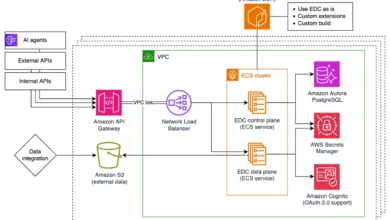
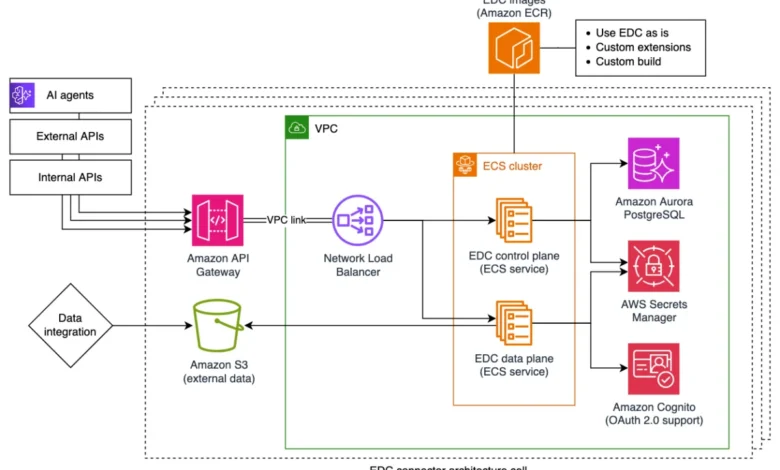
The cost estimations presented are grounded in a robust, production-ready reference architecture for deploying EDC connectors on AWS, a design comprehensively detailed in Part 2 of this blog series. This architecture typically leverages a suite of AWS services to ensure high availability, scalability, and security. Key components often include:
- Compute: Amazon Elastic Container Service (Amazon ECS) orchestrated with AWS Fargate for running containerized EDC connector instances. Fargate abstracts away server management, allowing developers to focus solely on their applications.
- Database: Amazon Aurora PostgreSQL-Compatible Edition, providing a highly scalable, fault-tolerant, and performant relational database solution for metadata and contract storage.
- Networking: An Network Load Balancer (NLB) to efficiently distribute incoming traffic to the EDC connectors, ensuring high availability and reliable connectivity.
- Security & Identity: AWS Secrets Manager for secure storage of credentials and sensitive information, and Amazon Cognito for managing user identities and M2M authentication flows.
- Storage: Amazon Simple Storage Service (Amazon S3) for object storage, potentially used for storing larger data assets or logs.
- Container Registry: Amazon Elastic Container Registry (Amazon ECR) for storing and managing Docker images of the EDC connectors.
- API Management: Amazon API Gateway for secure, scalable API endpoints for various EDC functionalities.
This architectural blueprint underpins two distinct cost scenarios, tailored to the criticality of the workload: one for business-critical applications demanding constant availability and performance, and another for non-critical environments suitable for development, testing, or experimentation. The primary distinctions between these scenarios lie in the sizing and type of compute and database resources employed.
Detailed Cost Analysis: Business-Critical Workloads
For business-critical EDC connector deployments, where uptime, performance, and reliability are paramount, AWS provides a robust configuration designed to meet demanding operational requirements. The estimated monthly cost for such a setup, based on the aforementioned assumptions, totals approximately $387.00 USD. This estimate is illustrative, and actual costs may vary depending on regional pricing, specific usage patterns, and data volumes. The breakdown of costs highlights the primary drivers:
- Amazon Aurora PostgreSQL-Compatible Edition: Configured with a
db.r6g.largeinstance (2 vCPU, 16 GB RAM), 20 GB of storage, plus 10 GB for backups, this service accounts for the largest portion of the cost at $276.00. Ther6g.largeinstance type is chosen for its high memory and performance, critical for consistent, low-latency database operations in a business-critical environment. Amazon Aurora’s fault tolerance and scalability further justify this investment. - Amazon Elastic Container Service (Amazon ECS) with AWS Fargate: Running with 2 vCPU and 4 GB RAM, configured to be "always on" for continuous availability, contributes $83.00. Fargate ensures that the containerized EDC connectors are always ready to process requests, minimizing operational overhead for server management.
- Network Load Balancer (NLB): Processing 20 GB of data, the NLB incurs a cost of $20.00. This component is essential for distributing traffic and ensuring the high availability of the connector endpoints.
- AWS Secrets Manager: Managing 10 secrets, this service costs $4.00, providing secure storage and retrieval of sensitive credentials.
- Amazon Cognito: Handling 1,000 machine-to-machine (M2M) token requests, Amazon Cognito adds $2.25 to the monthly bill, securing authentication for data plane operations.
- Amazon Elastic Container Registry (Amazon ECR): With 2 GB of storage and 10 GB of data transfer, ECR costs $1.00 for managing container images.
- Amazon API Gateway: Supporting 100,000 REST API calls, this service has a marginal cost of $0.40, offering a scalable and secure entry point for API interactions.
- Amazon Simple Storage Service (Amazon S3): Utilizing 5 GB in the Standard tier for object storage, S3 contributes a minimal $0.10 to the total.
This analysis clearly indicates that Amazon Aurora PostgreSQL and Amazon ECS with AWS Fargate are the primary cost drivers for business-critical EDC deployments. These services represent the baseline infrastructure required to guarantee reliability, performance, and continuous availability, emphasizing that foundational compute and database resources typically command the largest share of the budget in such setups.
Optimizing for Non-Critical Workloads: Achieving Significant Savings
For organizations operating development, testing, or experimentation environments, or even certain internal non-critical batch processing workloads, significant cost reductions can be achieved without compromising essential data throughput or API capacity. By rightsizing resources and strategically leveraging AWS’s flexible pricing models, costs can be slashed by up to 58%. The estimated monthly cost for a non-critical EDC connector deployment drops to approximately $164.00 USD.
- Amazon Aurora PostgreSQL-Compatible Edition: The instance type is downgraded to
db.t4g.medium(2 vCPU, 4 GB RAM), with the same 20 GB storage + 10 GB backup. This smaller, burstable instance reduces the database cost significantly to $110.00. While still providing reliable performance,t4ginstances are more cost-effective for workloads that don’t require sustained high performance 24/7. - Amazon ECS with AWS Fargate Spot: Instead of always-on Fargate, leveraging AWS Fargate Spot capacity for the 2 vCPU, 4 GB RAM containers brings down compute costs dramatically to $26.00. Fargate Spot allows users to run fault-tolerant containerized applications at a much lower cost, making it ideal for workloads that can tolerate interruptions, such as development and testing environments.
- Network Load Balancer: Processing 20 GB of data, the NLB cost remains consistent at $20.00, as the network traffic assumptions are identical.
- AWS Secrets Manager, Amazon Cognito, Amazon ECR, Amazon API Gateway, and Amazon S3: The costs for these supporting services remain unchanged ($4.00, $2.25, $1.00, $0.40, and $0.10 respectively), as their usage patterns are assumed to be consistent across both critical and non-critical scenarios.
The transition to a non-critical configuration results in a remarkable 58% reduction in monthly costs. This substantial saving is primarily attributed to the judicious selection of smaller database instances and the strategic adoption of AWS Fargate Spot capacity. The analysis underscores that while the core network and ancillary services maintain consistent costs, significant flexibility exists in optimizing compute and database resources based on workload criticality. This demonstrates that organizations can maintain the same data throughput and API interaction capacity for non-critical workloads at a substantially lower operational expense.
Strategic Cost Optimization Insights
The comparison between business-critical and non-critical scenarios reveals a crucial insight: the primary cost contributors are consistently database, compute, and load balancing resources. These represent fundamental infrastructure costs necessary for the very existence and operation of the EDC connector. In contrast, services like Amazon S3, API Gateway, and data transfer charges contribute only marginally at the assumed data volumes.
This cost structure suggests a highly efficient scaling model. As organizations onboard more use cases, increase data volume, and accelerate data velocity within their data spaces, the value derived from the existing infrastructure investment grows disproportionately to the increase in operational costs. The baseline infrastructure costs, once established, can support expanding data operations without a linear increase in expenditure, making data space participation increasingly economically attractive as adoption scales. This efficiency is a critical factor for long-term strategic planning and widespread adoption of data spaces across industries.
Well-Architected Pillars: Performance Efficiency, Cost Optimization, and Sustainability
Building on the operational excellence, security, and reliability pillars covered in Part 2, this final installment integrates the remaining three pillars of the AWS Well-Architected Framework: Performance Efficiency, Cost Optimization, and Sustainability. These pillars are integral to designing and operating cloud workloads that are not only effective but also economically sound and environmentally responsible.
Performance Efficiency
Performance efficiency focuses on using computing resources efficiently to meet system requirements and maintain that efficiency as demand changes and technologies evolve.
- Right-Size Compute Resources: The foundation of performance efficiency lies in matching compute resources to actual workload demands. For Amazon ECS task definitions, this means starting with smaller configurations and systematically scaling up based on observed metrics from tools like Amazon CloudWatch Container Insights. Over-provisioning resources from the outset leads to unnecessary costs and underutilized capacity.
- Leverage Amazon Aurora’s Flexibility: For workloads characterized by variable demand, Amazon Aurora Serverless v2 offers a compelling solution. This service automatically scales database capacity up or down based on real-time application needs, eliminating the need to provision for peak capacity while ensuring consistent performance during high-demand periods and reducing costs during low-demand times.
- Optimize Data Transfer Patterns: Efficient data plane operations are critical. Designing integrations to minimize unnecessary data movement is paramount. Employing Amazon S3 Transfer Acceleration can significantly speed up large transfers across geographical distances, and implementing data compression where appropriate can further reduce both transfer times and associated networking costs.
Cost Optimization
Cost optimization is the ability to run systems to deliver business value at the lowest price point.
- Reduce Compute Costs for Fault-Tolerant Workloads: AWS Fargate Spot provides a powerful mechanism for cost reduction, offering savings of up to 70% for containerized workloads that can gracefully handle interruptions. This makes it an ideal choice for non-critical environments, batch processing, development, and testing. Implementing robust graceful shutdown handling ensures that interruptions are managed effectively without data loss or significant operational disruption.
- Lower Storage Costs Over Time: For data stored in Amazon S3, configuring Amazon S3 Lifecycle policies automates the transition of infrequently accessed data to lower-cost storage classes. S3 Intelligent-Tiering automatically moves data between access tiers, while S3 Glacier Instant Retrieval is suitable for archived assets and historical transfer logs that require rapid access but are not frequently retrieved.
- Monitor for Unexpected Cost Increases: Proactive cost management is essential. Utilizing AWS Cost Explorer to visualize spending patterns and setting up AWS Budgets with alerts helps detect and respond to unexpected cost increases promptly. Consistent tagging of EDC-related AWS resources enables accurate cost allocation and facilitates the identification of further optimization opportunities across different projects or teams.
- Lock in Lower Rates for Predictable Workloads: For business-critical connectors with stable and predictable usage patterns, AWS Savings Plans offer significant discounts compared to On-Demand pricing for Amazon Aurora and AWS Fargate, providing a commitment-based cost-saving mechanism.
Sustainability
Sustainability focuses on minimizing the environmental impacts of running cloud workloads.
- Optimize Resource Utilization: Higher utilization of provisioned resources directly translates to less waste and a lower environmental footprint. Implementing automatic scaling policies to dynamically match capacity with demand, and conscientiously shutting down non-production environments outside of business hours, are effective strategies.
- Select Efficient Instance Types: Choosing energy-efficient hardware is a key sustainability lever. AWS Graviton-based instances, such as the
r6gandt4gfamilies highlighted in the cost examples, deliver superior price-performance and significantly higher energy efficiency compared to equivalent x86 instances. Graviton processors are designed to offer improved performance per watt of energy use, contributing to a reduced carbon footprint. - Minimize Data Movement: Every data transfer consumes energy. Designing data space integrations to avoid redundant transfers, caching frequently accessed catalog data of peers locally using a Federated Catalog, and batching operations where possible to reduce the total number of network round trips, all contribute to a more sustainable data ecosystem.
Broader Implications and Future Outlook
The insights provided by AWS underscore the growing strategic importance of data spaces. As industries worldwide increasingly recognize the value of secure, sovereign, and collaborative data sharing, the adoption of solutions like Eclipse Dataspace Components is set to accelerate. Understanding the cost dynamics and leveraging the AWS Well-Architected Framework becomes not just an operational necessity but a strategic advantage for organizations planning their participation in these evolving networks.
The ability to balance stringent data sovereignty requirements with robust performance and cost efficiency is a critical enabler for digital transformation across diverse sectors. From optimizing supply chains to fostering innovation in R&D, data spaces powered by efficient cloud infrastructure offer a pathway to unlock new collaborative opportunities while adhering to the highest standards of data governance.
Getting Started: Practical Steps
For organizations embarking on or expanding their data space journey, the recommendations are clear and actionable. The first step involves a thorough assessment of workload criticality to determine whether a business-critical or non-critical configuration best aligns with immediate needs and long-term objectives. Subsequently, the AWS Pricing Calculator serves as an invaluable tool for estimating costs tailored to specific data volumes, preferred AWS regions, and projected usage patterns. For those seeking a comprehensive, end-to-end reference implementation, the "Dataspace Connector on AWS" project, available on GitHub, offers a robust starting point. This project combines Infrastructure-as-Code principles with custom EDC extensions and integrated AI tooling, providing a holistic blueprint for advanced data space deployments.
In summary, by meticulously rightsizing AWS infrastructure to align with actual compute and database capacity needs, data space participants can achieve substantial cost savings without compromising the fundamental data security and sovereignty aspects that define the value proposition of data spaces. The detailed comparison between business-critical and non-critical workload configurations vividly illustrates how strategically combining AWS services like Amazon Aurora, AWS Fargate Spot, and Amazon S3 can effectively balance data sovereignty, performance, and cost efficiency. As data spaces continue their trajectory of widespread adoption across industries and geographies, mastering these cost dynamics will be increasingly pivotal for organizations planning their network participation and shaping their cross-organizational data strategy on AWS.