Google Ads Introduces Channel Prioritization Feature to Give Advertisers Greater Control Over Budget Allocation

For years, digital marketers and digital advertising professionals navigating the complex ecosystem of Google Ads have voiced frustrations regarding the platform’s rigid, all-or-nothing approach to channel targeting. Historically, major campaign types—most notably Performance Max—offered virtually no granular flexibility when it comes to selecting or pruning specific advertising channels. Once a campaign was deployed, its advertisements were automatically distributed across a sweeping array of properties, including Google Search, Discover, Gmail, Maps, YouTube, and the extensive Display Network. Similarly, standard Search campaigns forced marketers into a binary choice regarding Google’s Search partners: ads either appeared across partner networks in full, or they did not appear on them at all, leaving zero room for nuanced budget management or strategic compromise.
This long-standing paradigm shifted significantly when Google rolled out an anticipated update known as "channel prioritization." This feature introduces a structural mechanism allowing advertisers to assign explicit "High" or "Low" priority designations to individual channels within their campaigns. By offering a clearer view into spending distribution and conversion efficiency, the tool aims to address decades of advertiser grievances concerning wasted ad spend on underperforming networks.
The Evolution of Automated Campaign Management
The introduction of channel prioritization represents a notable evolution in how Google balances automated machine-learning optimization with advertiser oversight. Over the past several years, Google has increasingly leaned toward fully automated campaign structures like Performance Max, which utilize advanced artificial intelligence to optimize bids and placements across multiple properties simultaneously. While these automated systems often yield high aggregate conversion volumes, they have frequently operated as "black boxes" for media buyers.
Advertisers routinely struggled to diagnose where precisely their capital was being exhausted. A campaign might show strong overall performance, masking the fact that a disproportionate amount of budget was leaking into less effective channels, such as the Google Display Network or secondary Search partner sites. Industry analysts note that this new feature bridges a critical gap between hands-off, AI-driven automation and traditional, manual media buying control. By enabling advertisers to apply directional guidance through priority toggles and daily spend caps, Google is attempting to appease enterprise brands and performance agencies that demand fiscal transparency and tighter guardrails.
Analyzing Spend versus Performance: How the Feature Operates
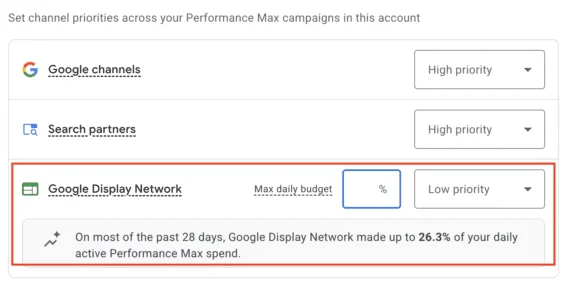
To utilize the new feature effectively, advertisers must look beyond surface-level metrics and examine the intersection of 28-day spend percentages and conversion outcomes. When an advertiser toggles a specific channel to a "Low" priority setting within the Google Ads interface, the platform begins displaying the precise 28-day spend percentage allocated to that channel.

However, platform experts emphasize that spend percentages alone do not paint a complete picture of channel efficacy. For instance, initial data from early adopters reveals scenarios where a channel such as the Google Display Network might consume roughly 26% of a campaign’s total budget over a given period. Viewed in isolation, that figure might prompt concern from a cost-conscious media buyer looking to trim fat.
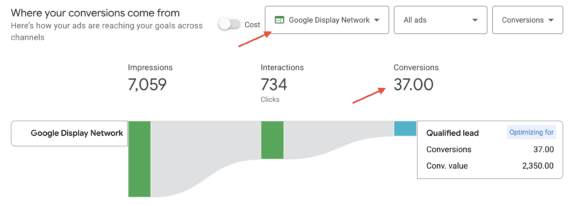
To determine the true value of the placement, advertisers must cross-reference these metrics with the channel performance report, located within the "Insights and reports" section of the dashboard. In a representative case study shared by industry practitioners, a broader Performance Max campaign generated a total of 77 conversions. A deeper dive into the channel performance report revealed that 37 of those conversions originated specifically from the Display Network. This meant that the channel accounted for 48.1 percent of the campaign’s total conversions while consuming only 26.3 percent of the total budget.
By calculating this efficiency ratio, advertisers can logically conclude whether a channel deserves a "High priority" status or if it should be constrained. Channels that drain excessive budgets while generating disproportionately low conversion counts can now be categorized as "Low priority," giving advertisers the capability to establish maximum daily-spend percentages to limit financial exposure.
Implementation at Account and Campaign Levels
Flexibility is a primary design element of the new channel prioritization framework. Google has structured the feature so that advertisers can implement prioritization rules at either the account level or the individual campaign level, depending on the operational scale and structural complexity of the advertising portfolio.
For smaller digital marketing accounts managing a limited number of campaigns, account-level settings offer a streamlined, centralized approach to enforcing broad channel preferences. Conversely, larger enterprise accounts managing complex, multi-layered portfolios spanning diverse geographic regions or product categories will likely benefit from granular, campaign-level prioritization. This allows media buyers to tailor their channel preferences dynamically based on the unique objectives of each distinct campaign.
For example, an e-commerce brand running a national holiday promotion may want to restrict display and partner network exposure aggressively on top-of-funnel conversion campaigns, while adopting a more permissive stance on brand-awareness initiatives. The ability to toggle settings per campaign provides a level of tactical agility that was previously unattainable without splitting budgets into entirely separate, siloed campaigns.
Practical Applications and Testing Opportunities
The arrival of channel prioritization has been met with cautious optimism across the digital marketing community. Many veteran media buyers are viewing the update as a valuable testing ground for channels they had previously abandoned entirely due to efficiency concerns.
One prominent area of interest involves Google’s Search partners. For years, numerous digital advertising specialists maintained a strict policy of opting out of Search partner networks, arguing that these secondary properties frequently delivered low-quality traffic, inflated click-through metrics, and ultimately wasted valuable ad spend without driving meaningful revenue.
Previously, the decision to test Search partners required a risky all-or-nothing commitment that often resulted in degraded campaign efficiency. With the implementation of channel prioritization, advertisers can now re-introduce Search partners into their standard Search campaigns under a "Low" priority designation backed by a strictly controlled, minimal budget. This controlled testing environment allows marketers to gather empirical data on partner network performance within their specific industry verticals, replacing long-held assumptions with verifiable performance metrics.
Notable Limitations and Structural Constraints
Despite the clear benefits of channel prioritization, industry analysts and practitioners have quickly identified several notable limitations that temper overall enthusiasm.
The most significant constraint involves Google’s broad categorization of "Google channels." Under the current framework, Google groups multiple distinct properties—such as Search, Maps, Discover, and Gmail—into a single collective bucket, forcing advertisers to apply a uniform priority setting across all of them simultaneously.
This grouping creates an operational paradox. Each of these five individual channels typically exhibits vastly different user intent, engagement patterns, and conversion efficiencies. Google’s own channel performance reports track each of these properties separately, implicitly acknowledging that they perform independently. Yet, the prioritization tool denies advertisers the ability to isolate and manage them individually.
Consequently, if a campaign performs exceptionally well on Google Search but struggles to generate meaningful engagement or conversions on Google Maps, an advertiser cannot elevate Search while suppressing Maps. Instead, they are locked into a collective setting that echoes the very all-or-nothing restrictions the update was ostensibly designed to dismantle, albeit applied to a slightly smaller cluster of platforms.
Furthermore, digital marketing professionals are monitoring how strictly Google’s automated bidding algorithms will respect the newly introduced maximum daily-spend percentages for Low-priority channels. Because machine-learning models are heavily incentivized to maximize conversion volume based on overarching target return on ad spend (ROAS) or cost-per-acquisition (CPA) targets, questions remain regarding whether the system will reliably suppress spend on restricted channels during periods of high market volatility or if automated loops will find workarounds that breach advertiser intent.
Broader Industry Implications and Future Outlook
The launch of channel prioritization marks a critical step in the ongoing dialogue between digital advertising platforms and the professionals who fund them. As automated, AI-driven campaign types continue to dominate the digital landscape, the demand for transparency, accountability, and tactical control has never been higher.
By acknowledging the need for more nuanced budget allocation tools, Google is signaling a responsiveness to enterprise and agency feedback. However, the success and long-term adoption of channel prioritization will largely depend on future platform updates. Advertisers are already calling for Google to expand the feature by dissolving the restrictive "Google channels" grouping, allowing for true, channel-by-channel isolation and control.
For now, digital marketers are advised to audit their existing high-spend campaigns, cross-reference their 28-day spend percentages with hard conversion data, and cautiously implement prioritization rules where budget leakage is evident. As these features mature and more empirical data becomes available, the industry will gain a clearer understanding of whether channel prioritization represents a permanent shift toward advertiser empowerment or merely an incremental adjustment within a fundamentally automated ecosystem.
Related posts: