The Aftershocks of the Midterms: Energy Stocks Plunge as Democratic Blue Wave, Data Center Backlash, and Iran Peace Hopes Reshape Markets


The American energy landscape experienced a profound and unexpected realignment on Wednesday following a stunning "blue wave" in the midterm elections. While broader Wall Street indices celebrated the prospect of legislative gridlock—sending the Dow Jones Industrial Average surging by roughly 3%—the energy sector moved in a starkly opposite direction. Traditional fossil fuel giants, aggressive independent power producers banking on the artificial intelligence infrastructure boom, and major oil refiners all suffered significant pullbacks.
At the same time, renewable energy developers, clean power suppliers, and utilities anchored in reliably red states enjoyed a notable rally. This market turbulence was triggered by a convergence of macroeconomic and political shifts: crude oil prices plummeted to one-month lows on renewed optimism surrounding Iran peace talks, voters delivered a clear message of discontent over spiking utility and fuel costs, and local ballot initiatives overwhelmingly clamped down on the rapid, energy-intensive expansion of data centers.
The Market Shocks: Winners and Losers on Wall Street
The financial fallout was swift and punishing for companies heavily exposed to the intersection of fossil fuels, state-level political surprises, and the burgeoning power demands of the artificial intelligence revolution. Analysts pointed to what many are calling the "Texas shock"—a series of unexpected Democratic victories in traditionally deep-red Texas that severely jeopardized the immediate outlook for localized infrastructure expansion.
NRG Energy and Vistra Corp., both of which have been aggressively building out natural gas-fired power generation in Texas to supply the massive electricity needs of incoming data centers, saw their stock values plummet by 12% and 15%, respectively. GE Vernova, a major manufacturer of gas turbines, dipped by 10%. Jefferies analyst Julien Dumoulin-Smith noted that the sheer magnitude by which Texas voted Democratic caught investors off guard, immediately imperlying the timeline and viability of major data center developments across the region.
Tesla and SpaceX CEO Elon Musk, whose business empire is anchored in Texas and who reportedly poured hundreds of millions of dollars into supporting Republican candidates during the midterms, took to social media to voice his frustration. Posting on X, Musk quipped, "Data centers in space looking pretty appealing right now."
Oil and gas producers likewise felt the pinch as global benchmark crude oil prices tumbled by roughly 8% to dip below $100 per barrel for the first time in nearly a month. ExxonMobil and Chevron declined by 4% and 5%, respectively. Downstream refiners Marathon Petroleum and Valero Energy, both of which had recently posted record profitability, suffered steep losses of 9% and 7%, respectively.
Conversely, the market rewarded companies positioned on the other side of the political and technological ledger. Utilities operating within states that successfully defended their Republican strongholds, such as Florida, saw immediate gains. NextEra Energy jumped 5%, and Duke Energy rose 3%. Renewable energy equities also surged alongside expectations of a more green-friendly federal and state apparatus: First Solar climbed over 4%, while solar component manufacturer Nextpower spiked by 13%. Quanta Services, a top transmission line developer, fell 12% amid uncertainties surrounding grid infrastructure legislation, though broader clean-tech sentiment remained generally buoyant.
A Referendum on Inflation, Energy Bills, and the Cost of Living
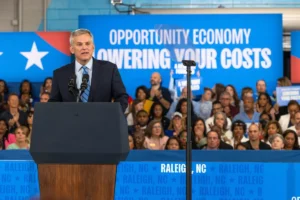
According to energy policy experts and political analysts, the election results served as a sweeping nationwide referendum on inflation, mounting utility bills, and the pervasive cost-of-living crisis that has dominated kitchen-table discussions over the past several years. Charles Hua, executive director of the nonprofit PowerLines, described the seismic political shift—stretching from congressional races to gubernatorial contests and state public service commissions—as a direct reaction to systemic economic instability.
"You only get such seismicity in political results if something is fundamentally unsteady or unstable, and I think one of the big manifestations of that really has been energy costs," Hua told reporters.
Voter dissatisfaction was not merely abstract; it manifested directly at the ballot box. Across the country, more than 40 local ballot measures were introduced to restrict, regulate, or temporarily halt the construction and operation of data centers. In a striking statistic, every single one of those measures passed, with the sole exception of a single initiative in North Dakota.
These local rebuffs highlight a growing grassroots friction between communities facing skyrocketing household electricity bills and the hyper-growth of data-intensive artificial intelligence facilities, which strain local water and power grids. Major growth hubs for data centers—including Texas, Georgia, and Ohio—all saw Democratic gubernatorial challengers secure victories while actively campaigning on platforms that called for strict data center moratoriums or heightened regulatory oversight.
The Fate of Energy Permitting Reform in the Lame-Duck Session
Beyond state-level surprises, the midterm outcome has cast a long shadow over federal legislative efforts, most notably the pending bipartisan energy permitting reform bill. The legislation, designed to expedite the construction of energy projects of all kinds—balancing long-distance transmission lines for renewable energy with crucial oil and gas pipelines needed to fuel the AI boom—now faces an uncertain path forward.
Prior to the election, Wall Street analysts viewed the Bipartisan American Affordability and Jobs Act (BAAJA) as having a moderate chance of passing during the upcoming lame-duck session before a newly sworn-in Congress takes office. However, following the Democratic gains, TD Cowen analysts dramatically slashed their projection for the bill’s passage during the lame-duck window from 40% to 25%.
With enhanced political leverage heading into the next legislative term, anti-fossil fuel Democrats are increasingly incentivized to adopt harder negotiating tactics. Many are expected to push for a delay, hoping to strip out fossil fuel pipeline provisions and advance a much narrower, clean energy-transmission-focused package next year—or scrap the deal entirely. Such a strategy carries inherent political risks, as any final package would still require the signature of President Donald Trump.
Despite the headwinds, some federal lawmakers are urging pragmatism. Senator Sheldon Whitehouse (D-R.I.), a prominent Democratic sponsor of the permitting legislation, issued a strong appeal to his party to maintain support for the compromise package.
"Democrats ran and won on affordability, and this bill lowers costs for families and will allow us to start delivering on our election promises," Whitehouse said in a statement. "It’s a bird in the hand. We’d be fools not to take it."
Geopolitical Shifts and the Outlook for Global Oil Markets
The sudden drop in crude oil prices was further accelerated by shifting geopolitical narratives surrounding the ongoing conflict in Iran. President Donald Trump publicly downplayed the likelihood of a major military escalation, while Vice President JD Vance explicitly pointed to the war as a primary contributor to his party’s midterm electoral setbacks.
Dan Pickering, founder of Pickering Energy Partners and a veteran oil market forecaster, noted that the election results effectively signal that the Trump administration will face significantly more domestic pushback and constrained maneuverability regarding its foreign policy in the Middle East.
"We had a referendum on inflation, high oil prices, and Trump in general," Pickering observed. "It feels like Trump will have more pushback and less maneuverability around how he wants to conduct the conflict in Iran."
Nonetheless, Pickering warned that despite optimism surrounding potential peace talks, the underlying geopolitical conflict remains far from resolved. Without a clear, stable diplomatic compromise on the horizon, the risk of renewed friction remains high.
"I think the Iran conflict gets more complicated for the U.S. We’ve been looking for an off-ramp, but we want an off-ramp that doesn’t leave the Middle East in chaos," Pickering explained. "I think that issue probably transcends the election. Even with more Democrats, I don’t think they’re going to want a bad outcome for the Iran crisis. Oil is down, but it’s not cratering."
Looking Ahead: Balancing AI Ambitions with Community Demands
As policymakers, corporate executives, and Wall Street investors digest the new political reality, the primary focus moving forward will center on the delicate balancing act between technological innovation and consumer affordability. The exponential power demands of the artificial intelligence boom had initially fostered a rare moment of bipartisan consensus around an "all-of-the-above" energy strategy.
However, the local backlash against data centers and the political realignment in key industrial states suggest that future infrastructure development will face stringent new hurdles. Whether local government "moratoria" translate into permanent roadblocks or simply temporary pauses for better resource planning remains one of the defining questions for the coming year. What is certain, however, is that energy costs and grid reliability have firmly cemented themselves as paramount electoral issues—one that can rapidly shift markets, alter legislative trajectories, and reshape the fortunes of the nation’s largest energy corporations.
Related posts: