How AgentFlo Scaled Autonomous Commerce AI with Amazon Bedrock AgentCore and AWS Serverless Architecture

Deploying artificial intelligence agents for enterprise commerce at scale has traditionally forced developers to navigate a precarious balancing act between high-volume operational performance and rigorous transaction security. As digital marketplaces face increasingly volatile traffic spikes, retail platforms require autonomous systems that can manage real-time customer interactions, execute secure transactions, and maintain absolute reliability without exposing proprietary data or risking operational failures. Addressing these fundamental enterprise hurdles, commerce technology innovator AgentFlo has developed an advanced agentic architecture built on Amazon Bedrock AgentCore and AWS serverless infrastructure. This strategic technological deployment highlights a significant evolution in how modern cloud-native enterprises handle customer-facing automation, achieving a measurable net revenue uplift of 12 percent during early implementation phases.
The architectural framework behind AgentFlo’s deployment represents the second installment of a comprehensive two-part technical series, following a foundational exploration of system velocity, standardization, and scalability. While initial development phases focused on rapid deployment pipelines and consistent operational baselines, subsequent engineering efforts targeted the complex requirements of autonomous commercial trust and long-term data reliability. In modern digital commerce, deploying conversational AI extends far beyond simple text generation. Autonomous agents frequently execute sensitive operations, including cart modifications, order placements, discount applications, and direct queries into protected backend enterprise systems. Consequently, ensuring that artificial intelligence models operate strictly within defined commercial and security boundaries has emerged as a paramount engineering priority for global retail enterprises.
Addressing Trust and Autonomous Governance at Scale
Enterprise merchants have consistently expressed reluctance to deploy fully autonomous AI agents without comprehensive governance frameworks that mitigate operational risks. Without strict regulatory and architectural guardrails, an AI agent operating in a live production environment risks exposing confidential customer data, authorizing unverified promotional discounts, or inadvertently accessing unauthorized account profiles. Furthermore, commercial deployments face persistent vulnerabilities such as prompt injection attacks, price hallucinations, unauthorized application programming interface tool calls, and credential exposure. Additionally, distinct business models demand highly granular access control mechanisms. Business-to-business enterprises often require tightly restricted access protocols limited strictly to pre-authenticated corporate buyers, whereas consumer-facing retail applications typically require open, frictionless accessibility to maximize market reach.
To resolve these security vulnerabilities, AgentFlo implemented a defense-in-depth security model that separates the AI model’s probabilistic reasoning loop from deterministic policy enforcement. In this architecture, the language model proposes prospective actions, but deterministic policy engines ultimately decide whether those actions execute. This rigorous control mechanism operates across three distinct phases of the agent lifecycle: pre-request filtering, active tool execution, and post-response privacy screening.
During the initial ingestion phase, an AWS Fargate layer actively inspects incoming communications for potential prompt injection attacks and manages user opt-out preferences before messages ever reach the core agent runtime. For messaging platforms such as WhatsApp, incoming requests are authenticated using unique phone number identifiers. Enterprise clients enforce strict access parameters, whereas open deployments maintain flexible entry points for general consumers.
During the intermediate tool execution phase, the Amazon Bedrock AgentCore layer validates user identity and enforces stringent operational locks. The AgentCore Gateway applies explicit access policies that prevent sales agents from inadvertently accessing customer support utilities. Simultaneously, Cedar—an open-source policy authorization language developed by Amazon Web Services—enforces granular business logic, such as maximum allowable discount thresholds, independently of the underlying artificial intelligence model. Furthermore, integration with Amazon Bedrock Guardrails allows Cedar policies to invoke configurable safeguards directly at the gateway boundary for prompt attack detection, content filtering, and sensitive data masking.
Finally, post-turn privacy filters systematically screen all generated outputs to eliminate accidental token disclosures and unverified pricing claims before responses reach the end user. Underpinning this infrastructure, sensitive credentials and cryptographic secrets are managed securely via AWS Secrets Manager, supported by OpenID Connect authenticated continuous integration and continuous delivery pipelines that ensure zero credentials ever reside directly within the agent application codebases.
Real-Time Observability and End-to-End Analytics
Maintaining absolute trust in autonomous commercial systems requires comprehensive, real-time visibility into operational behaviors rather than retroactive analysis after system anomalies occur. AgentFlo incorporated AgentCore Observability to establish end-to-end tracing across every individual agent interaction, capturing telemetry data from the initial user request through intermediate tool execution to the final customer response. Structured execution traces record essential performance metrics, including foundational model latency, sequential tool invocation paths, aggregate token consumption rates, and operational error frequencies.
These telemetry streams route directly into Amazon CloudWatch, powering real-time administrative dashboards that display active user sessions, latency distributions, and prevailing tool usage patterns. By leveraging granular request-to-response traces, engineering teams can perform rapid trace-level debugging, monitor P50 and P95 latency profiles, and configure automated alerts when runtime behaviors deviate from established performance baselines. Additionally, integrated cost attribution mechanisms deliver precise per-merchant and per-agent financial breakdowns mapped directly to specific customer interactions, providing stakeholders with clear insight into operational expenditure versus commercial return on investment.
Data Foundations and Stateful Session Management
Reliable commercial agents require robust, verified data foundations to prevent hallucinations and maintain contextual continuity across extended customer interactions. In digital retail environments, consumer purchasing journeys frequently span multiple hours or even several days, transitioning from initial product inquiries to comparative evaluations and eventual transaction completions. An effective commerce agent must retain comprehensive conversation history and manage session state seamlessly so that customers are never forced to restart interactions.
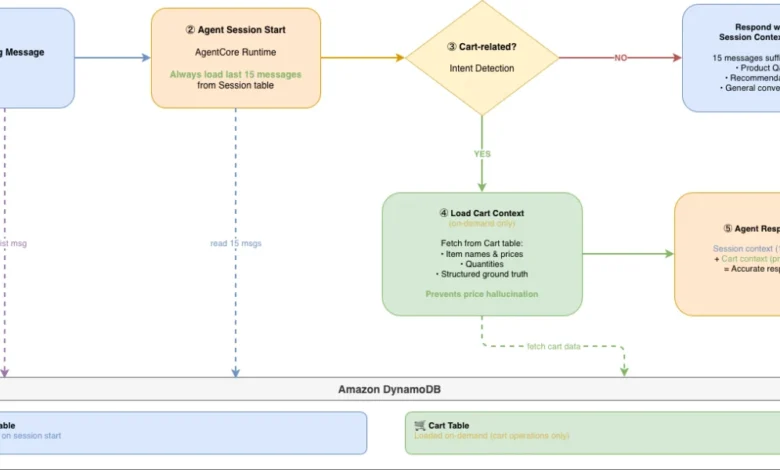
AgentFlo addresses this requirement through a stateful architecture combining Amazon Bedrock AgentCore runtime environments with Amazon DynamoDB. At the inception of each conversational turn, the runtime retrieves the preceding message history from a dedicated session table, while cart-related data tables are queried exclusively on-demand when intent detection algorithms confirm active purchasing behavior. This selective data loading strategy prevents language models from generating incorrect pricing figures or inventory quantities.
Furthermore, merchants upload proprietary business data—including restaurant menus, clinical policies, product specifications, and promotional calendars—into Amazon Bedrock Knowledge Bases backed by Amazon Simple Storage Service. This configuration enables agents to reason over authoritative, up-to-date merchant information without requiring manual prompt engineering. To enhance product discovery, AgentFlo incorporates semantic search capabilities by assigning lightweight vector embeddings to every catalog item stored within Amazon Aurora databases. Consequently, natural language phrasing such as conversational references to specific colors, sizes, or packaging details accurately maps to correct inventory items, significantly improving the intuitiveness of customer interactions.
Measurable Commercial Impact Across Early Deployments
Evaluated across a comprehensive 90-day early deployment period comparing agent-assisted customer journeys against traditional control groups, AgentFlo’s platform delivered profound quantitative improvements across the entire customer lifecycle. Net revenue across participating merchants experienced an average uplift of 12 percent. Concurrently, customer engagement metrics rose by 40 percent, conversion rates improved by 15 percent, average order values increased by 8 percent, and customer reactivation rates grew by 20 percent.
Given that AgentFlo processes approximately $300 billion in annual transacted commercial value across its broader ecosystem, even single-digit operational efficiencies generate billions of dollars in incremental revenue for participating merchants. Beyond direct financial metrics, merchants reported substantial operational enhancements, including reduced customer service ticket volumes, accelerated checkout completion times, and consistent brand compliance across multilingual communication channels.
Future Technological Roadmap: Voice Integration and Server-Side Execution
Looking toward the future of autonomous enterprise commerce, AgentFlo is actively expanding its technological platform across three primary development tracks. The first major initiative involves the integration of real-time voice agents. While the platform currently supports voice notes within messaging channels via multi-pass transcription and domain-aware catalog matching, engineers are currently piloting advanced bidirectional audio streaming solutions powered by the Strands SDK BidiAgent and Amazon Bedrock AgentCore WebRTC support. This infrastructure enables natural conversational interruptions, concurrent tool execution during live voice calls, and peer-to-peer audio transport for mobile and browser environments without requiring centralized relay infrastructure.
Concurrently, AgentFlo is pioneering server-side tool execution within Amazon Bedrock to eliminate traditional client-side orchestration loops. By utilizing the Amazon Bedrock Responses API alongside AgentCore Gateway Model Context Protocol connectors, the AI model independently discovers, invokes, and processes backend tools entirely within secure cloud infrastructure via a single API call. Early benchmark testing indicates that this architecture reduces specialized agent latency by approximately 30 percent while simplifying developer onboarding and ensuring all sensitive API credentials remain securely contained within server-side environments.
Through the systematic integration of advanced policy controls, stateful data foundations, and high-performance serverless infrastructure, AgentFlo has established a scalable blueprint for autonomous enterprise commerce. As organizations increasingly adopt agentic artificial intelligence systems, these robust architectural patterns demonstrate that high-volume scalability and rigorous enterprise trust can be successfully deployed in tandem to drive measurable commercial growth.
Related posts: