AWS Builder Center Celebrates First Anniversary, Marking a Year of Rapid Ecosystem Expansion and Community Engagement

The AWS Builder Center, a pivotal platform designed to foster innovation and skill development within the Amazon Web Services ecosystem, recently commemorated its first anniversary. Launched on July 9, 2025, the platform has rapidly evolved from a foundational community hub into a comprehensive ecosystem, providing an array of resources, tools, and interactive environments for cloud developers worldwide. The anniversary, marked by significant growth and feature rollouts, underscores AWS’s strategic commitment to empowering its vast global community of builders.
Initially conceived as a vibrant community hub offering Wishlist voting, personalized community profiles, and a developer toolbox, the AWS Builder Center has significantly expanded its capabilities over the past year. Its current iteration boasts sandbox environments, structured workshops, dedicated "Spaces" for community-created groups, and an extensive Builders’ Library. This transformation reflects a concerted effort to create a holistic learning and collaboration environment that caters to the diverse needs of cloud professionals, from novices to seasoned architects.
A Chronology of Growth: Key Milestones and Feature Rollouts
The journey of the AWS Builder Center over its inaugural year has been characterized by continuous innovation and a responsive approach to community feedback. The platform’s initial launch on July 9, 2025, laid the groundwork for its community-centric model. Since then, a steady stream of enhancements has been introduced, significantly enriching the user experience and expanding the platform’s utility.
Among the notable features shipped in its first year, as detailed in a comprehensive timeline published by Rick Suttles, are:
- AWS Capabilities by Region: An invaluable resource now cataloging over 1,500 services across 37 AWS Regions, providing builders with critical information for architectural planning and deployment.
- Spaces for Community-Created Groups: Facilitating more organized and focused collaboration among builders with shared interests or project goals.
- Workshops with Category and Complexity Filters: Enhancing the discoverability and relevance of educational content, allowing users to tailor their learning paths effectively.
- Badges and Streaks: Introduced in March 2026, these gamification elements incentivize continuous learning and engagement, fostering a sense of achievement and community participation.
- Article Series and View Counts: Improving content organization and providing authors with insights into the impact of their contributions.
- Saved Items and Student Status: Personalizing the user experience by allowing easy access to preferred content and recognizing the specific needs of student builders.
- Availability Notifications: Keeping users informed about new content or feature releases.
- Enhanced Sign-in Options: Streamlining access with support for GitHub and Amazon accounts.
- Sandbox Environments: The latest headline addition, providing free, temporary AWS accounts for hands-on workshop exercises.
This chronological expansion demonstrates AWS’s agile development philosophy and its dedication to building a platform that truly serves its community. Each feature rollout has been strategically aligned with the overarching goal of making cloud development more accessible, collaborative, and rewarding.
Quantitative Success: A Retrospective on Community Engagement
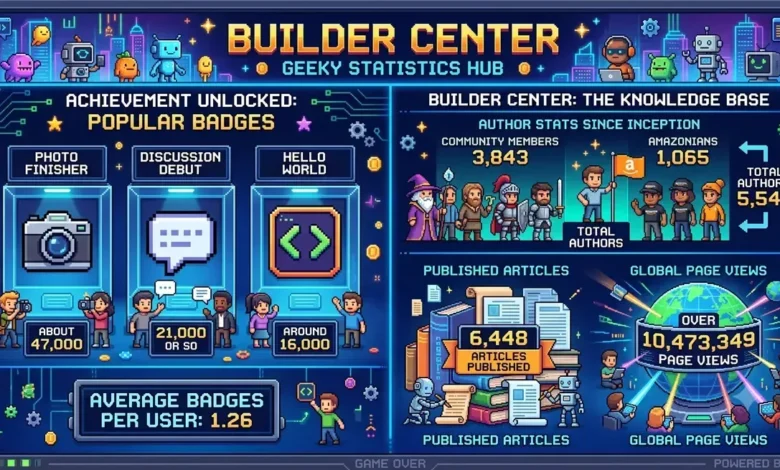
Jeff Barr, a prominent voice within the AWS community, offered a retrospective summarizing the Builder Center’s remarkable first year. His insights reveal compelling statistics that underscore the platform’s rapid adoption and impact:
- Authors and Articles: Since its inception, an impressive 5,548 authors have contributed 6,448 articles, transforming the platform into a rich repository of community-generated knowledge. This extensive content library covers a vast spectrum of AWS services, use cases, and best practices.
- Page Views: The collective wisdom shared through these articles has garnered more than 10.4 million page views, indicating a significant thirst for practical, real-world AWS insights from the community.
- Badges Earned: Since the launch of the badge system in March 2026, builders have collectively earned 99,226 badges, highlighting the success of gamification in driving engagement and recognizing skill acquisition.
- Community Wishlist Impact: The community’s active participation extends to shaping the platform itself. Members have submitted 565 wishes for new features or improvements, with 10 already shipped and another 20 firmly placed on the near-term roadmap. This direct feedback loop is a testament to the platform’s community-driven development model.
These figures paint a vivid picture of a thriving, engaged community actively contributing to and benefiting from the AWS Builder Center. The platform’s ability to attract thousands of authors and millions of views in its first year signifies its critical role in the broader AWS learning and development ecosystem.
Spotlight on Community-Driven Content: Top-Performing Articles
The quality and relevance of community-contributed content are central to the AWS Builder Center’s success. Several articles have stood out, demonstrating the practical value and innovative spirit of the platform’s authors:
- "Building an AWS Study Buddy with MCP + Strands Agents SDK" by Dineshraj Dhanapathy: This article topped the charts with over 50,000 views. Its popularity can be attributed to its timely focus on leveraging advanced AI services (like Strands Agents SDK and MCP) for practical learning applications, resonating with builders seeking to enhance their AWS proficiency through intelligent tools.
- "Migrating an EOL Linux Server to AWS in 8 Hours with Kiro" by Chris Miller: Securing the second spot with over 45,000 views, this piece addresses a common, critical challenge faced by many organizations: modernizing legacy infrastructure. The promise of a rapid, efficient migration process using specific tools like Kiro likely made it highly appealing to IT professionals and cloud architects.
- "AIdeas: NeuroVoice – Multimodal AI for Early Screening of Neurological Diseases" by Yash Aggarwal: Reaching over 38,000 views, this article exemplifies the innovative and impactful applications of AWS technologies in critical domains like healthcare. Its exploration of multimodal AI for early disease screening highlights the transformative potential of cloud computing beyond traditional IT.
These top-performing articles underscore the diverse range of topics covered on the platform, from practical skill-building and infrastructure modernization to cutting-edge AI research and real-world problem-solving. They serve as a powerful testament to the expertise and ingenuity of the AWS builder community.
Empowering Hands-on Learning: The Introduction of Sandbox Environments
A significant development coinciding with the anniversary celebrations is the introduction of Sandbox Environments, spearheaded by Rick Suttles. This feature directly addresses a long-standing challenge for aspiring cloud professionals: gaining hands-on experience without incurring costs or managing complex account setups.
Sandbox Environments provide users with a free, pre-provisioned AWS account specifically designed to complete workshop exercises. Key features of this offering include:

- Cost-Free Access: Eliminating the need for a personal AWS account or credit card, significantly lowering the barrier to entry for new learners.
- Pre-provisioned Resources: Accounts come ready with necessary configurations, allowing builders to dive directly into exercises without initial setup overhead.
- Temporary and Secure: Each environment remains active for 8 hours, after which the account and all its provisioned resources are automatically de-provisioned. This ensures resource cleanup and prevents unintended costs.
- Controlled Usage: Users can have one active sandbox at a time and request one per week, promoting focused learning while managing resource allocation.
The strategic implications of Sandbox Environments are profound. They democratize access to practical cloud experience, enabling a wider audience to learn and experiment with AWS services. This initiative directly supports AWS’s mission to upskill the global workforce and accelerate cloud adoption by providing a risk-free, hands-on learning environment. It removes a significant hurdle for students, career changers, and those hesitant to experiment with live cloud environments, making the journey to cloud proficiency more accessible than ever.
Broader Impact and Strategic Implications
The AWS Builder Center’s first year of operation has cemented its position as a critical component of AWS’s broader strategy for developer enablement and ecosystem growth. The platform serves multiple strategic objectives:
- Addressing the Cloud Skills Gap: By providing free learning resources, workshops, and now sandbox environments, the Builder Center directly contributes to mitigating the global shortage of skilled cloud professionals. It offers a structured yet flexible pathway for individuals to acquire and validate AWS competencies.
- Fostering Community and Collaboration: The platform’s emphasis on community profiles, Spaces, and the Wishlist cultivates a strong sense of belonging among builders. This collaborative environment encourages knowledge sharing, peer-to-peer learning, and collective problem-solving, which are vital for innovation in a rapidly evolving technological landscape.
- Driving AWS Adoption and Innovation: By making it easier for developers to learn, experiment, and build on AWS, the Builder Center indirectly drives the adoption of AWS services. The innovative projects and solutions shared by the community also highlight the vast potential of AWS, inspiring further development and pushing the boundaries of what’s possible with cloud technology.
- Content Curation and Dissemination: The Builder Center acts as a centralized, trusted source for high-quality, community-vetted content. This helps users navigate the vastness of AWS documentation and tutorials, finding relevant and practical solutions quickly. The success of top articles demonstrates the demand for such curated, experience-based insights.
Reflecting on this milestone, an AWS spokesperson underscored the company’s satisfaction with the Builder Center’s achievements. "The rapid growth of the AWS Builder Center, both in terms of content and community engagement, is a testament to the passion and ingenuity of our global builder community," the spokesperson stated. "Our goal has always been to empower developers with the resources they need to innovate, and the platform’s evolution, particularly with the introduction of Sandbox Environments, significantly advances that mission. We are deeply committed to fostering this vibrant ecosystem and look forward to even greater collaboration and innovation in the years to come."
The platform’s continuous development, driven by community feedback through the Wishlist, indicates a strong future trajectory. The 20 wishes currently on the roadmap suggest that AWS intends to keep the Builder Center at the forefront of developer experience and education.
Beyond the Builder Center: A Unified AWS Experience
While the AWS Builder Center serves as a focal point for community and learning, it operates within a broader ecosystem of AWS resources. Builders are encouraged to supplement their experience by regularly monitoring the "What’s New with AWS" page for the latest service announcements and the "AWS Blogs" page for in-depth technical insights and best practices from AWS experts. The platform also highlights upcoming AWS events, ensuring that builders have opportunities for continuous learning, networking, and direct engagement with AWS teams and the wider community.
The first anniversary of the AWS Builder Center marks not just a year of operation, but a year of accelerated growth, profound community impact, and strategic evolution. By democratizing access to hands-on learning through initiatives like Sandbox Environments and fostering a vibrant hub for knowledge exchange, the platform has firmly established itself as an indispensable resource for anyone looking to build, learn, and innovate on AWS. As it moves into its second year, the AWS Builder Center is poised to further strengthen its role in shaping the future of cloud development, continuing to empower the next generation of builders worldwide.
Related posts: