AWS Launches Enhanced Custom Event Bus to Streamline Enterprise Event-Driven Architectures

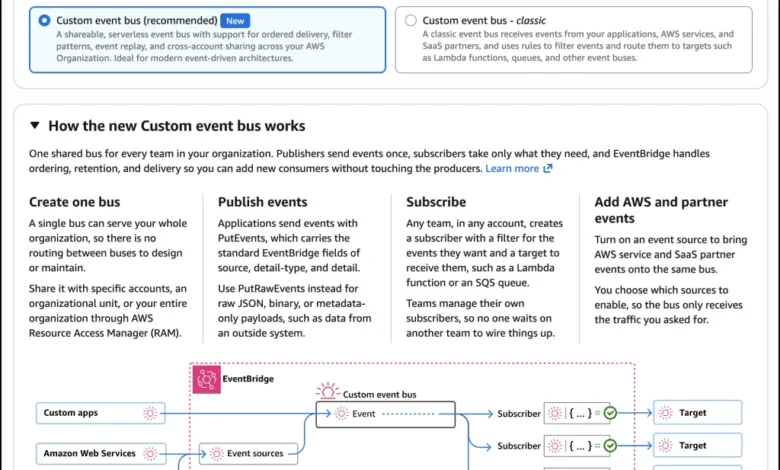
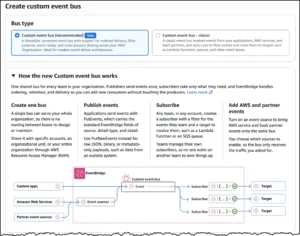
The evolution of cloud-native development has long favored the agility of event-driven architectures, yet as organizations scale their digital footprints, the complexity of managing these systems has increasingly become a bottleneck. Today, Amazon Web Services (AWS) announced the launch of an enhanced custom event bus for Amazon EventBridge, a strategic update designed to simplify cross-account event routing and eliminate the operational friction that has historically plagued large-scale, multi-account AWS environments. This development marks a significant shift in how enterprise platform teams manage event backbones, moving away from fragmented, multi-bus configurations toward a unified, centralized infrastructure model.
The Challenge of Multi-Account Complexity
For years, the standard architecture for event-driven applications on AWS involved the deployment of custom event buses within individual accounts. While this provided isolation, it created a "spaghetti" effect as organizations grew. As teams expanded, they were forced to implement complex cross-account rules or bus-to-bus configurations to maintain communication across disparate AWS accounts.
This operational overhead resulted in several critical pain points for engineering organizations. First, visibility suffered; platform teams struggled to maintain a clear audit trail of who was consuming which events. Second, the cost structure became inefficient, with routing charges compounding rapidly as events traversed multiple buses. Finally, the inherent limitations of standard event delivery—such as the lack of native ordering—forced developers to build elaborate custom workarounds or integrate third-party technologies to handle mission-critical data that required strict sequencing, such as logistics tracking or financial transactions.

Evolution of Amazon EventBridge: A Chronology
The introduction of this enhanced bus follows a decade of incremental improvements to AWS’s serverless event orchestration capabilities. Amazon EventBridge was originally launched as an evolution of CloudWatch Events, intended to provide a more robust, schema-driven approach to event-driven programming.
Since its rebranding and expansion in 2019, EventBridge has become the central nervous system for many AWS-native applications. However, the requirement for a unified, organizational-level event bus has been a frequent request from large-scale enterprise customers. By mid-2024, industry analysts noted a trend toward "platform engineering," where companies sought to consolidate their cloud infrastructure to reduce maintenance costs. Today’s release is a direct response to this trend, providing a centralized architecture that mirrors the organizational structure of large enterprises.
Core Features and Technical Capabilities
The new enhanced custom event bus introduces several architectural primitives designed to handle the scale of modern enterprise workloads:
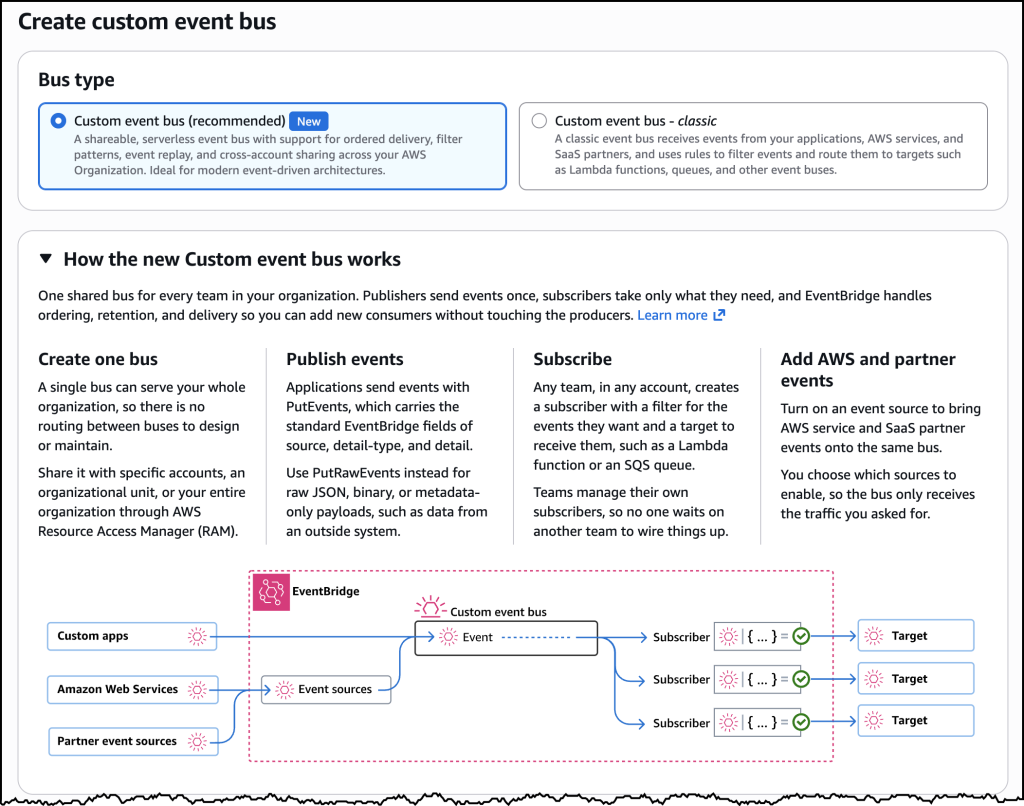
- Centralized Organization-Wide Sharing: Leveraging AWS Resource Access Manager (RAM), platform teams can now deploy a single event bus and share it across an entire AWS Organization, Organizational Unit (OU), or specific IAM principals. This removes the need for manual cross-account permission management.
- Ordered Delivery Guarantees: For applications where sequence is paramount, the bus introduces
EventGroupId. By tagging events with this ID, EventBridge ensures that events are delivered to subscribers in the exact order they were ingested, solving the long-standing "stale data" problem in time-sensitive applications. - The Subscriber Resource: A major shift in management, the Subscriber resource consolidates event filtering, target configuration, retry policies, and dead-letter queue (DLQ) settings into a single entity. This simplifies the previous requirement of managing disparate rules and target resources.
- Content-Based Deduplication: To address the "at-least-once" delivery model inherent in distributed systems, the new bus offers content-based deduplication. By hashing event payloads, EventBridge can automatically drop duplicate retries within a five-minute window, effectively providing "exactly-once" semantics for sources that cannot generate unique idempotency tokens.
- JSONata and Format Support: The platform now natively supports JSONata expressions for data transformation and provides built-in deserialization for Apache Avro and Protocol Buffers, allowing subscribers to filter and route based on full payloads without manual transformation logic.
Economic Implications and Cost Structure
A significant component of this release is the transition to a simplified throughput-based pricing model. In previous multi-bus configurations, the cost of moving events between accounts and across buses often created unpredictable billing spikes.

Under the new model, publishers pay for ingestion and subscribers pay for delivery. This shift provides greater cost transparency and enables organizations to allocate cloud spend more accurately to specific teams based on their actual consumption patterns. By eliminating the compounding routing charges associated with traditional multi-bus topologies, AWS aims to make large-scale event-driven architectures more economically viable for cost-conscious enterprises.
Implications for Platform Engineering
Industry experts view this development as a maturation of the serverless ecosystem. By moving the "plumbing" of event-driven systems into a native, managed service, AWS is effectively reducing the "undifferentiated heavy lifting" that platform teams must perform.
"The transition from managing infrastructure to managing policies is the defining characteristic of modern cloud platform engineering," noted an industry observer familiar with the release. "By providing a centralized bus with built-in ordering and deduplication, AWS is allowing developers to focus on business logic rather than building custom reliability layers on top of the infrastructure."
For existing users, the classic custom event bus remains available, ensuring that current workloads are not disrupted. The new enhanced bus is an opt-in resource, allowing organizations to migrate at their own pace. The availability spans multiple key AWS regions, including US East (N. Virginia, Ohio), US West (Oregon), and a significant footprint across Europe and the Asia-Pacific, signaling that the feature is intended for immediate, global adoption.
Looking Ahead
As organizations continue to decentralize their application architectures into microservices, the need for a robust, reliable, and observable event backbone has never been greater. With a default quota of 10,000 subscribers per bus, the enhanced EventBridge is clearly targeted at massive enterprise scale.
The integration of synchronous invocation for targets like AWS Lambda further suggests that AWS is aggressively closing the gap between event-driven systems and request-response patterns. By enabling high-reliability synchronous processing alongside asynchronous event streaming, AWS is providing a versatile toolset that could simplify the architecture of complex, mission-critical systems.
For organizations currently struggling with the "spaghetti" of multi-account event routing, this update offers a clear path toward consolidation. As teams begin to adopt these enhanced features, the industry will likely see a reduction in custom, infrastructure-heavy workarounds, leading to more resilient and maintainable cloud architectures. Developers and architects are encouraged to review the updated AWS documentation and experiment with the new bus configuration via the EventBridge console to understand how these features map to their specific operational requirements.
Related posts: