The Battle Over Artificial Intelligence Regulation Intensifies as Former Palantir Engineer Launches New Nonprofit to Counter Silicon Valley Lobbying

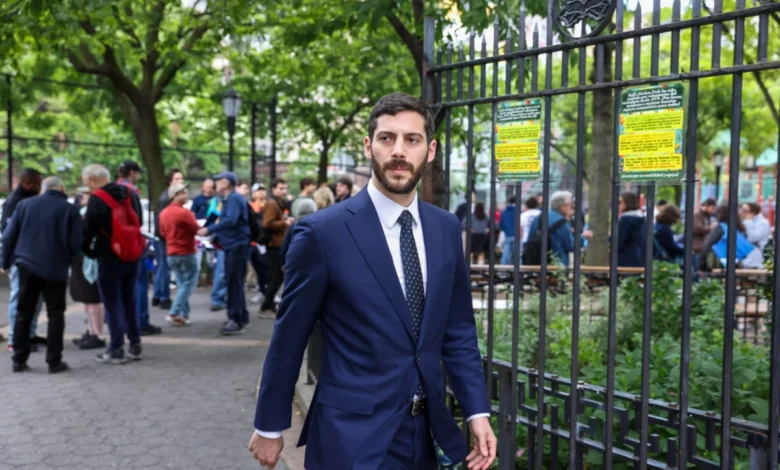
The political battleground surrounding artificial intelligence has entered a new and more organized phase, highlighted by the launch of "Who Decides," a newly formed political nonprofit created by New York State Assemblymember Alex Bores and his former chief of staff, Anna Myers. Bores, a former Palantir software engineer, established the organization following a grueling and financially historic congressional primary campaign in Manhattan. Bores ran on a pro-regulation platform, championing the pioneering frontier AI safety legislation known as the RAISE Act, which he co-authored in New York. Despite widespread public support for federal and state oversight of emerging technologies, Bores faced a massive onslaught of outside spending from industry-backed super PACs, ultimately losing the race.
The primary cycle underscored a profound tension in American politics: while a broad majority of voters across the political spectrum demand stricter guardrails for artificial intelligence, a heavily financed faction of Silicon Valley executives and mega-donors are aggressively spending to prevent legislative intervention. Who Decides aims to counter this influence by uniting trusted Democratic advocacy organizations, helping them streamline their legislative agendas, and establishing a unified front to ensure everyday citizens retain a voice in the technological revolution. With an initial fundraising haul of $10 million and a target of raising an additional $20 million through 2027, the nonprofit intends to deploy resources across eleven key battleground states ahead of the 2028 election cycle.
The Genesis of a Regulatory Crusade
The foundation of Who Decizes lies in the bruising political lessons learned during Bores’s recent congressional bid for the seat vacated by Representative Jerry Nadler. The primary became the most expensive House primary of the 2026 cycle, with total outside expenditures exceeding $40 million. A significant portion of that capital was deployed directly against Bores due to his hardline stance on artificial intelligence safety.
Leading the Future, a super PAC funded in part by OpenAI president Greg Brockman and venture capital firm Andreessen Horowitz, poured more than $7.6 million into opposition advertising against Bores. Conversely, groups like Public First Action—backed by a $20 million contribution from Anthropic—entered the fray to support him. Despite the heavy investment from pro-regulation entities, the sheer volume of anti-regulation spending and localized opposition proved insurmountable at the ballot box.
This financial arms race mirrored the legislative battles fought in Albany over the passage of the RAISE Act. Signed into law late last year by New York Governor Kathy Hochul following a contentious legislative session, the statute required building a massive, diverse coalition of 55 distinct organizations representing interests from academic AI policy to chatbot implementation in public education. According to Bores, the opposition was markedly different in composition. It consistently emanated from a narrow, well-financed subset of Silicon Valley figures who believe artificial intelligence development should remain entirely unfettered by government regulation.
Public Sentiment Versus Industry Lobbying
The disconnect between public desire for regulation and the political power of technology industry lobbying bears striking similarities to other contentious policy debates in the United States, such as firearm control. Data from organizations like Gallup and the Pew Research Center consistently demonstrate that substantial majorities of Americans—ranging from 56% to nearly 90%, depending on the specific measure—support common-sense regulations and background checks. Yet, federal legislative action remains sparse, a phenomenon political scientists frequently attribute to asymmetric lobbying power overcoming a diffuse public majority.
Polling data regarding artificial intelligence reveals a nearly identical trajectory. An independent survey conducted by the Annenberg Public Policy Center found that 65% of Americans believe the federal government has done "too little" to regulate artificial intelligence. This sentiment cuts across partisan lines, with majorities of Democrats (77%), independents (72%), and Republicans (53%) expressing a desire for greater oversight. Furthermore, broader polling regularly indicates that roughly 80% of voters across the political spectrum favor increased regulatory scrutiny of frontier models.
However, the messaging and positioning from prominent industry leaders have evolved unevenly, creating a gray area in public understanding. In May 2023, OpenAI CEO Sam Altman famously testified before the Senate Judiciary Committee and explicitly requested government regulation for advanced AI systems. By May 2025, however, Altman had shifted his stance, telling the Senate Commerce Committee that imposing federal government approval requirements would be "disastrous." Conversely, Anthropic CEO Dario Amodei maintained a consistently pro-regulation posture throughout successive legislative battles, even as capital linked to his company flowed into political campaigns.
Bores points out that while technology executives frequently oscillate in their public positions, a dedicated cohort of high-net-worth financiers—frequently identified as Republican mega-donors such as Marc Andreessen and Elon Musk—consistently fund efforts to block statutory oversight entirely. This financial pressure was visibly felt during the drafting of New York’s RAISE Act, which ultimately saw key provisions, including mandatory third-party audits and robust whistleblower protections, stripped away before the final text could pass the legislature.
Federal Maneuvering and the Threat to State Laws
The legislative tug-of-war has since shifted aggressively to Washington, D.C., where federal lawmakers are attempting to capitalize on mounting public anxiety and high-profile industry departures. The urgency surrounding federal oversight heightened following the September resignation of Jacob Coxon from Anthropic, an event that drew renewed scrutiny from congressional leaders and presidential hopefuls alike.
Federal lawmakers are currently weighing comprehensive safety frameworks, mirroring past attempts to preempt state-level authority. In 2025, Senator Ted Cruz introduced language into a major federal budget bill that would have placed a sweeping 10-year moratorium on all state-level artificial intelligence enforcement. Following intense pushback from a bipartisan group of 17 governors, the provision was ultimately struck down in a dramatic 99-1 Senate vote.
Despite that defeat, federal efforts to consolidate regulatory power have reemerged. Senator Cruz has partnered with Senator Amy Klobuchar and Senate Majority Leader John Thune to co-sponsor a new federal AI safety bill centered on mandatory safety testing and incident reporting. While policy experts view the bill as the most viable candidate for passage in the current congressional session, critics argue it serves as a federalized wrapper for Cruz’s previous preemption efforts—effectively dismantling state-level laws, such as New York’s RAISE Act, under the guise of national uniformity.
Bores has been candid about this legislative strategy, describing it as an effort by opponents to exploit a genuine national security and safety crisis to strip local populations of their sovereign regulatory power. "It’s people trying to use this momentum and this crisis to shut down the real power people have to regulate," Bores noted.
Strategic Alignment and the Path Forward
To combat the well-funded opposition threatening both state and federal oversight, Who Decides is deliberately bypassing traditional, top-down national lobbying campaigns. Rather than attempting to match the multi-million-dollar war chests deployed by groups like Leading the Future or Build American AI, the nonprofit is adopting a decentralized strategy. It is directly funding and coordinating with grassroots advocacy organizations already embedded within eleven strategic battleground states.
A central hurdle Bores hopes to overcome is the historical tendency of progressive and pro-regulation factions to fracture over ideological or tactical nuances—a phenomenon he describes as a "circular firing squad." He argues that well-intentioned advocates frequently dilute their collective political capital by prioritizing localized sub-issues over the broader, foundational consensus that unites them.
"Democrats are very passionate about making a difference, and that passion is usually well placed," Bores observed. "But that occasionally gets misdirected into turning into a circular firing squad and saying, no, my sub-issue is more important than your sub-issue."
By establishing what he terms a "shared floor of an agenda," Who Decides seeks to unify diverse stakeholders under a common banner: empowering the American public to actively participate in shaping how artificial intelligence develops and integrates into society. As the technological landscape accelerates and the political stakes of the 2028 election approach, the success or failure of Bores’s coalition may well determine whether the future of artificial intelligence is guided by democratic institutions or dictated by Silicon Valley boardrooms.