Hyperlight bridges the gap between high-speed sandboxing and robust security for modern cloud-native environments

The modern cloud-native ecosystem faces a significant security paradox: as the reliance on autonomous agents, AI-generated code, and third-party plugins grows, so does the risk surface of the host environments executing these processes. Organizations are increasingly executing code that was neither written nor audited by their internal engineering teams, creating an urgent need for isolation boundaries that are both lightweight and cryptographically secure. The CNCF Sandbox project Hyperlight, an embedded virtual machine monitor (VMM), has emerged as a critical response to this challenge, offering a novel approach to hardware-level isolation that functions at near-native speeds.
The Security Crisis: A Chronology of Vulnerabilities
The necessity for stronger code isolation has been underscored by a series of high-profile security incidents throughout 2026. The vulnerability of traditional runtime environments has been exposed, shifting the conversation from "if" a breach will occur to "how much" damage that breach can cause.
In May 2026, the industry witnessed the emergence of the "Mini Shai-Hulud" npm worm. This sophisticated malware targeted continuous integration (CI) runners and individual developer workstations. By embedding itself within session hooks associated with AI coding agents, the worm managed to persist even after the removal of the original npm packages. It successfully scanned over a thousand known file paths for sensitive credentials, demonstrating that modern development environments—often left with broad permissions—are prime targets for exfiltration.
This was followed in October 2026 by the disclosure of "PHP2Shell," a critical set of memory-handling vulnerabilities within the PHP runtime. The exploit allowed unauthenticated attackers to execute arbitrary code on servers, with evidence suggesting that threat actors were actively leveraging the flaw in the wild before an official patch was made available to the public. These events collectively highlight a fundamental flaw: when the runtime itself or the code executing within it is compromised, the only remaining defense is the strength of the isolation boundary between the workload and the host kernel.
The Trade-off: Performance vs. Protection
Historically, engineers have been forced to choose between two imperfect solutions for code execution. On one side are process or language-level sandboxes, which offer low-latency startup times—often in the range of milliseconds—but rely solely on software-defined boundaries. If a vulnerability exists within the kernel or the sandbox logic, the isolation is breached. On the other side are virtual machines (VMs), which utilize hardware-level hypervisors to provide superior isolation. However, VMs were designed to boot full operating systems, resulting in significant overhead and startup times that are often incompatible with high-frequency, event-driven cloud applications.
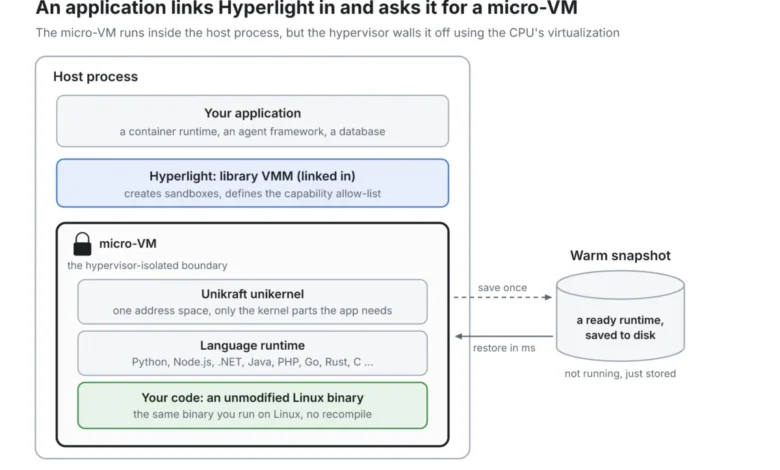
Hyperlight aims to collapse this dichotomy. As an embedded library VMM, it does not function as a monolithic, independent process like QEMU or Firecracker. Instead, it is linked directly into the host application. Written primarily in Rust, with SDKs for Python and .NET, Hyperlight allows developers to instantiate micro-VMs that leverage hardware virtualization extensions (such as KVM on Linux, MSHV on Windows, or Hypervisor.framework on macOS). By stripping away emulated devices and unnecessary kernel components, Hyperlight achieves a footprint that is significantly smaller and more secure than standard virtualization solutions.
Technical Evolution: Unmodified Linux Applications
A major milestone for the project is the introduction of hyperlight-unikraft. While previous iterations of Hyperlight were focused on WebAssembly and JavaScript, the new integration with the Unikraft unikernel project allows for the execution of unmodified Linux binaries.
This represents a paradigm shift for developers. Because the micro-VM runs a specialized operating system built for a single application with a singular address space, there is no need for re-compilation, special libraries, or porting efforts. Whether an organization is running Python, Node.js, .NET, Java, Go, or Rust, the binary that runs on a standard Linux server can run within a Hyperlight micro-VM.
The capability-based security model is perhaps the most significant feature for enterprise adoption. By default, the guest environment has no access to the host, no network connectivity, and no file system access. Permissions are granted via an explicit allow-list defined by the embedder. This "zero-trust" approach to code execution prevents horizontal movement, as demonstrated by tests involving known sandbox escape exploits like CVE-2023-26489. When executed within the Hyperlight boundary, the exploit—which would otherwise allow an attacker to read host memory—is confined to the micro-VM, resulting in a controlled guest crash rather than a host system compromise.
Data-Driven Performance: The Snapshot Advantage
The most common criticism of virtualized environments is latency. Hyperlight addresses this by utilizing a snapshot mechanism that effectively neutralizes the "cold start" problem. Many modern runtimes (such as Python or .NET) spend the majority of their startup time performing JIT compilation, loading frameworks, or initializing modules.
Hyperlight-unikraft performs these heavy-lifting tasks once, captures the state of the micro-VM as a snapshot, and restores it in milliseconds. Benchmarking data from November 2026 shows that for complex workloads, the restoration of a warm snapshot is substantially faster than starting a native process. For example, a Python script importing heavy libraries like numpy, pandas, and scikit-learn takes approximately 1,119 milliseconds to start natively, compared to just 45 milliseconds when restored from a Hyperlight snapshot.
These performance metrics suggest that Hyperlight is viable for high-concurrency environments. On an 8-vCPU Azure instance, the system was able to manage eight concurrent micro-VMs sharing a single Python snapshot, collectively handling roughly 850 calls per second. This efficiency makes it suitable for serverless functions, AI agent frameworks, and high-performance database extensions.
Ecosystem Integration and Broader Implications
The adoption of Hyperlight is currently manifesting across several key infrastructure categories:
- Container Orchestration: Through the
uruncintegration, Hyperlight-unikraft guests can be managed as OCI-compliant containers. This allows Kubernetes operators to utilize familiar tools likenerdctlorkubectlwhile benefiting from the hardware-level isolation of a micro-VM. - AI Agent Frameworks: Platforms like
smolagentsand MCP servers are integrating Hyperlight to isolate AI-generated code. By maintaining a micro-VM per session, these frameworks ensure that code execution is stateful during a single session but ephemeral and isolated between sessions. - Database Security: ClickHouse has begun exploring the use of Hyperlight for User Defined Functions (UDFs). By running Python-based UDFs within a micro-VM, the database ensures that one query cannot leave behind malicious code or state that would affect subsequent queries from different users.
- Model Training: The
verl-hyperlightintegration allows for secure execution of code-based test cases during reinforcement learning, ensuring that the training node remains protected while evaluating untrusted code solutions at scale.
Future Outlook
As the industry continues to integrate autonomous agents into the software development lifecycle, the distinction between "trusted" and "untrusted" code will continue to blur. The Hyperlight project represents a maturing of the cloud-native security stack, moving away from perimeter-based defenses toward a model where every unit of execution is treated as potentially compromised.
By providing a drop-in library that enforces hardware-level isolation without sacrificing the performance of modern runtimes, Hyperlight is well-positioned to become a standard tool in the cloud-native security toolkit. For organizations managing complex, multi-tenant, or AI-driven systems, the ability to isolate code execution in a few milliseconds at the cost of a lightweight library link is not just a performance optimization—it is an essential operational requirement. Development teams interested in exploring these capabilities can leverage the hluk CLI to begin initializing sandboxed environments, marking a transition toward a more resilient and secure cloud architecture.