Automating SCORM Course Publishing to Learning Management Systems Using Agentic AI and Kiro

Publishing educational or corporate training materials to a learning management system (LMS) has historically been an administrative bottleneck. While drafting the pedagogical content—such as slides, playbooks, and textual modules—demands creative and instructional expertise, the subsequent phase of packaging that content often derails project timelines. Specifically, sharing content via the Shareable Content Object Reference Model (SCORM) requires strict adherence to standardized formats, directory structures, and meticulous hand-editing of XML manifests. Failure in any of these technical parameters inevitably results in import errors, broken launch sequences, or tracking failures within the LMS. Consequently, instructional designers and curriculum developers spend valuable hours troubleshooting packaging mechanics rather than refining educational outcomes.
To address these perennial inefficiencies, recent developments in artificial intelligence offer new automation pathways. This report examines how developers and instructional designers can leverage Kiro, an agentic AI system equipped with an integrated development environment (IDE) and a command-line interface (CLI), to completely automate the transformation of raw training documents into fully compliant SCORM packages. By embedding domain expertise directly into version-controlled repository rules, the tool abstracts away the complexities of SCORM packaging, enabling a streamlined transition from raw documentation to upload-ready digital coursework.
Background Context: The Complexity of E-Learning Interoperability
The e-learning industry relies heavily on interoperability standards to ensure that digital training modules created in one authoring tool can run seamlessly across different learning management systems. Established decades ago, standards such as SCORM 1.2 and SCORM 2004 dictate how content packages are zipped, organized, and communicated back to the LMS database regarding learner progress, completion status, and assessment scores.
Despite their widespread adoption, these standards were designed in an era before automated content generation pipelines. A standard SCORM package requires a specific root directory structure, a precise run-time API discovery mechanism, and a imsmanifest.xml file that explicitly maps every single asset, resource, and organizational hierarchy. When content creators attempt to manually convert Markdown files, slide decks, or company handbooks into this rigid structure, human error is common. Missing tags, incorrect relative file paths, or improperly formatted manifest entries frequently trigger frustrating upload rejections.
Enterprises and educational institutions have long sought ways to decouple instructional design from packaging mechanics. While traditional rapid e-learning authoring tools attempt to solve this by providing graphical user interfaces, they often lock organizations into proprietary ecosystems, limit customization, and fail to integrate cleanly with modern developer workflows, such as Git-based version control and continuous integration pipelines.
The Solution Architecture: A Two-Layer Pipeline
The integration of agentic AI into the course publishing lifecycle introduces a paradigm shift. Rather than relying on rigid GUI software, the process utilizes an agentic framework capable of understanding natural language instructions, executing local shell commands, linting files, and validating output against pre-defined technical invariants.
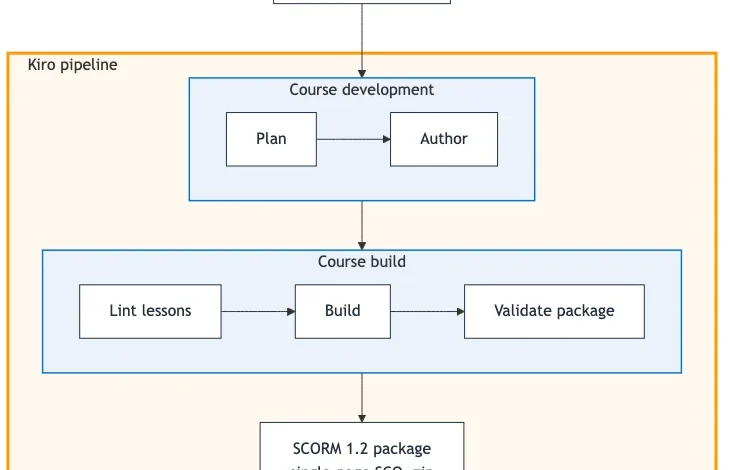
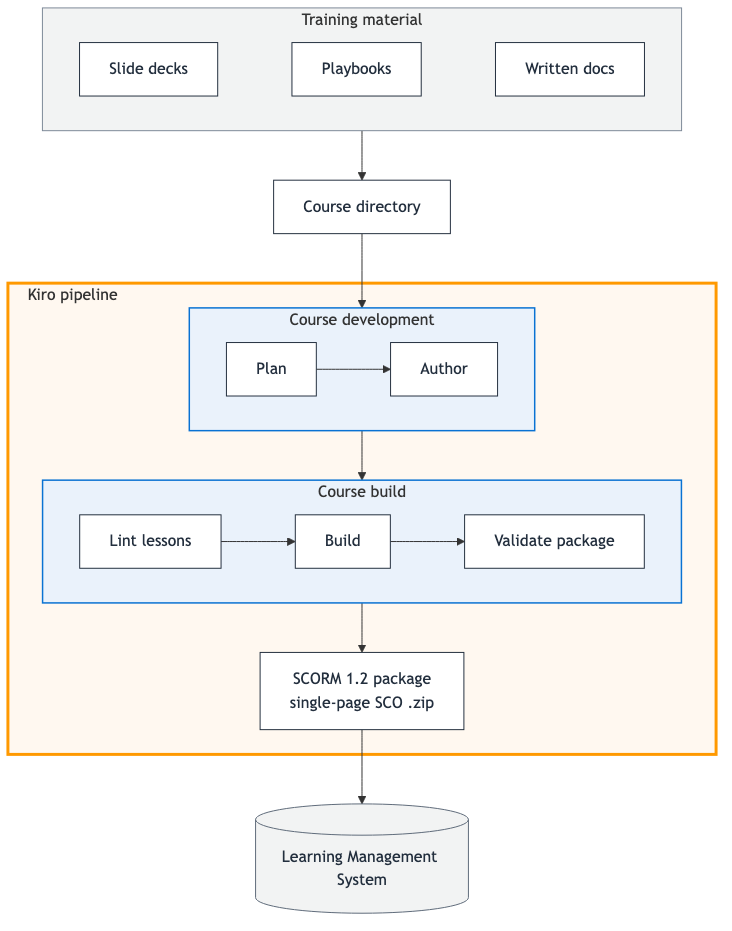
The end-to-end publishing pipeline is broadly categorized into two main stages: Course Development and Course Build.
During the Course Development phase, human authors deposit raw source materials—ranging from PDF playbooks and raw Markdown notes to presentation slide decks—into a designated course directory within their local repository. The agentic AI then assists the author in planning the structural layout of the curriculum, establishing module boundaries, determining target durations, and drafting individual lesson files.
Once the content is authored, the Course Build phase initiates automatically or via explicit command. This stage encompasses three critical operations: linting the generated lesson files to ensure syntactic consistency, assembling the standardized SCORM directory structure alongside its corresponding manifest, and validating the final output. The resulting artifact is a compressed SCORM 1.2 .zip file, completely configured for immediate deployment into enterprise learning management systems. Throughout this entire sequence, the human operator interacts exclusively through conversational prompts within the AI environment, effectively delegating all mechanical overhead to the automated agent.
Core Primitives and Workflow Mechanics
The operational efficacy of this pipeline rests upon several foundational building blocks embedded within the development environment.
At the center of course definition is the course manifest (course.yaml). Created automatically by the agent after raw content is ingested, this configuration file declares vital metadata including the course title, short name, language, total estimated duration, module identifiers, and specific SCORM configurations such as passing scores and minimum page dwell times. By modifying simple YAML properties, administrators can globally alter course behavior without manually rewriting underlying codebases or XML schemas.
Furthermore, the system utilizes a specialized concept known as "Steering." Steering files act as localized knowledge bases that instruct the agent on how to behave within the repository. These files are categorized by inclusion modes—such as always-loaded core directives, file-matched context triggers, and on-demand deep guides. For example, product definitions and pipeline sequences load globally, while specific SCORM invariant rules load exclusively when packaging files are edited. This modular context management ensures the AI retains precise operational boundaries without hallucinating or violating technical constraints.
To eliminate repetitive manual interventions, the pipeline incorporates automated hooks. These background scripts execute routine checks—such as validating YAML syntax, verifying file links, and running automated tests—whenever an author modifies the course structure. By automating these quality assurance checkpoints, the pipeline prevents common errors from propagating down the line into the final build artifact.
Step-by-Step Implementation Walkthrough
Implementing this automated pipeline requires a standard local development setup. Administrators initiate the process by cloning the designated repository, opening the workspace within the agentic IDE, and allowing the pre-configured workspace steering rules to load automatically. Because the environment is pre-loaded with knowledge regarding pipeline commands, repository layout, and SCORM constraints, the AI is immediately primed to execute build commands.
Building the bundled sample course requires a single conversational prompt. Upon entering a command such as "Build the sample course," the agent executes the internal linting, building, and validation scripts, ultimately returning the precise local file path of the distribution-ready .zip archive.
For custom enterprise training materials, authors simply create a new directory under the course repository, deposit their raw source documents, and instruct the agent to plan and build a course from that specific source directory. The agent responds by systematically generating the course.yaml manifest, authoring individual Markdown-based lessons for each module, and packaging the assets.
Verification and Quality Assurance
Before uploading newly generated packages to a production LMS environment, rigorous verification is essential. Beyond the automated validation scripts built into the pipeline, developers can perform a visual inspection by serving the unzipped build output locally over an HTTP server. Utilizing standard local tools, authors can launch a local web server to preview the exact user interface that learners will experience.
This local preview displays the course home page, complete with title descriptions, estimated durations, module summaries, and interactive navigation links. By previewing the course locally, instructional designers can evaluate the visual hierarchy, typographic consistency, and responsiveness of the layout before committing the package to the corporate LMS. Once verified, the .zip file can be uploaded to any SCORM 1.2-compliant learning management system. Because learning management systems often feature proprietary quirks in how they handle tracking data, the agent can also be consulted interactively to diagnose and troubleshoot any platform-specific import warnings.
Implications and Broader Impact on Enterprise Training
The convergence of agentic AI and standardized e-learning packaging protocols carries significant implications for corporate training departments and higher education institutions. By abstracting the technical complexities of SCORM compliance, organizations can significantly reduce the time-to-market for new educational content.
Furthermore, because the entire publishing pipeline is maintained as version-controlled code—incorporating structured specs, steering files, and automated hooks—the institutional knowledge required to build compliant courses is no longer locked inside the heads of specialized developers or external contractors. Every team member can produce standardized, high-quality training packages by interacting with a natural language assistant. This democratization of course publishing ensures greater consistency across enterprise training portfolios while allowing instructional designers to reallocate their energy toward pedagogy rather than XML troubleshooting.
Related posts: