Mux Officially Launches Production-Ready Mux Robots and Interactive Playground for AI-Powered Video Workflows

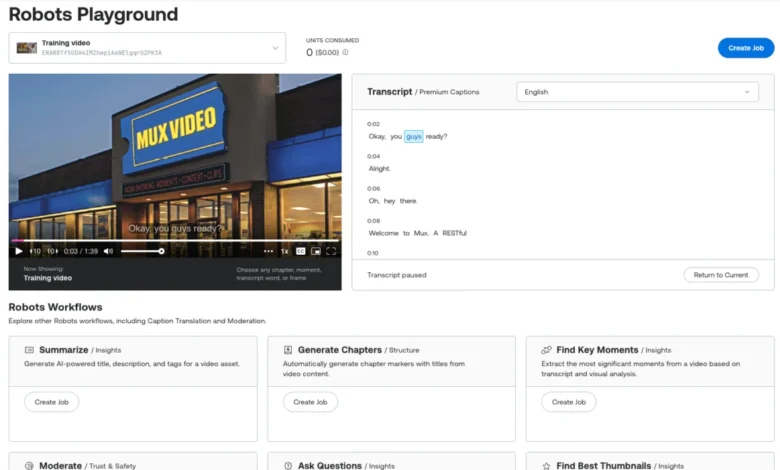
The landscape of video infrastructure and artificial intelligence integration reached a significant milestone today with the official general availability (GA) of Mux Robots, accompanied by the launch of an interactive dashboard playground. Developed by Mux, a leading provider of video streaming and data platforms for developers, the new suite of production-ready AI workflows enables applications to process, analyze, and transform video assets through single API calls. The rollout aims to solve long-standing bottlenecks in video engineering, specifically addressing the friction developers face when attempting to extract meaningful context, summaries, chapters, and automated moderation from large video libraries.
Background and Context in Video AI Integration
For years, developers working with video hosting, streaming, and content management systems have encountered a steep technical barrier when implementing artificial intelligence features. While machine learning models for transcription, object detection, and natural language processing have matured rapidly, gluing these capabilities into existing video pipelines has traditionally required complex orchestration layers. Engineering teams typically had to spin up separate cloud transcription services, pass raw data through large language models (LLMs) via custom scripts, manage disparate JSON outputs, and construct bespoke interfaces just to preview how an AI model interpreted a video file.
Mux Robots was designed to abstract this underlying complexity. By embedding intelligent workflows directly into the video pipeline, the system allows platforms to automate labor-intensive tasks such as generating chapters, identifying key moments, translating closed captions, and moderating content for safety. The transition of Mux Robots to general availability signifies that the underlying APIs are now fully stable, scalable, and optimized for high-volume production environments.

The Mux Robots Playground: Bridging the Gap Between Design and Deployment
Historically, tuning AI workflows for video content was an iterative and tedious trial-and-error process. Developers had to write code, trigger API jobs or dashboard batch tasks, wait for processing to complete, and parse through dense, raw JSON files to determine whether parameters like confidence thresholds, rubric priorities, or selection strategies produced the desired outcome.
To eliminate this friction, Mux has introduced the Robots Playground within the main developer dashboard. The playground provides a live, interactive environment where engineers and product managers can experiment with workflows against actual video assets before writing a single line of code.
Rather than relying on mocked data or simulated environments, jobs executed within the playground run against the live Robots API. This ensures that the results mirrored in the interface are identical to what would be achieved programmatically. Output data is stored in the user’s standard job list for 30 days, and token or unit usage is tracked transparently in real time. A prominent cost-tracking meter at the top of the interface displays units consumed and the corresponding dollar amount, mitigating the risk of unexpected expenses during extensive tuning sessions.
Transforming Raw JSON into Rendered Context
A core innovation of the Mux Robots Playground is its ability to translate programmatic JSON payloads into rich, human-readable UI components.
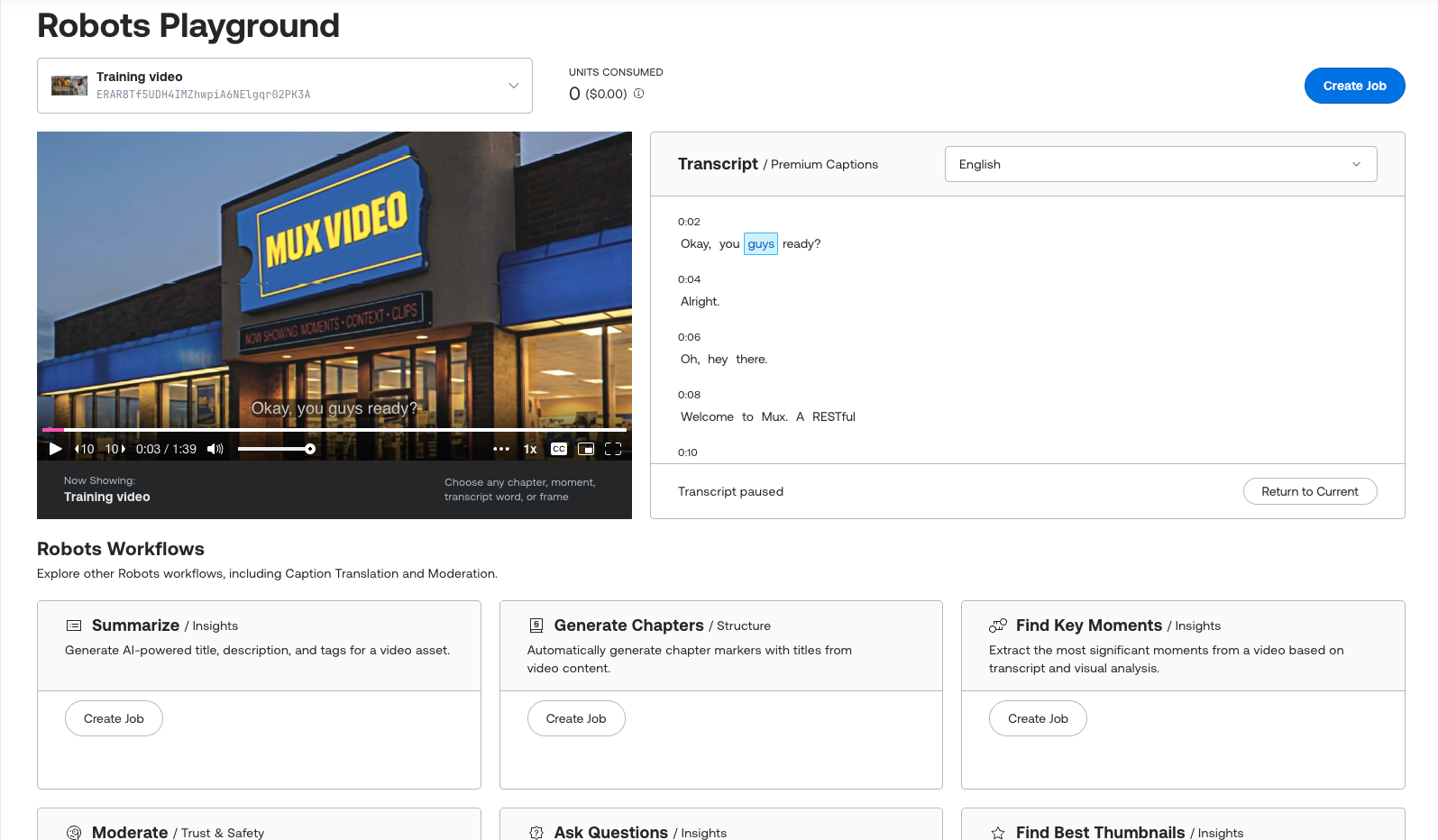
When an engineer runs a workflow such as chapter generation or moment detection, the platform renders the output directly alongside the video player. Generated video chapters are presented as clickable lists synchronized with the video timeline. Similarly, identified key moments appear as detailed cards featuring transcript cues and candidate thumbnail strips scored by relevance and visual quality.
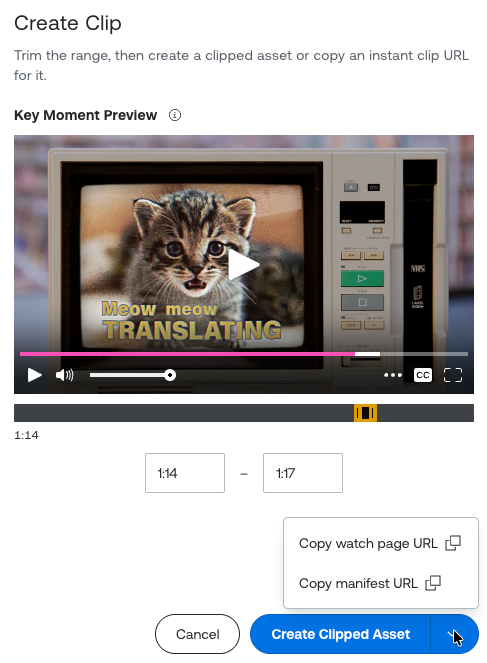
Furthermore, the platform integrates tightly with existing Mux features, such as Instant Clips. When a particularly valuable segment is discovered during a playground session, users can instantly trim the range, generate a clipped asset, and secure a new playback ID or watch page URL directly from a dropdown menu. For caption workflows, if the system’s speaker diarization or premium transcription mislabels an individual, developers can correct the speaker tag directly in the transcript panel. The corrected track immediately replaces the legacy data on the asset, demonstrating a seamless feedback loop between human validation and automated processing.
Side-by-Side Comparison and Parameter Tuning
Optimizing AI workflows often hinges on fine-tuning parameters and output steering instructions. For instance, running a Find Key Moments job using a selection strategy focused on product-oriented highlights yields vastly different outputs compared to a strategy prioritizing narrative story beats.
To simplify this optimization process, the playground features a dedicated comparison tool. Developers can execute a workflow multiple times with varying parameters—such as adjusted brand terms, target audience definitions, or stylistic guidelines—and view the resulting jobs side by side. This visual diff view allows engineering teams to evaluate how subtle modifications to steering prompts alter timestamp boundaries, generated titles, and narrative relevance, replacing guesswork with empirical analysis.
Accelerating Production Deployment with Agent Prompts
One of the most notable workflow innovations introduced with the GA release is the "Copy agent prompt" feature. Once a developer has successfully tuned a workflow and achieved optimal results in the playground, translating those settings into production code can still consume valuable engineering cycles.
To streamline this transition, Mux has introduced functionality that packages the entire configuration into a structured prompt for AI coding agents. By clicking the export option, developers copy a comprehensive specification to their clipboard. This specification includes the exact API endpoint, the validated parameters, output steering rules, webhook handling requirements, and implementation notes. Pasting this prompt into modern AI coding assistants allows teams to instantly generate production-ready code blocks tailored precisely to the parameters discovered during their dashboard tuning sessions.
Financial and Operational Implications for Developers
The broader implications of production-ready video AI extend well beyond developer convenience. Content platforms, media companies, educational institutions, and enterprise communication tools are under increasing pressure to make extensive video libraries searchable, accessible, and engaging. Manual content tagging, chapter creation, and highlight extraction are economically unviable at scale.
By standardizing these capabilities into native API workflows with transparent unit-based pricing, Mux lowers the barrier to entry for advanced video intelligence. The elimination of upfront credit card requirements for basic exploration further encourages experimentation, allowing smaller development teams to test complex AI automation without financial commitment.
Industry analysts note that as video consumption continues to dominate global internet traffic, platforms that successfully embed generative AI and automated contextualization directly into their core pipelines will capture significant market share. Mux Robots positions the company firmly in this competitive landscape, offering a cohesive bridge between raw video ingestion and intelligent content consumption.
As the general availability rollout proceeds, Mux plans to expand the ecosystem surrounding Robots, introducing additional workflows and deeper integrations across its video streaming and data analytics suites. For developers seeking to modernize stagnant video archives or build intelligent, responsive media applications, the combination of stable APIs and the new interactive playground provides a robust foundation for the next generation of video technology.
Related posts: