Revinate Modernizes Global Hospitality Data Infrastructure with Amazon API Gateway and AWS-Native Developer Portal


As the global hospitality sector increasingly relies on data-driven guest personalization to drive direct bookings and combat rising fees from online travel agencies, technology providers face immense pressure to scale their digital architectures. Revinate, a prominent customer data platform and guest-messaging provider supporting over 12,500 hotels worldwide and powering upwards of 1.25 billion individual guest profiles, encountered this exact architectural bottleneck. Responsible for generating more than $24 billion in lifetime direct revenue for hoteliers, the company found its legacy, in-house API management methods increasingly unsustainable. To unlock operational efficiency, enhance security, and accelerate partner integrations, Revinate executed a comprehensive architectural migration to Amazon API Gateway and the newly introduced Amazon API Gateway Portal.
The imperative for a structural overhaul stemmed directly from the rapid expansion of Revinate’s Customer Data Platform (CDP). As the platform evolved to offer deeper data insights and broader messaging touchpoints, hotel properties and third-party software partners required programmatic, real-time access to critical hospitality repositories, including granular guest profiles and live reservation feeds. Historically, each new partner integration necessitated manual provisioning, custom security configuration, and intensive ongoing oversight by internal engineering teams. This self-hosted approach consumed valuable technical hours that could have otherwise been dedicated to core product innovation.
Faced with mounting operational overhead, leadership at Revinate established four primary business drivers to guide their infrastructure evolution: eliminating manual onboarding friction, ensuring seamless elasticity to match unpredictable traffic spikes, implementing robust security governance to protect sensitive consumer records, and adopting a consumption-based financial model that tied expenditures directly to API utilization rather than rigid, fixed-term software licenses.
Evaluating the Technical Landscape and Strategic Alternatives
To address these core drivers, Revinate’s engineering organization conducted a rigorous comparative evaluation of three distinct API management archetypes: self-managed open-source gateways, proprietary custom-built architectures, and legacy enterprise API management platforms.
A self-managed open-source approach offered maximum initial flexibility and avoided vendor licensing fees, but it ultimately failed the evaluation due to the prohibitive operational burden of ongoing infrastructure maintenance, security patching, horizontal scaling, and the necessity of building a proprietary developer portal entirely from scratch. Conversely, building a custom proprietary gateway yielded precise operational control but demanded an untenable upfront development investment, perpetually diverting engineering talent away from core hospitality features. Finally, while traditional enterprise API management platforms delivered out-of-the-box feature parity, they introduced significant vendor lock-in and rigid, fixed-term licensing fee structures that sharply misaligned with variable revenue growth patterns.
Recognizing that all three alternatives shared the critical drawback of consuming engineering bandwidth and capital for undifferentiated heavy lifting, Revinate pivoted toward a fully managed, cloud-native paradigm. The introduction of the Amazon API Gateway Portal in late 2025 provided the final catalyst for the transition, delivering a comprehensive, AWS-native developer hub that eliminated months of prospective custom development.
Architectural Blueprint: Unifying AWS Cloud-Native Services
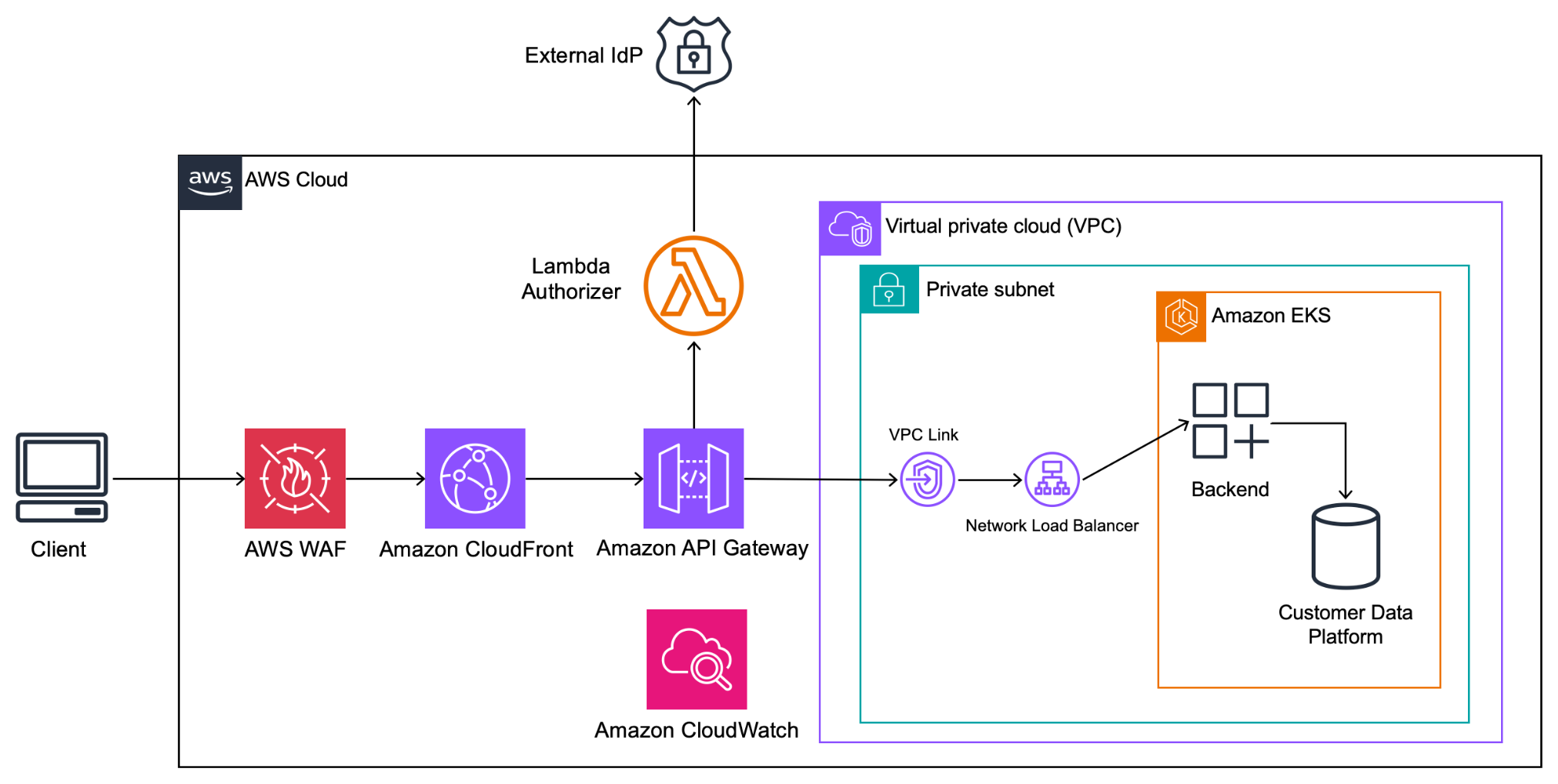
The implemented solution leverages a modernized, globally distributed architecture designed to handle high-volume transactional data with sub-second latencies. At the network perimeter, hotel properties and third-party developers interact with the platform through Amazon CloudFront, which provides edge caching to minimize latency across international markets. Simultaneously, AWS WAF delivers advanced threat intelligence and comprehensive protection against malicious web traffic, volumetric distributed denial-of-service (DDoS) attempts, and automated bot scripts.
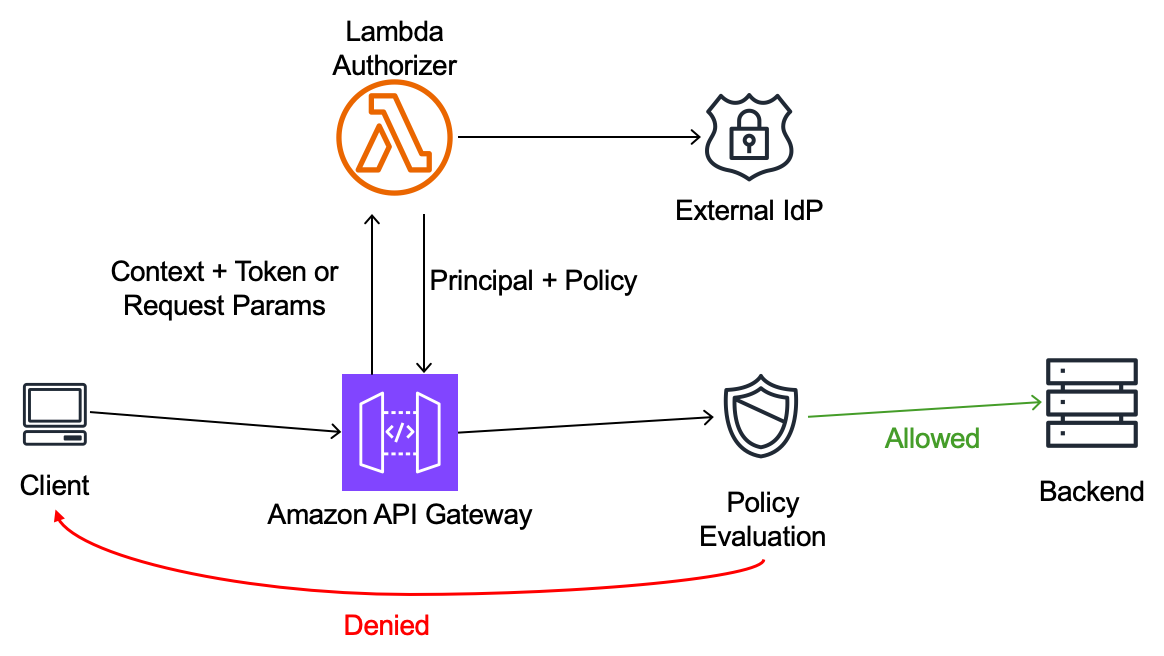
Incoming requests terminate at Amazon API Gateway, which serves as the centralized orchestration and governance plane. For machine-to-machine (M2M) authentication and authorization, Revinate deployed an OAuth 2.0 client credentials flow integrated with external identity providers through AWS Lambda authorizers. These lightweight authorization functions evaluate caller identity tokens and translate them into granular IAM policies, ensuring secure, token-based validation without introducing latency or infrastructure management overhead.
Once authenticated, API traffic routes securely to containerized microservices operating on Amazon Elastic Kubernetes Service (Amazon EKS). Rather than deploying a traditional, resource-heavy NGINX ingress controller or adding unnecessary routing hops via traditional load balancing layers, Revinate’s architects implemented the Target Group Binding feature of the AWS Load Balancer Controller. This architectural choice directly binds EKS pods to Network Load Balancer target groups, preserving traffic entirely within the high-performance AWS backbone network via VPC Link. This streamlined data path eliminates intermediate network hops, optimizing throughput and ensuring reliable performance even during peak seasonal booking surges across the global hospitality network.
Infrastructure as Code and Governance at Scale
A cornerstone of Revinate’s operational transformation was the strict enforcement of Infrastructure as Code (IaC) principles. The engineering organization mandated Terraform exclusively for all production deployments associated with the new gateway infrastructure. By defining Amazon API Gateway configurations, REST APIs, deployment stages, usage plans, and Lambda authorizers as version-controlled code, the team achieved complete architectural consistency across development, staging, and production environments.
This declarative methodology not only automated the provisioning workflow but also established an immutable audit trail for compliance verification. Code reviews for infrastructure modifications are now subjected to the same rigorous peer-review processes as application code, significantly mitigating the risk of human configuration errors and reinforcing enterprise security postures.
Furthermore, the integration of usage plans and API keys within Amazon API Gateway enabled precise per-consumer cost attribution. Revinate can now accurately track API consumption down to the individual hotel property or partner organization. This granular visibility underpins a flexible pay-per-use pricing model, replacing legacy software licensing structures with predictable expenditures that scale precisely in tandem with business adoption and customer growth.
Transforming the Developer Experience and Onboarding Lifecycle
Beyond backend optimizations, the deployment of the Amazon API Gateway Portal revolutionized the external developer experience. Historically, onboarding a new hotel chain or software integration partner required manual coordination, static PDF documentation exchanges, and active engineering intervention.
The centralized, managed portal transformed this dynamic into a frictionless, self-service model. Developers representing hotel properties can now independently discover available endpoints, examine comprehensive interactive documentation complete with live "try-it-now" testing capabilities, and manage their own API keys and subscription tiers. Consequently, customer onboarding timelines plummeted from weeks of administrative friction to mere days of autonomous execution. This accelerated time-to-value enabled Revinate to scale its ecosystem rapidly without linearly expanding its customer support headcount.
Security Posture and Regulatory Compliance
In the hospitality sector, safeguarding personally identifiable information (PII) and financial transaction metadata is an uncompromising operational requirement. The adoption of Amazon API Gateway inherently fortified Revinate’s security perimeter by centralizing policy enforcement. Request throttling and quota limits safeguard backend microservices against accidental overloads or intentional denial-of-service vectors, while native integration with AWS Shield provides continuous, automated perimeter defense.
Additionally, audit logging and telemetry data are channeled directly into Amazon CloudWatch, offering comprehensive visibility into API request patterns, error rates, and authorization attempts. This centralized observability framework allows Revinate’s security operations team to maintain continuous compliance with stringent global data protection standards, including GDPR and CCPA, without sacrificing operational agility.
Implications and Future Roadmap
Revinate’s successful migration to Amazon API Gateway and the AWS-native Developer Portal highlights a broader industry shift toward fully managed serverless and containerized hybrid architectures. By offloading undifferentiated infrastructure management to hyperscale cloud providers, growing software enterprises can reallocate precious engineering capital toward core product differentiation and customer-facing value creation.
Buoyed by the success of its outbound API initiative, Revinate’s engineering roadmap includes expanding the gateway architecture to govern inbound data ingestion channels, wherein external partners push operational metrics and reservation updates back into the CDP. Furthermore, the team is actively investigating advanced platform capabilities, including declarative request and response data transformations, edge-level response caching to further optimize latency, and deeper heuristic rule engines within AWS WAF.
Ultimately, the modernization of Revinate’s API infrastructure underscores the vital role that cloud-native integration patterns play in the digital evolution of the hospitality industry. By establishing a secure, scalable, and developer-friendly foundation, Revinate has positioned itself to support ongoing global expansion while empowering hoteliers worldwide to deliver exceptional, data-informed guest experiences at unprecedented scale.