How boAt and AWS Built an AI Fitness Coach for Millions of Indian Smartwatch Users Using Amazon Bedrock and Llama 3

India’s leading consumer electronics and wearable brand, boAt—operated by Imagine Marketing Limited—has successfully scaled its generative artificial intelligence-powered fitness feature, "AI Coach," to millions of users across the country. Developed in collaboration with KaHa Technologies Pvt Ltd, a wholly-owned subsidiary of Imagine Marketing Limited, the feature has been in active production for over six months. By leveraging Amazon Web Services (AWS), specifically Amazon Bedrock and AWS Lambda, boAt has transitioned from offering raw, disconnected biometric data to delivering real-time, highly customized wellness plans tailored to individual user profiles, preferences, and historical behavioral patterns.
The rapid deployment of the AI Coach represents a significant milestone in the mass-market adoption of generative AI within consumer wearables. As the wearable technology landscape transitions from passive data tracking to active, predictive health intervention, companies face the dual challenge of processing massive data volumes while maintaining low operational costs and rigorous data privacy compliance. Through a strategic architectural framework built on serverless computing and managed artificial intelligence services, boAt has navigated these challenges to deliver an adaptable, scalable, and cost-effective solution for its expanding customer base.
Background and Market Context of Imagine Marketing Limited and boAt
Founded in 2015, Imagine Marketing Limited launched the boAt brand with a clear vision: to capture India’s burgeoning young, tech-savvy demographic by offering mass-premium, lifestyle-oriented consumer electronics at accessible price points. Initially establishing its market dominance in the personal audio sector—spanning wireless earbuds, headphones, and portable speakers—boAt systematically expanded its product portfolio into adjacent high-growth categories, including smart wearables and advanced charging solutions.
The company’s commercial strategy hinges on an agile, digital-first operational model. By distributing products through online marketplaces, direct-to-consumer (D2C) channels, and an extensive offline retail network, boAt achieved remarkable market penetration. Industry metrics from fiscal year 2025 highlight boAt’s commanding position in India’s branded personal audio market, capturing substantial value and volume shares. According to reports from FounderPin, the company surpassed 34 million units sold domestically in a single fiscal year, solidifying its standing among the top global audio brands by volume.
This rapid commercial growth created a massive influx of user metrics collected through boAt smartwatches and the companion boAt Crest application. However, company leadership recognized a fundamental paradigm shift in consumer expectations: raw metrics—such as step counts, sleep duration, and heart rate variability—were no longer sufficient to maintain long-term user engagement. Consumers demanded actionable, contextual, and intelligible guidance that could translate complex biometric data into sustainable daily health habits.
The Opportunity: Addressing the Need for Personalized Wellness
The genesis of the AI Coach feature lay in a distinct market opportunity: transforming passive data collection into active lifestyle coaching. Modern wearable users are inundated with numerical data, yet few possess the nutritional, kinesiological, or behavioral expertise required to interpret these metrics effectively. boAt sought to bridge this gap by introducing an intelligent agent capable of delivering real-time, personalized fitness and wellness planning.
To conceptualize and execute this vision, the engineering and product teams established three core design principles: hyper-personalization, strict affordability, and seamless scalability.
Personalization required the system to ingest individual user onboarding inputs—such as specific fitness goals, preferred physical activities, workout frequencies, sleep schedules, and self-reported stress levels—and continuously reconcile them against historical performance metrics stored within the ecosystem. Affordability was a critical commercial constraint; because boAt operates in a price-sensitive market, the underlying cloud infrastructure could not introduce prohibitive per-query costs that would erode product margins. Scalability dictated that the architecture must effortlessly absorb traffic spikes across millions of concurrent users without service degradation.
Solution Architecture: The Synergy of Amazon Bedrock and AWS Lambda
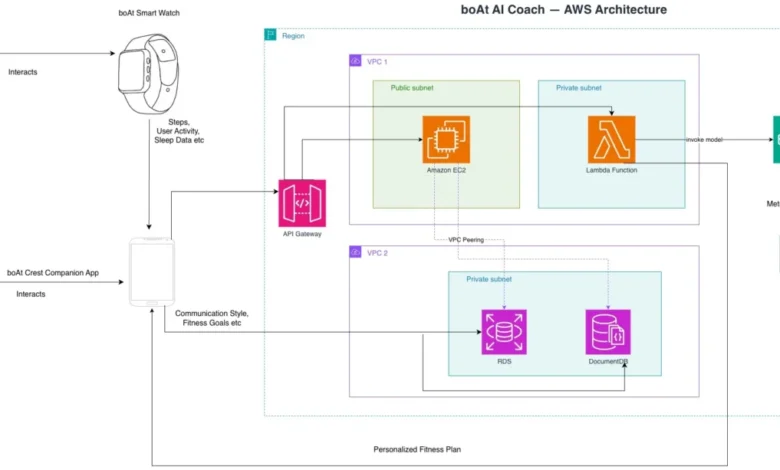
To meet these demanding design criteria, boAt, in partnership with KaHa Technologies, engineered a serverless and managed-service architecture hosted on AWS. The system architecture bypasses the operational overhead of managing dedicated machine learning infrastructure, relying instead on a streamlined pipeline connecting the boAt Crest companion app, AWS Lambda, Amazon RDS for MySQL, Amazon DocumentDB, and Amazon Bedrock.
At the core of the generative intelligence layer is the Meta Llama 3.3 70B Instruct model, accessed via Amazon Bedrock using on-demand inference. Meta Llama 3.3 70B was selected for its advanced reasoning capabilities, robust instruction-following performance, and cost-to-performance ratio.
The technical workflow operates through a precise sequence of events:
- Data Retrieval: AWS Lambda securely fetches historical user data for a predefined, privacy-compliant window from the boAt Crest companion app. Comprehensive historical archives are maintained securely within Amazon RDS for MySQL and Amazon DocumentDB.
- Contextual Prompt Construction: Lambda structures the retrieved user data alongside onboarding preferences, translating raw metrics into contextualized prompts designed for the large language model (LLM).
- Model Inference: The constructed prompt is dispatched to Meta Llama 3.3 70B Instruct via Amazon Bedrock. The model generates a structured, personalized coaching plan or behavioral nudge.
- Response Parsing and Delivery: AWS Lambda parses the model’s output, validates the data keys, and delivers the finalized coaching plan directly to the client interface within the mobile application.
Furthermore, boAt designed the backend schema to be resilient to future product iterations. By abstracting user input parameters from the core backend logic, subsequent updates to onboarding questionnaires or feature sets do not necessitate structural refactoring of backend components.
Dynamic Nudging and Tone Customization
A standout feature of the boAt AI Coach is its dynamic nudge engine. Rather than delivering static daily reminders, the system evaluates real-time user metrics against recommended targets at various intervals throughout the day. If a user falls behind on activity goals or exhibits elevated stress indicators, the system generates a context-aware intervention.
Recognizing that psychological triggers vary widely among consumers, boAt introduced customizable style packs for these notifications. Users can configure the tone and style of their AI coach to match their personal preferences. Options range from objective, highly informational fitness directives to casual, pop-culture-infused, or even sarcastic motivational prompts. This granular level of customization significantly enhances user retention and emotional resonance with the brand.
Technical Challenges and Responsible AI Implementation
Developing and deploying a production-grade generative AI feature for millions of users presented notable engineering hurdles. During real-world testing, the development team encountered challenges related to LLM output variance, latency optimization, and data consistency across distributed databases.
To mitigate the risk of hallucinatory or unsafe outputs—a common hurdle in generative AI deployments—the team instituted rigorous responsible AI safeguards. These included strict output validation layers, safe default substitutions for missing response keys, and hardcoded prompt constraints. These constraints ensure that the AI model only recommends activities and wellness routines directly supported by the hardware capabilities of the user’s specific smartwatch model.
Moreover, while the engineering team currently relies exclusively on Amazon Bedrock on-demand inference to guarantee low-latency user experiences, they have established a roadmap to transition toward Amazon Bedrock batch inference. This future optimization is projected to further reduce operational expenditures as platform adoption scales globally.
Broader Industry Implications and Future Outlook
The successful deployment of the boAt AI Coach serves as a case study for the integration of generative AI into consumer Internet of Things (IoT) ecosystems. By proving that complex, large language model workloads can be deployed economically via serverless architectures like AWS Lambda and managed platforms like Amazon Bedrock, boAt has established a new benchmark for domestic consumer technology firms in emerging markets.
As artificial intelligence continues to permeate edge devices and wearables, the boundary between consumer electronics and digital healthcare is increasingly porous. The ability to process localized biometric telemetry through secure cloud-based LLMs unlocks unprecedented opportunities for preventative healthcare, chronic condition management, and hyper-targeted wellness education.
For boAt and Imagine Marketing Limited, the AI Coach represents far more than a software update; it is a strategic evolution of their brand identity. By migrating up the value chain from hardware manufacturer to intelligent lifestyle ecosystem provider, boAt has fortified its competitive moat against international rivals. As the company continues to refine its technological infrastructure and explore advanced model optimization techniques, millions of Indian consumers are poised to experience a more intuitive, responsive, and deeply personalized approach to everyday wellness.